← BACK TO ARCHIVES
Heritage-Black
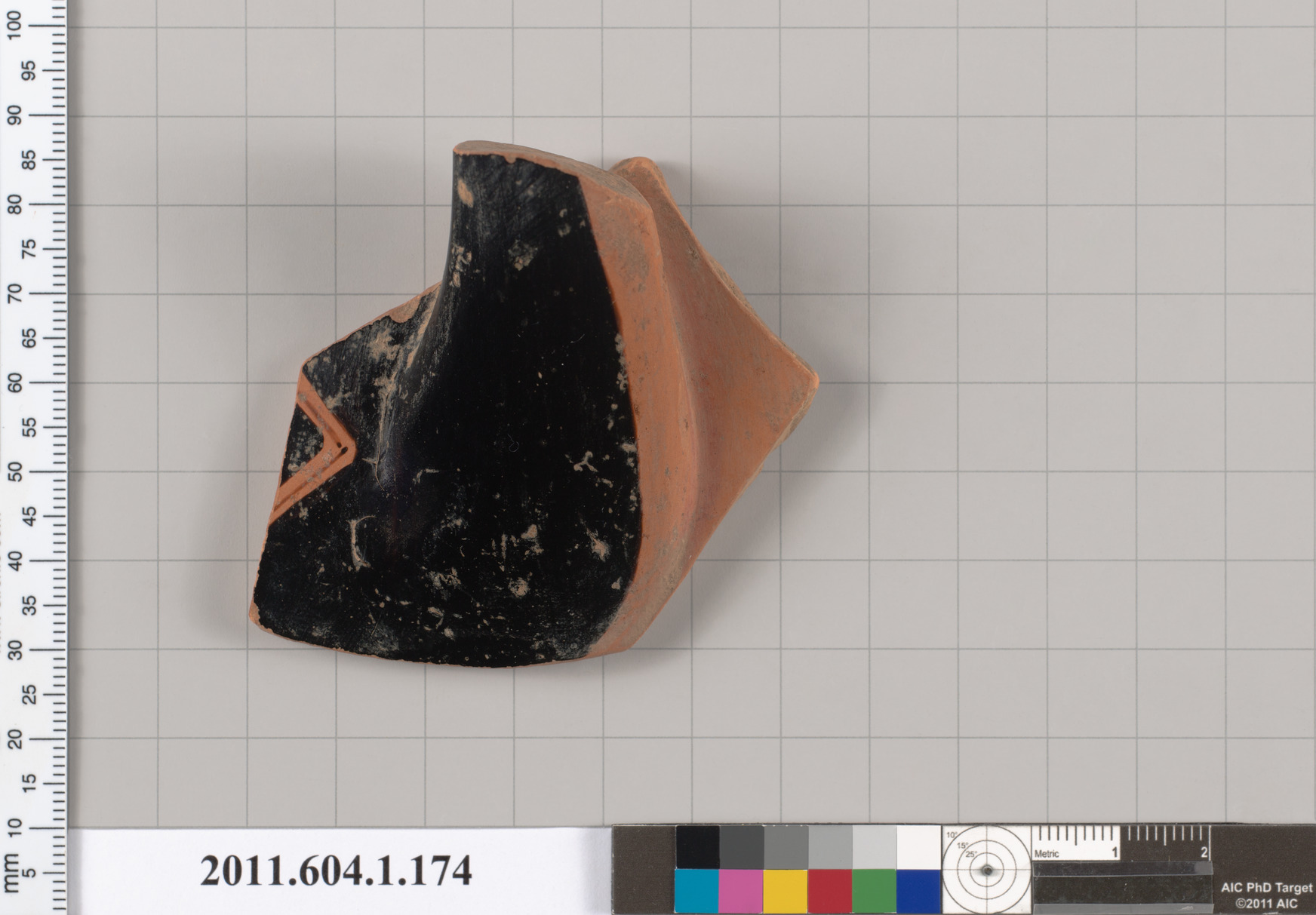
Heritage Synthesis: Terracotta fragment of a kylix (drinking cup)
Curated on Aug 26, 2026 // Node: LDN-01
The Aesthetics of the Unadorned: Terracotta Fragments and the 2026 Old Money Silhouette
In the vast, often gilded archive of Lauren Fashion Heritage Lab, we frequently turn to the opulent textiles of the past—the Lyons silks, the Scottish cashmeres, the Venetian gold-thread brocades—to decode the language of luxury. Yet, the most profound provocations for the coming season’s Old Money aesthetic do not arrive swathed in velvet, but rather in the stark, sun-baked silence of a broken shard. The museum artifact before us—a terracotta fragment of an Attic kylix, a drinking cup from the Greek classical age—offers a radical counter-narrative to the Western canon’s obsession with heroic immortality. It is a fragment, not a whole; a utilitarian object, not a monument. As we synthesize this internal genetic code with our design directives for the 2026 Old Money silhouette, we find that this shard of fired earth provides the philosophical blueprint for a new form of quiet power—one defined not by the imposition of meaning, but by the acceptance of time, impermanence, and the profound eloquence of the unadorned.
The Paradox of the Painted Death and the Silent Vessel
Our internal archives have long meditated on Jacques-Louis David’s 1787 masterpiece, *The Death of Socrates*. That painting is the apotheosis of a certain kind of Western visual rhetoric: the articulation of transcendence through geometric rigor, chiaroscuro, and the heroic, athletic body. David’s Socrates is not a dying man; he is a rational idea made flesh, his gesture toward the heavens a declaration of intellectual victory over corporeal decay. The cup of hemlock is rendered as a crystalline elixir, a final sacrament of reason. This is the aesthetic of the *whole*—the completed narrative, the triumph of the mind over the messy, chaotic, and ultimately *fragmentary* nature of physical existence.
The terracotta kylix fragment, however, is the silent rebuttal to David’s grandiloquence. It does not depict a story; it *is* the residue of one. Its broken edges are not a failure of form, but a testament to the passage of time. It does not argue for the immortality of the soul; it accepts the mortality of the object. Where David’s painting is a closed system of meaning, the kylix is an open one. It invites the viewer to imagine the hand that held it, the wine that stained its interior, the symposium where voices rose in philosophical debate and drunken laughter alike. It is a vessel for life, not a monument to an idea. This is the critical distinction that informs our 2026 direction: we are moving away from the *Davidian* silhouette—one that projects power through structured, imposing, and complete forms—toward a *kylix* silhouette, one that finds its luxury in ease, in the acceptance of natural drape, and in the quiet confidence of a garment that does not need to shout its provenance.
Deconstructing the "Old Money" Silhouette: From Imposition to Inhabitance
The traditional "Old Money" aesthetic, as often interpreted, has been a secular version of David’s painting. It is a costume of inherited power, marked by impeccable tailoring, rigid shoulders, and a color palette that whispers of old wealth—navy, charcoal, and cream. It is an aesthetic of *control*, designed to project an unassailable sense of belonging. However, this interpretation is increasingly a caricature, a museum piece itself. The 2026 Old Money silhouette, as informed by our terracotta fragment, is not about the *imposition* of structure onto the body, but the *inhabitance* of the garment by the body.
The fragment teaches us that true heritage is not about preservation in amber, but about graceful degradation. Therefore, the new silhouette embraces a softer shoulder, not as a sign of weakness, but as a nod to the organic line of a well-worn garment. We are exploring fabrics that move with a fluid, almost liquid weight—a heavy silk crepe that falls like water, a double-faced cashmere that drapes like a cloud, a wool gabardine that has been washed to a suede-like finish. The construction is meticulous, but the *appearance* is effortless. The goal is not to armor the wearer against the world, but to allow them to move through it with the same unselfconscious ease with which a Greek citizen would have lifted his kylix. The seams are not meant to be seen; they are meant to be *felt*—as a subtle assurance of quality, much like the smooth interior of the terracotta vessel.
The Color of Time: The Heritage-Black Palette
The most direct translation of the kylix’s aesthetic is in our color story for 2026, which we have codified internally as "Heritage-Black." This is not the stark, absolute black of the tuxedo, nor the mourning black of the Victorian era. It is the black of the Attic vase after centuries of burial—a black that has been tempered by the earth, carrying undertones of umber, of the deep red of the clay from which it was born, and the faintest whisper of ochre. It is a black that is not flat, but has depth and warmth, like a shadow cast by a low sun.
This "Heritage-Black" is the foundation of the entire collection. It is the color of the ground from which all other colors emerge. In our tailoring, it manifests as a deep, matte wool that absorbs light rather than reflecting it, creating a silhouette that is present but not aggressive. In our knitwear, it appears as a mélange of black, charcoal, and brown fibers, producing a texture that mimics the granular surface of the terracotta itself. This is a deliberate move away from the high-gloss, logo-driven luxury of the past decade. The 2026 Old Money wearer does not need to announce their status through a flash of metal or a blinding white shirt. Instead, they are enveloped in a monochromatic depth that speaks of a different kind of wealth: the wealth of time, of history, and of a refined sensibility that understands the beauty of a patina.
Designing for the Fragment: The Beauty of the Incomplete
Perhaps the most radical design principle we are extracting from the kylix is the concept of the *deliberate fragment*. In the past, a garment’s value was tied to its completeness—a perfectly matched pattern, a pristine finish. The terracotta fragment challenges this notion. Its broken edge is not a flaw; it is a narrative. It tells us that the object has a history, that it has been used and loved, and that it has survived.
In 2026, we are exploring this through subtle, intentional "imperfections." This is not the manufactured distress of streetwear, but a more sophisticated, artisanal approach. We are developing techniques for raw, hand-finished edges on silk scarves and jacket linings, where the fabric is cut and left to naturally fray just slightly, creating a soft, feathery border. We are experimenting with visible mending in our knitwear, using a contrasting, tonal thread to repair a simulated tear in a cashmere sweater, turning a point of wear into a point of interest. We are designing garments with asymmetric closures and off-center plackets, creating a silhouette that feels slightly *off-balance*, echoing the irregular geometry of a broken pot. This is not a rejection of craftsmanship, but its ultimate expression. It requires a master tailor to create a garment that looks as if it has simply *evolved* into its current state, rather than being manufactured. It is the difference between a new building and a beautiful ruin. The ruin is more compelling because it holds the memory of the whole, while acknowledging the reality of time.
Conclusion: The Quiet Dignity of the Vessel
The terracotta kylix fragment offers a profound philosophical correction to the Davidian impulse that has dominated luxury aesthetics for centuries. It reminds us that the most enduring form of power is not the power to defy death through heroic narrative, but the power to embrace life through humble utility. As we move toward 2026, the Lauren Fashion Heritage Lab is not designing clothes for a monument; we are designing clothes for a life. The new Old Money silhouette is not a suit of armor; it is a second skin, a vessel for the individual.
It is a silhouette that finds its strength in the softness of a shoulder, its luxury in the depth of a "Heritage-Black" hue, and its narrative in the quiet dignity of a raw edge. It is an aesthetic that understands that true heritage is not about what you have accumulated, but about how you have lived. The kylix was not made to be displayed in a museum; it was made to be held, to be drunk from, and eventually, to be broken. In its fragments, we find the most honest and compelling definition of enduring style: the grace to be worn, the wisdom to age, and the quiet confidence to simply *be*, without the need for a grand, painted gesture. This is the new old money—not the immortality of the idea, but the enduring beauty of the fragment.
Heritage Lab Insight
Genetic Bridge: Archive node focusing on Heritage-Black craftsmanship.