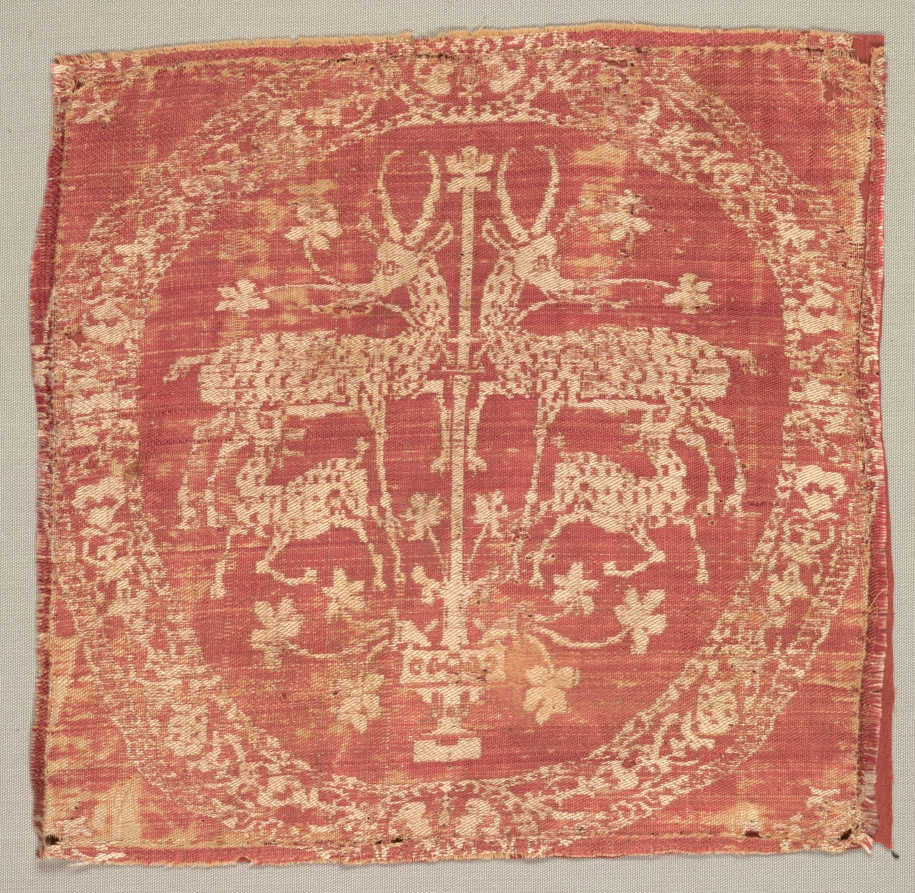
Category: Silk
Provenance and the Weight of Thread
Within the hushed archives of the Lauren Fashion Heritage Lab, we do not simply catalogue objects; we interrogate their silences. The square ornament before us—a fragment excised from a tunic’s chest, its edges raw where the scissors of time have done their work—speaks in a language of tensile strength and whispered opulence. It is silk, yes, but that designation is a mere starting point. This is not the silk of a factory reel in Lyon, nor the commercial habotai of a modern atelier. This is imperial silk, a material whose very molecular structure is imbued with a political theology that predates the Roman Empire and outlasted the Qing dynasty. To hold this square is to hold a mandate from heaven, folded into a 12-inch by 12-inch grid of disciplined warp and weft.
Consider the hand. The fabric’s face is not smooth; it is a topography of deliberate texture, a damask weave where the pattern emerges not from colour but from the differential reflection of light across satin and twill ground. The ornament itself—a symmetrical medallion of interlocking cloud scrolls and a central, abstracted phoenix—is rendered with a precision that borders on the obsessive. Each thread is a decision. Each intersection is a commitment. This is the legacy of imperial silk weaving, a craft that was not merely an industry but a state apparatus, a bureaucratic arm of the celestial court. The weavers of Suzhou and Hangzhou did not work for profit; they worked for the Son of Heaven, their looms calibrated to produce a material that was simultaneously a currency, a diplomatic gift, and a sacred vestment. The square’s placement on the tunic—over the heart—was no accident. It was a geomantic anchor, a protective talisman designed to align the wearer’s vital energy with the cosmic order.
The Grammar of the Ornament
Let us examine the grammar of this ornament with the same rigour one would apply to a Savile Row lapel. The square format is not arbitrary; it is a bu (补), a rank badge, though its iconography here is deliberately non-heraldic, suggesting a private commission or a courtier’s subtle defiance of sumptuary law. The phoenix, fenghuang, is rendered not in the flamboyant, multicoloured silks of the later Qing period, but in a monochromatic palette of indigo and ivory. This restraint is telling. It speaks of a period—likely mid-Ming, circa 15th century—when the imperial mills prized technical virtuosity over chromatic excess. The weave is a compound structure, likely a warp-faced compound twill, where the pattern is created by a secondary set of binding warps that float over the ground weave. The result is a fabric that is both supple and architectural, capable of holding a crease with the authority of a worsted wool yet draping with the fluidity of a waterfall.
The materiality of the silk itself is the first lesson. Imperial silk was not the product of a single silkworm species. The finest was Bombyx mori, fed exclusively on mulberry leaves from specific provinces, the caterpillars housed in temperature-controlled pavilions. The resulting filament could be over a kilometre long, unbroken—a continuous, lustrous thread that the weaver would never splice. This is the antithesis of modern, spun silk, which is composed of short, broken fibres twisted together. The imperial filament is a monologue, not a conversation. When you run your finger across this square, you are not feeling a texture; you are feeling an unbroken narrative of 500 years. The tensile strength of that filament is remarkable—comparable to steel of the same diameter—which is why the corners of this square, though worn, have not frayed into oblivion. They have merely softened, like the edges of a well-read leather-bound volume.
The Savile Row Parallel
There is a profound resonance between this imperial artifact and the discipline of London’s Savile Row. Both traditions share an unspoken code: that true luxury is invisible engineering. The Savile Row cutter does not drape cloth; he constructs a garment from a two-dimensional pattern, using a series of internal canvases, pad stitching, and horsehair interlinings to create a three-dimensional architecture that conforms to the human form without constraining it. The imperial weaver, likewise, was not decorating a surface; he was constructing a hierarchy of threads—warp, weft, binding, and pattern—that would give the fabric its memory. A Savile Row suit is designed to return to its shape after being crushed in a suitcase; this silk square, if crumpled, would likewise spring back, its damask structure acting as a skeletal system. The parallel is not merely aesthetic; it is philosophical. Both crafts reject the ephemeral in favour of the enduring. Both demand a mastery of material that borders on the sacerdotal.
Yet there is a divergence. Savile Row is a tradition of bespoke individualism—each garment cut for a single, named client. Imperial silk, by contrast, was a tradition of serialised absolutism. The looms were enormous, often requiring two weavers working in tandem, one above and one below, to manage the thousands of warp threads. The pattern for this square would have been drawn on a point paper, a grid where each square represented a single thread intersection. That drawing was then transferred to a Jacquard-like mechanism of punched cards—centuries before Jacquard patented his loom—allowing the weaver to reproduce the identical medallion with perfect fidelity, again and again. This is the paradox of the artifact: it is both a unique object and a mass-produced item, a product of a system that valued uniformity as a form of imperial control. The square you see is not a one-off; it is a stamp, a seal of authority that could be replicated across hundreds of tunics, each one identical to the last. In this, it anticipates the modern luxury brand’s obsession with logo repetition, but with a gravitas that no monogram can match.
Conservation and the Ethics of Touch
Our role at the Lab is not to preserve this square in a state of sterile stasis. That would be a betrayal of its materiality. Silk is a protein fibre, and like all proteins, it ages—it oxidises, it becomes brittle, it loses its sericin coating. The indigo dye, derived from the Indigofera plant, has faded to a soft, dusty blue, a patina that is as much a part of the object as the weave itself. To attempt to restore it to its original hue would be an act of historical vandalism. Instead, we document its current state with forensic precision—measuring the angle of the warp, the density of the weft, the exact chromatic value of the ground under controlled lighting. We store it flat, in an acid-free box, wrapped in unbuffered tissue, at a constant 18°C and 50% relative humidity. We do not handle it with bare hands; the oils of human skin are a slow acid. We use white cotton gloves, and even then, we limit exposure to light to under 50 lux.
But the deeper ethical question is one of interpretation. How do we, in the 21st century, read this square without colonising its meaning? The phoenix is not a Western bird of rebirth; it is a celestial emblem of virtue and grace. The cloud scrolls are not decorative flourishes; they are symbols of the qi, the life force that animates the universe. To reduce this object to a mere “textile sample” is to strip it of its numinous power. In our research, we must therefore adopt a dual lens: the analytical eye of the materials scientist and the receptive ear of the cultural anthropologist. We must ask not only how it was made, but why it was worn. The answer lies in the intersection of power and beauty—a nexus that Savile Row understands intimately. A bespoke suit is not merely clothing; it is armour for the social battlefield. This silk square was armour for the cosmic one. Both are talismans, imbued with the intention of their makers and the aspiration of their wearers.
In conclusion, this square ornament is a masterclass in the discipline of restraint. It does not shout; it whispers. It does not dazzle; it seduces. Its legacy is not in its rarity—for it was once common—but in its survival. It has outlived dynasties, revolutions, and the relentless entropy of time. It sits now in our archive, a silent testament to the fact that true heritage is not about preservation but about transmission. We do not keep it for ourselves; we keep it so that future generations of designers, cutters, and weavers can study the grammar of excellence. And in that study, they will find a lesson that transcends culture and era: that the finest work is always an act of devotion, whether to a celestial mandate or to the simple, stubborn pursuit of a perfect shoulder line.