← BACK TO ARCHIVES
Silk
Heritage Synthesis: Dragons Chasing Flaming Pearls
Curated on Aug 26, 2026 // Node: LDN-01
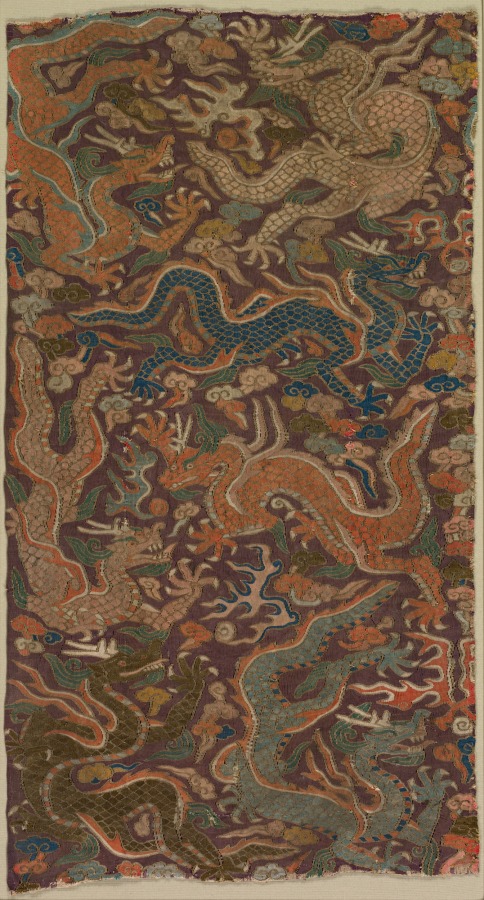
The Dragon’s Pursuit: Materiality and the Imperial Legacy of Silk
In the hushed, wood-panelled ateliers of Savile Row, where the air is thick with the scent of beeswax and fine wool, one learns to read cloth as a ledger of power. We speak of drape, of hand, of the unforgiving line of a lapel. Yet there exists a textile that transcends tailoring’s geometry—a material that does not merely clothe a body but narrates a dynasty. I refer, of course, to imperial silk, and to its most potent, most enigmatic motif: the dragon chasing the flaming pearl.
This is not a pattern. It is a manifesto woven in filament.
The Material Grammar of Imperial Silk
To understand the dragon’s chase, one must first understand the ground upon which it runs. Imperial silk, particularly that produced during the Ming and Qing dynasties, was not a commercial commodity. It was a state apparatus. The Imperial Silk Works in Nanjing, Suzhou, and Hangzhou operated under direct imperial mandate, their looms—often twelve feet wide and requiring two weavers working in tandem—producing bolts of fabric whose technical complexity defied replication. The warp was set with a precision that would shame a Swiss chronometer; the weft, often of gold-wrapped thread, was beaten down so densely that the resulting textile felt less like cloth and more like gilded armour.
The materiality of this silk is the first layer of meaning. Its weight is substantial, almost solemn. When you handle a fragment of a dragon robe, you feel the compression of thousands of hours of human labour. The lustre is not the cheap sheen of modern satin; it is a deep, internal glow, born of the sericin being carefully preserved and the dye—often derived from madder root or indigo—being fixed with alum and iron. This silk does not whisper; it speaks in a register reserved for thrones and edicts.
The Motif: A Celestial Cartography
The dragon chasing the flaming pearl is a composition of dynamic tension. The dragon—typically a five-clawed *mang* for the emperor, four-clawed for princes—is rendered not as a static emblem but as a creature in mid-leap. Its body undulates in a series of S-curves, its whiskers streaming, its scales individually outlined with fine gold thread. The pearl, a sphere of iridescent white or coral, hovers just beyond its grasp, often wreathed in curling flames or cloud bands.
The iconography is deceptively complex. In Daoist cosmology, the pearl is the thunder pearl, the manifestation of yang energy, the seed of creation. The dragon, a creature of water and storm, does not chase the pearl to consume it. It chases it to *balance* it. The pursuit is a cosmic dance—the yin and yang, the wet and the dry, the terrestrial and the celestial. In the imperial context, this chase becomes a metaphor for the emperor’s own role: the Son of Heaven perpetually striving to align the earthly realm with the mandates of heaven. The pearl is not a prize; it is a responsibility.
The Weave as Political Theology
What elevates this from mere decoration to political theology is the technical execution. The *kesi* technique, or "cut silk," used for the most important robes, is a form of tapestry weaving where the weft threads are not carried across the full width but are individually interlocked to form the design. This allows for an extraordinary level of detail—each dragon scale can be a separate colour, each flame a gradation of gold. But the technique is also brutally inefficient. A single *kesi* robe could take two weavers three years to complete. The cost, in both gold and human life, was astronomical.
This is the Savile Row principle taken to its logical, terrifying extreme: the bespoke garment as a weapon of state. When a foreign envoy or a provincial governor saw the emperor in his dragon robe, they were not seeing a man. They were seeing a woven edict, a material proof of the empire’s ability to command resources, to harness skilled labour, and to impose order upon chaos. The chasing dragon was not a whimsical ornament; it was a statement of intent. The pearl would forever remain just out of reach, just as the full comprehension of imperial power would forever elude the observer.
Material Decline and the Modern Echo
The legacy of this weaving is one of loss. With the fall of the Qing dynasty in 1912, the imperial looms fell silent. The master weavers dispersed, their knowledge passed down in fragments to private workshops that could never match the scale or the purity of the imperial output. Modern reproductions, even those made with great skill, lack the density of the original warp and the organic irregularity of hand-dyed threads. They are, to use a tailoring term, "off-the-peg"—correct in silhouette but devoid of the soul that comes from a garment made for one body alone.
Yet the motif persists. In contemporary fashion, from haute couture to high-street, the dragon and pearl appear as a shorthand for luxury, for orientalist mystery. But this is a hollow echo. The true power of the motif lies in its material specificity. A printed silk scarf with a dragon motif is a souvenir. A *kesi* robe with a chasing dragon is a historical document, a piece of statecraft, a frozen moment in a cosmic negotiation.
Conclusion: The Unattainable Pearl
For the connoisseur, the heritage specialist, the collector, the lesson of the dragon chasing the flaming pearl is one of humility. We can study the weave, document the dye, trace the provenance. But we cannot fully possess the meaning. The pearl remains elusive. It represents not a thing to be captured but a process to be revered. The silk itself is the only true relic—a material that, even in its decay, retains the memory of the loom, the hand, and the empire that demanded perfection.
At Lauren Fashion Heritage Lab, we do not seek to recreate the dragon’s chase. We seek to understand its pursuit. For in that pursuit lies the entire history of silk as power, as art, and as the ultimate expression of human ambition woven into a cloth that will outlive us all. The flame is eternal; the dragon, forever in motion. And we, the inheritors of this legacy, are but the careful custodians of its thread.
Heritage Lab Insight
Lab Insight: CMA Silk Archive Node integration.