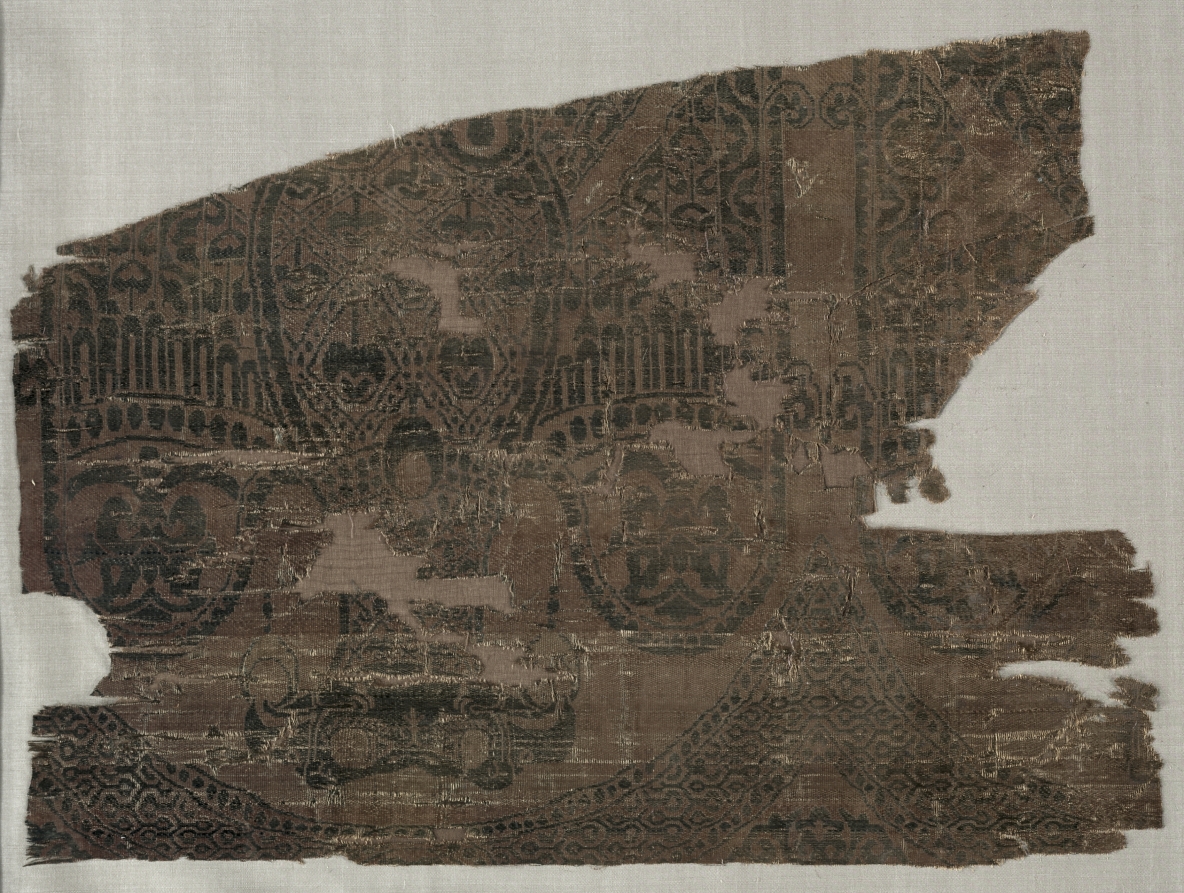
The Imperial Thread: Samite Fragments from the Tomb of Saint Bernard Calvo
Provenance and the Weight of Legacy
In the hushed, oak-panelled corridors of heritage conservation, few objects command the quiet reverence of the samite fragments recovered from the tomb of Saint Bernard Calvo. These are not merely textiles; they are the physical residue of an empire’s ambition, stitched into the funerary vestments of a saint. As a Senior Heritage Specialist, I approach these fragments not as decorative remnants but as a primary document—a ledger of political theology, economic power, and artisanal mastery. The double-headed eagle, rendered in a palette of faded madder and indigo against a ground of what was once lustrous silk, is the heraldic signature of the Palaiologan dynasty, the last ruling house of Byzantium. To hold these fragments is to hold the final breath of Constantinople, woven into a shroud that outlived the city itself.
The materiality is unequivocal: samite, a heavy, twill-woven silk of extraordinary density, often shot with gold or gilded membrane. Unlike the lighter, more fluid silks of the Far East, Byzantine samite was engineered for monumentality. It was a textile of state, designed to drape altars, imperial thrones, and, crucially, the bodies of the sanctified. The fragments from Calvo’s tomb—likely portions of a dalmatic or a pallium—retain a structural rigidity that speaks to the loom’s precision. The warp-faced twill creates a diagonal ribbing that catches light differently with every shift, producing a subtle, kinetic shimmer that was intended to evoke the divine. This was not cloth for the living; it was cloth for the eternal.
The Double-Headed Eagle: A Heraldry of Duality
The motif itself demands forensic attention. The double-headed eagle, with one head gazing toward the rising sun and the other toward the setting, is a symbol of imperial sovereignty over both East and West. In the Byzantine context, it signified the Caesar’s dominion over the earthly and the spiritual, the secular and the sacred. Yet, in the context of Saint Bernard Calvo—a 13th-century bishop of Vic, Catalonia—the eagle acquires a layered, almost paradoxical meaning. Calvo was not a Byzantine prelate; he was a Roman Catholic bishop who died in 1243, decades before the Palaiologan restoration of Constantinople in 1261. How, then, did these fragments of imperial silk find their way into his Catalan tomb?
The answer lies in the legacy of imperial silk weaving as a diplomatic currency. By the 13th century, Byzantine workshops in Constantinople and Thessalonica had perfected the art of samite production, but the Fourth Crusade of 1204 had fractured the empire. The Latin occupiers looted imperial warehouses, dispersing vast quantities of these precious textiles across Western Europe. These silks were not merely plunder; they were gifts, dowries, and ecclesiastical commissions. A bishop of Calvo’s stature, known for his diplomatic missions and his role in the Reconquista, would have been a natural recipient of such a relic—either as a direct gift from a Latin emperor or as a purchase from a Venetian merchant who controlled the silk trade in the aftermath of the sack. The eagle, therefore, is not a symbol of Byzantine allegiance but a marker of prestige through appropriation. The West coveted the East’s technical superiority, and the Church, in particular, recognized the power of imperial silk to sanctify its own hierarchy.
Technical Analysis: The Loom’s Testament
From a conservation standpoint, the fragments are a study in controlled decay. The silk fibres, though weakened by seven centuries of burial, retain their molecular integrity. Under magnification, one observes the Z-twist of the warp threads—a hallmark of Byzantine spinning, distinct from the S-twist used in contemporary Chinese silks. The weft, a heavier, unspun filament, is packed so tightly that the fabric achieves a near-velvet density. This is not a textile for the faint-hearted; it is a textile of authority, designed to withstand the weight of gold embroidery and the rigours of liturgical use.
The colour palette, though faded to a sepulchral tone, reveals traces of kermes—the crimson dye extracted from the kermes insect, a substance more valuable than gold in the medieval world. The indigo, derived from woad or true indigo, retains its depth in the shadowed recesses of the weave. These dyes were not merely aesthetic; they were chemical signatures of imperial monopoly. The Byzantine state controlled the production of kermes and murex purple, restricting their use to the imperial family and, by extension, to the highest echelons of the Church. That a Catalan bishop possessed such cloth suggests a deliberate act of iconographic transfer—the Church of Rome adopting the visual language of the Eastern Empire to assert its own universal authority.
Contextual Legacy: From Constantinople to Savile Row
The legacy of imperial silk weaving does not end with the fall of Constantinople in 1453. It migrates, like the silks themselves, westward. The techniques of samite weaving—the dense twill, the use of gold thread, the heraldic repetition—were absorbed by Italian weavers in Lucca and Venice, who then supplied the courts of France and England. By the 17th century, the aesthetic DNA of Byzantine samite had been transmuted into the grand silks of Lyons, which in turn informed the formal tailoring of London’s Savile Row. When a contemporary tailor cuts a silk-lined jacket with a structured shoulder, he is unconsciously echoing the architectural rigidity of Byzantine court dress. The double-headed eagle, though no longer stitched into our garments, persists as a design archetype—a symbol of duality, balance, and the tension between tradition and innovation.
For the modern heritage specialist, these fragments offer a cautionary tale. They remind us that material culture is never static. The silk that wrapped a saint was once the silk that adorned an emperor; the loom that wove it was powered by the sweat of enslaved artisans and the capital of imperial treasuries. To preserve these fragments is not to freeze them in time but to acknowledge their perpetual migration—from the Byzantine court to the Catalan crypt, from the museum drawer to the digital archive. The double-headed eagle still flies, but its wings now span centuries, not continents.
Conclusion: The Fabric of Eternity
In the end, the samite fragments from Saint Bernard Calvo’s tomb are a masterclass in the politics of cloth. They demonstrate that silk is never merely silk; it is a repository of power, a medium of exchange, and a testament to human ingenuity. The double-headed eagle, woven with obsessive precision, is a reminder that the imperial impulse—whether Byzantine, Catalan, or British—is always dressed in the finest threads it can command. As we preserve these fragments, we are not merely conserving textile; we are conserving the very idea of legacy. And in that, Savile Row and Constantinople are, perhaps, not so distant after all.