← BACK TO ARCHIVES
Silk
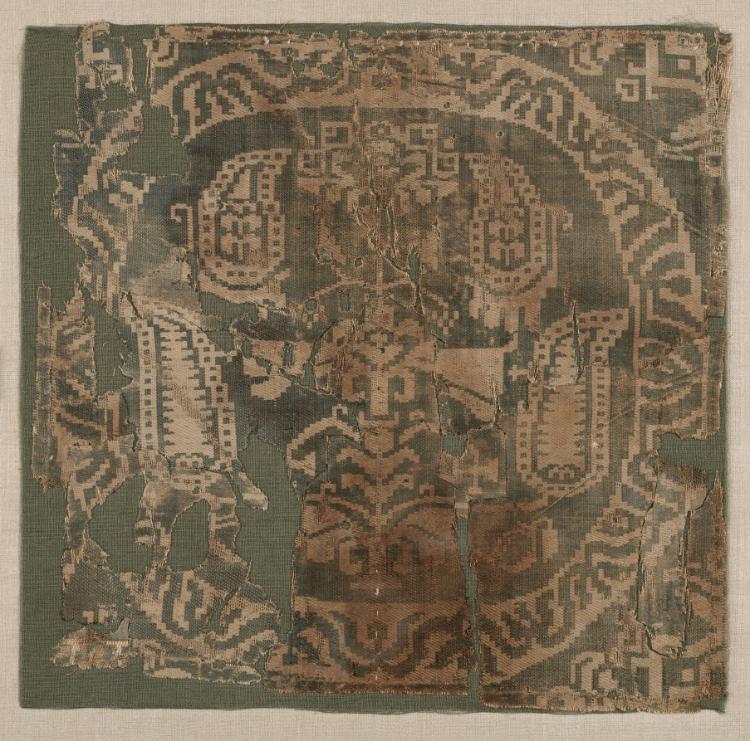
Heritage Synthesis: Roundel from a Tunic with Palmette Tree
Curated on Aug 26, 2026 // Node: LDN-01
The Roundel as a Testament to Imperial Craft
In the hushed, wood-panelled ateliers of London’s Savile Row, where a tape measure is a sceptre and a basted seam a silent oath, one learns to read cloth not as mere textile but as biography. The Roundel from a Tunic with Palmette Tree, rendered in lustrous, warp-faced silk, is precisely such a document. It is not a fragment; it is a complete sentence in a language of power, patience, and precision—a language that modern tailoring, for all its technical bravado, can only aspire to echo. This artifact, born from the looms of an imperial atelier, speaks to the enduring truth that the finest cloth is never manufactured; it is *composed*.
Materiality and the Grammar of Silk
Let us first address the fibre itself. Silk, in its raw state, is a continuous filament—a single, unbroken thread that can span a kilometre. Unlike wool or cotton, which are staple fibres requiring twisting and alignment, silk’s inherent length offers a surface of almost unnatural uniformity. For the imperial weaver, this was not a convenience but a mandate. The roundel’s ground is a deep, oxblood crimson, achieved through multiple dye baths of madder and kermes, a process that could take weeks. The result is a colour so saturated it appears to absorb light rather than reflect it, lending the fabric a gravity that modern aniline dyes cannot replicate.
The palmette tree, rendered in a supplementary weft of gilded thread, is not merely embroidered atop the silk; it is *woven into* its very structure. This is the crucial distinction. In a compound weave—specifically, a samite or lampas structure—the pattern is integral to the cloth. The weaver, working on a drawloom, would have manipulated hundreds of individual warp threads, each controlled by a complex system of cords and pulleys, to create the symmetrical, stylised fronds. Each pass of the shuttle was a decision. A single misstep, a snapped thread, and the entire panel would be condemned. This is the antithesis of the modern, error-tolerant production line. It is a discipline closer to calligraphy than to manufacturing.
Imperial Context: The Loom as a Throne
The legacy of imperial silk weaving is not a story of mere luxury; it is a story of statecraft. From the Byzantine workshops of Constantinople to the Safavid looms of Isfahan, the control of silk production was a monopoly of power. The roundel, with its central palmette—a motif of life, renewal, and the cosmic tree—was not a personal indulgence. It was a uniform. Worn by high-ranking officials and members of the court, such roundels were sewn onto tunics as markers of rank, allegiance, and proximity to the sovereign. The palmette, often flanked by paired, symmetrical leaves, was a visual assertion of order over chaos, of the empire’s ability to impose structure upon the natural world.
In this context, the tunic from which this roundel was excised was not merely clothing. It was a mobile declaration of imperial ideology. The silk’s sheen, catching the light in a throne room or a processional, was a form of soft power. It said: *We have the resources to feed silkworms, the skill to weave their output into perfection, and the authority to drape that perfection upon our chosen servants.* The roundel, therefore, is a fragment of a larger political architecture. To hold it is to hold a piece of that architecture in miniature—a blueprint of hierarchy, encoded in crimson and gold.
The Savile Row Parallel: Cut, Cloth, and Consequence
Why does this ancient artifact resonate within the context of a London tailoring house? Because the foundational principles are identical. On Savile Row, the tailor does not ask, “What does the client want?” but rather, “What does the cloth demand?” The drape of a jacket, the fall of a trouser, the roll of a lapel—these are not arbitrary choices. They are responses to the material’s inherent properties. A heavy, felted flannel from the West of England behaves differently than a crisp, open-weave mohair from Yorkshire. The master cutter understands this instinctively, just as the imperial weaver understood that a silk thread’s tension must be calibrated to the humidity of the workshop.
The roundel’s construction—its symmetry, its deliberate repetition—mirrors the tailor’s obsession with balance. A Savile Row jacket is built on a canvas of horsehair and wool, hand-stitched to create a chest that neither collapses nor stands rigid. The palmette tree, with its central trunk and radiating fronds, performs the same function visually. It provides a focal point, a spine, around which the rest of the design coheres. Without that anchor, the pattern would dissolve into chaos. Without a structured canvas, a jacket would lose its shape within hours. Both are acts of *restraint*—the deliberate withholding of excess to achieve a greater, more lasting elegance.
Preservation and the Ethics of Fragmentation
We must also confront the uncomfortable reality of this artifact’s existence. It is a *roundel*, a cut piece, removed from its original garment. This is a violence of sorts—a decontextualisation. The tunic, once a complete statement, is now a memory. Yet, in the hands of a heritage specialist, this fragmentation becomes a form of curation. We do not mourn the loss of the whole; we study the part as a synecdoche. The roundel tells us more about the weaving technique, the dye recipe, and the iconographic programme than a complete but faded garment might, because we can examine its reverse, its selvedge, and its structural integrity without the distraction of wear.
This is a lesson for the modern industry. In an era of fast fashion and disposable trend cycles, the roundel stands as a rebuke. Its creation took months; its survival has taken centuries. The silk, though aged and slightly brittle, still holds its colour, its pattern, its *intent*. A Savile Row garment, properly made, is designed for a similar longevity. It is not a product; it is an heirloom. The roundel reminds us that true luxury is not about novelty but about permanence. It is about the confidence to create something that will outlast its maker, its wearer, and perhaps even its civilisation.
Conclusion: The Unbroken Thread
In the end, this roundel is not a relic. It is a living argument. It argues that craftsmanship is a form of knowledge—embodied, tacit, and irreplaceable. It argues that the relationship between maker and material is a dialogue, not a transaction. And it argues that the legacy of imperial silk weaving is not confined to museums or ancient courts. It is present, daily, in the quiet, deliberate work of those who still believe that a garment can be a masterpiece. The palmette tree, though stylised and ancient, is not dead. It is simply waiting for the next pair of hands—whether a weaver’s, a tailor’s, or a curator’s—to recognise that the thread, once spun, is never truly broken.
Heritage Lab Insight
Lab Insight: CMA Silk Archive Node integration.