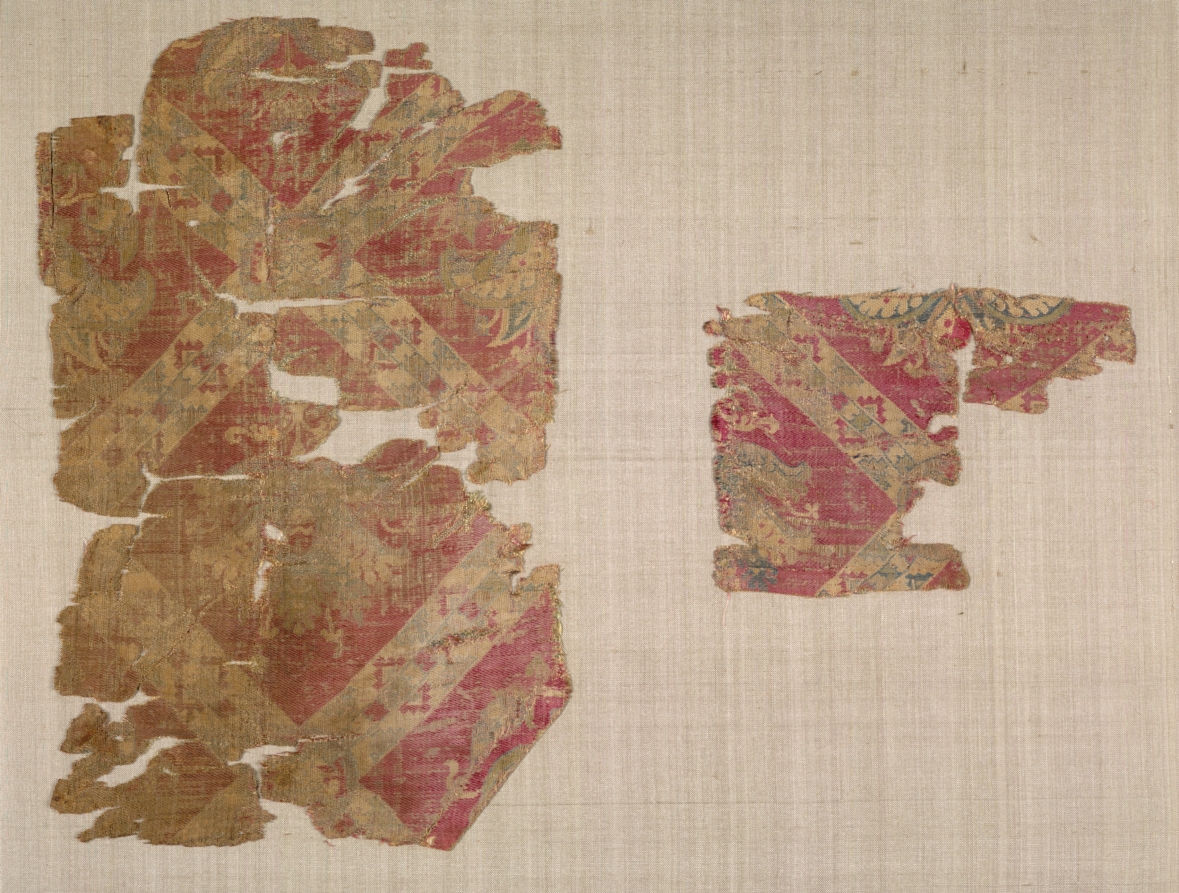
Silk Fragments with Palmette Blossoms: An Examination of Imperial Lineage and Modern Craft
Provenance and Materiality: The Weight of a Thread
These silk fragments, bearing the enduring motif of the palmette blossom, are not merely textile remnants; they are the distilled essence of an imperial aesthetic that has traversed centuries and continents. The materiality of the silk itself—a filament of unparalleled fineness, strength, and lustre—speaks to a production lineage that was once the exclusive purview of royal ateliers. To hold such a fragment is to hold a document of power, a tactile record of the sericulture that began in ancient China and wove its way westward along the Silk Road, eventually adorning the courts of Byzantium, the Safavid Empire, and the grand houses of Renaissance Italy.
The weave structure, likely a compound twill or a lampas, reveals a technical sophistication that modern machinery still struggles to replicate with equal soul. The warp and weft are not simply interlaced; they are choreographed. The silk’s high twist in the warp provides a resilient foundation, while the finer, untwisted weft floats across the surface to create a luminous, almost liquid, field of colour. This is not a fabric for the faint-hearted. It is a fabric of ceremony, of state, of the highest order of sartorial diplomacy. The density of the weave, the precise tension of the threads, and the flawless dye penetration—likely from madder root for the deep crimson and indigo for the blues—all attest to a workshop operating under the strictest imperial mandate, where error was not an option but a form of treason.
The Palmette: A Symbolic Lexicon of Power
The palmette blossom, our central motif, is a masterclass in symbolic endurance. Originating in ancient Egypt and Mesopotamia, it was adopted and refined by the Greeks and Persians before becoming a signature of Sassanian royal textiles. Its presence on these fragments is not decorative whimsy; it is a deliberate invocation of authority. The palmette, with its radiating fronds and central fan, is a stylised representation of the date palm—a tree of life, fertility, and victory. In the imperial context, it signified the ruler’s role as the sustainer of the realm, the bringer of order from chaos.
Observe the symmetry. The blossoms are arranged in a strict, mirrored repeat, creating an infinite lattice of order. This is the visual language of absolutism. The repetition is hypnotic, reassuring, and unyielding. It tells the viewer that the empire is eternal, its laws immutable. The scale of the palmette is also telling; it is neither diminutive nor overwhelming, but perfectly proportioned to the human form when draped. This suggests a garment designed for a figure of consequence, one who understood that power is not shouted but whispered through the language of cloth. The negative space between the blossoms is as important as the motif itself, creating a rhythm that draws the eye across the surface, a silent procession of floral authority.
From Imperial Loom to Savile Row: A Continuum of Craft
Now, we must consider the journey from the imperial loom to the contemporary workbench. On Savile Row, we do not deal in nostalgia; we deal in lineage. The legacy of imperial silk weaving is not a museum piece to be admired from a distance. It is a standard of excellence, a benchmark of what cloth can achieve when patience, skill, and the finest materials are brought into perfect alignment. The modern tailor, when presented with a silk of this calibre, understands that he is not merely cutting a garment; he is engaging in a dialogue with a tradition that predates the very concept of the suit.
The discipline required to weave such a fabric is mirrored in the discipline required to cut it. Silk of this weight and construction demands a master’s hand. It does not forgive a hesitant scissor or a misplaced chalk mark. The tailor must respect the fabric’s natural drape, its propensity to move with the body rather than against it. The construction of a jacket from these fragments would be an exercise in restraint. The cut would be clean, the shoulders soft, the waist suppressed just so, allowing the fabric to be the protagonist. The palmette pattern, if used for a dressing gown or a smoking jacket, would be aligned with precision at the seams, ensuring the motif flows uninterrupted around the body, creating a seamless statement of quiet, unassailable confidence.
The Modern Commission: Wearing History, Not Costume
The contemporary client who commissions a piece from such material is not seeking a costume. They are seeking a connection to a standard of craftsmanship that has become increasingly rare. They understand that true luxury is not about logos or fleeting trends, but about the integrity of the object. To wear a silk fragment with palmette blossoms is to wear a piece of history that has been re-contextualised for the present. It is a statement that one understands the value of provenance, the importance of materiality, and the quiet power of a well-made thing.
In our atelier, we approach such commissions with a reverence that borders on the ceremonial. We study the fragment, map its pattern repeat, and consider its optimal use. We do not force it into a modern silhouette; we adapt the silhouette to honour the cloth. The result is a garment that feels both ancient and utterly contemporary—a paradox that is the hallmark of true heritage. It is not a reproduction; it is a continuation. The imperial weaver’s hand, though long stilled, guides our own. The palmette blossom, once a symbol of a ruler’s dominion, now becomes a symbol of the wearer’s discerning taste, their understanding that true authority is worn, not spoken.
These fragments, therefore, are not merely artefacts. They are a brief. A brief for excellence, for patience, and for the enduring power of beauty. And it is a brief we accept with the utmost seriousness, for we know that we are not just tailors; we are custodians of a legacy that must not be allowed to fray.