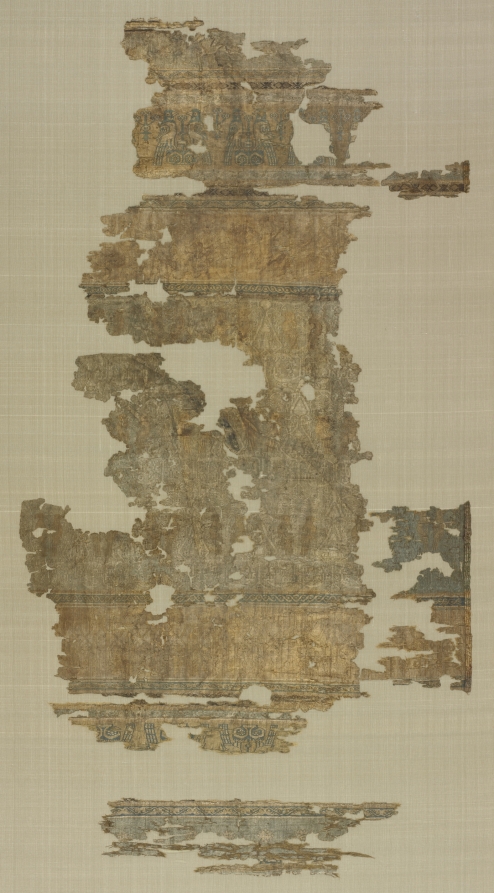
A Consideration of Imperial Fragments: On the Material Authority of Silk
To handle a fragment of imperial silk is to engage in a dialogue with absolute authority. It is not merely an encounter with a textile, but a tactile conference with a system of power, aesthetics, and control so refined it defined civilizations. The fragment, in its deliberate incompleteness, is the most eloquent of speakers. It does not boast of a full garment, a completed narrative. Instead, it presents evidence. It is the forensic remnant of a world where cloth was not simply worn but decreed; where the very thread was a manifestation of dominion, and its patterns were the cartography of an empire’s self-regard.
The Weave as Edict: A Grammar of Power
Consider the materiality. True imperial silk possesses a density, a substantial hand, that immediately communicates its provenance. This is not the gossamer of mere luxury; it is the robust, enduring product of state-sanctioned looms. The imperial workshops—the jiangzuo of China’s Forbidden City, the karkhanas of the Mughal court, the Byzantine gynaecaea—were not ateliers in the modern sense. They were ministries of visual propaganda, operating under the unblinking eye of the throne. The silk they produced was governed by sumptuary laws of the most exacting kind, a rigid syntax that dictated who might wear which colour, which motif, and at what occasion. A five-clawed dragon, a specific shade of saffron, a pattern of pomegranates—these were not decorative whims. They were insignia, as clear and as regulated as the braid on a military uniform.
The fragment, therefore, is a clipped clause from this vast legislative text. Its surviving pattern, however small, allows one to reconstruct the entire hierarchy it once adorned. The precision of the weave—the absolute perfection demanded in every intersecting warp and weft—mirrored the desired perfection of the imperial order. Flaws were not tolerated, for the fabric was a metaphor for the realm itself: seamless, strong, and radiantly ordered.
The Patina of Legacy: A Narrative in Degradation
It is in the fragment’s state of dignified degradation that its second great testimony lies. Time, that most impartial of critics, has worked upon it. Colours have subsided from their original, violent brilliance into a library of nuanced tones: vermilion to rust, imperial yellow to ochre, azure to a dusty twilight. The metallic threads, once spun with real gold or silver leaf, have tarnished, their brilliance softened to a melancholic gleam. This patina is not to be lamented; it is the artifact’s acquired character, its non-negotiable provenance.
This ageing process performs a crucial alchemy. It transmutes the cloth from a tool of contemporary power into an object of historical evidence. The wear along a fold line suggests the drape of a robe; a strengthened selvedge hints at a seamstress’s reinforcement for a heavy ceremonial garment; a slight asymmetry in the repeat, invisible from a distance, whispers of the human hand operating within the inhuman standard. The fragment thus escapes its original, rigid purpose. It ceases to be merely a symbol of a specific emperor’s glory and becomes a witness to the passage of dynasties, to the fall of courts, and to the enduring allure of the craft itself. It carries the quiet, unassailable authority of survival.
From Imperial Loom to Modern Consciousness: The Continuum of Excellence
The legacy of this imperial materiality is not confined to museums. Its principles—of uncompromising quality, of symbolic depth, of technical mastery exercised in the service of a defining aesthetic—form the very bedrock of a certain philosophy in craftsmanship. One observes a direct, if spiritual, lineage. The imperial weaver, bound by edict to achieve perfection, finds his echo in the Savile Row cutter, for whom the integrity of the cloth and the precision of the line are non-negotiable tenets. Both operate within a tradition that is larger than the individual, where innovation occurs not through rebellion, but through a deeper understanding of the foundational code.
The modern appreciation for these fragments lies in this recognition of continuum. To study them is to understand that true luxury is not defined by price, but by context, constraint, and consummate execution. The imperial silk fragment teaches that the most powerful statements are often made through subtlety and system. It champions the idea that material, when imbued with meaning and mastered by technique, transcends its physical form to become culture itself.
In the end, the silk fragment stands as a silent arbiter of taste. It reminds us that the highest expressions of human endeavour are often those that marry immense power with exquisite subtlety. It is a ruined palace wall that still shows the frescoed outline of a dragon; a single clause from a lost constitution that implies an entire worldview. To hold it is to acknowledge a simple, enduring truth: that authority, when it wishes to be remembered, weaves its manifesto in silk.