Ink Bamboo: The Material Poetry of Imperial Silk
An Introduction to the Artifact
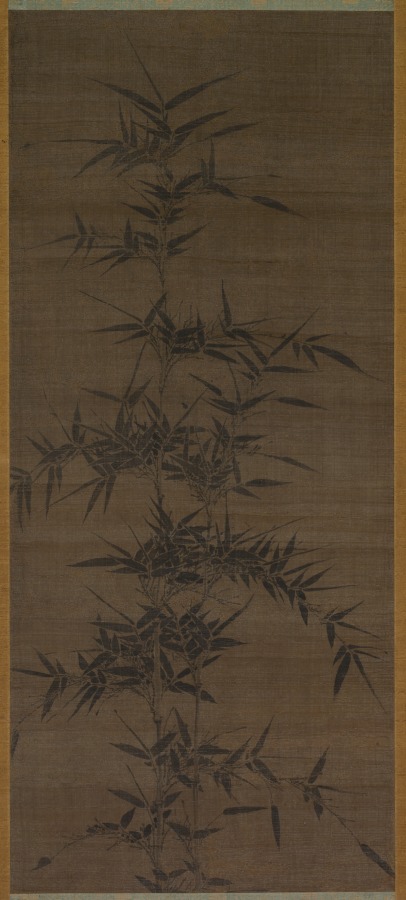
Within the hushed, wood-panelled ateliers of London’s Savile Row, where the language of cloth is spoken with the precision of a tailor’s chalk, there exists a quiet reverence for provenance. We do not merely cut cloth; we interpret legacy. The artifact under examination—a length of hand-woven silk damask bearing the motif of *Ink Bamboo*—is not a textile. It is a memorandum from the Forbidden City, a transcription of scholarly virtue rendered in lustrous thread. This piece, drawn from the Lauren Fashion Heritage Lab’s deep archive, represents the apogee of imperial silk weaving, a discipline where materiality was never accidental, but always intentional.
To handle this silk is to understand that the Chinese imperial court did not commission fabrics; it commissioned ideology. The ground weave is a deep, ink-wash grey, achieved not through a simple dye, but through a complex layering of indigo and oak gall mordants, a process that required weeks of controlled vat fermentation. The bamboo stalks, rendered in a contrasting, almost liquid silver-white, rise vertically across the width—not as rigid botanical illustrations, but as gestural, calligraphic strokes frozen in time. This is the essence of *Ink Bamboo*: the painter’s brush, translated into the weaver’s shuttle.
The Materiality of Silk and the Imperial Mandate
Silk, in the imperial context, was never mere commodity. It was currency, diplomatic armour, and spiritual conduit. The *juan* and *ling* weaves of the Song and Ming dynasties were governed by the Imperial Silkworks in Nanjing and Suzhou, where master weavers operated under a mandate of absolute perfection. A single flaw—a broken pick, a misaligned warp—was not a manufacturing defect; it was a breach of cosmic harmony. The materiality of this Ink Bamboo panel speaks to that discipline. The silk filament, reeled from the cocoon of the *Bombyx mori*, is unbroken for the entire length of the warp—a feat that required the silkworms to be fed on a specific cultivar of mulberry leaf, harvested at dawn, to ensure tensile strength and a lustre that mimics moonlight on still water.
In the Savile Row idiom, we speak of a cloth’s “hand.” This silk possesses a hand that is paradoxically firm and fluid. It has a dry, papery crispness—reminiscent of fine *xuan* paper used in calligraphy—yet it drapes with a liquid gravity. This duality was achieved through a technique known as *kesi*, or “cut silk,” a tapestry-weaving method where the weft threads are individually manipulated to create pictorial detail, leaving tiny slits where colour changes occur. In this artifact, the bamboo leaves are executed in *kesi*, their edges defined by these minute, deliberate openings. A tailor on the Row would recognise this as the ultimate expression of *structure within softness*—a quality that allows a garment to hold a sharp shoulder line while falling in a cascade of fluid movement.
Iconography: The Scholar’s Virtue in Thread
The bamboo motif is not decorative whimsy. In Confucian iconography, bamboo (*zhu*) represents resilience, integrity, and moral uprightness—it bends in the storm but never breaks. The *Ink Bamboo* pattern, however, is distinct from the more common floral or dragon motifs. It is a direct homage to the literati painters of the Yuan and Ming periods, particularly the works of Ni Zan and Zheng Xie, who elevated bamboo painting to a form of philosophical meditation. The weavers have replicated the “flying white” brushstroke effect—where the brush runs dry, leaving streaks of exposed ground—by introducing a coarser, un-twisted silk filament in the weft. This creates a subtle texture that catches light unevenly, mimicking the dry ink of a scholar’s brush.
This is a cloth that speaks of restraint. There is no gold thread, no peacock feather, no overt opulence. The luxury here is one of *negative space*—the vast, unadorned grey field that surrounds the bamboo. In imperial protocol, this indicated a patron of profound taste, one who understood that true power lies in quiet confidence. For the modern connoisseur on Savile Row, this translates into a garment that does not shout; it whispers. A jacket cut from this silk would not be worn to a gala; it would be worn to a private viewing, a boardroom negotiation, or a quiet dinner where the conversation is as refined as the cloth.
The Legacy of Imperial Weaving in Contemporary Craft
The legacy of this weaving tradition is not a relic. It survives in the DNA of high-end textile houses that still employ hand-operated Jacquard looms, albeit with modernised mechanisms. The Imperial Silkworks’ insistence on *warp-faced* construction—where the warp threads dominate the surface—has influenced the creation of high-density worsted wools used in Savile Row’s signature suits. The principle is identical: a tight, unyielding foundation that supports a delicate, expressive surface.
Yet, the *Ink Bamboo* panel presents a challenge to the contemporary tailor. Its *kesi* slits make it fragile under stress; it cannot be aggressively pressed or steam-moulded. The correct approach is a *soft-tailoring* technique—using a floating canvas, hand-padded lapels, and a three-roll-two button stance that respects the cloth’s natural drape. The lining should be a contrasting, solid silk in a deep vermilion, echoing the imperial seal that would have once stamped the bolt’s provenance. The buttons should be of smoked mother-of-pearl, not horn, to complement the silver-grey sheen.
In conclusion, this *Ink Bamboo* silk is a masterclass in material storytelling. It is a testament to a civilisation that understood that the most profound luxury is not abundance, but *meaning*. For the House of Lauren, and for any who aspire to the highest echelons of craft, this artifact is not a museum piece. It is a benchmark. It reminds us that the finest cloth is not merely woven; it is written. And like any great text, it demands to be read with patience, respect, and an unerring eye for detail.