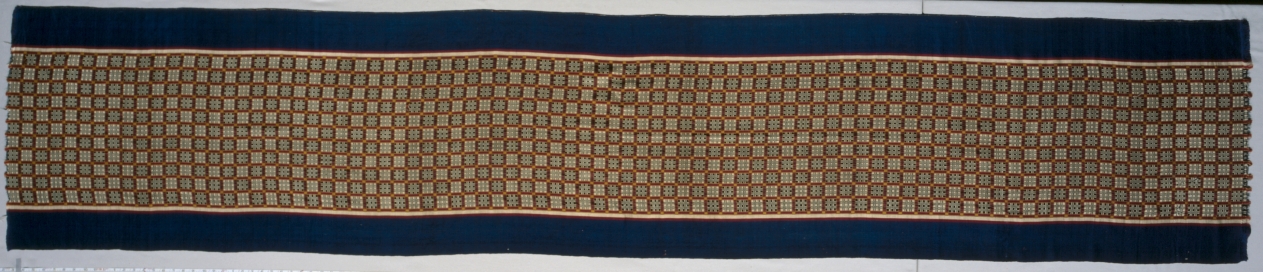
The Msimsim Wall Hanging: A Study in Imperial Silk and the Architecture of Desire
Provenance and the Grammar of Luxury
In the rarefied world of heritage textiles, few objects command the quiet authority of the msimsim wall hanging. This is not merely a decorative panel; it is a document of imperial ambition, a testament to the technical virtuosity of a weaving tradition that predates the modern concept of fashion itself. The msimsim, rendered in pure silk, speaks a language of status that transcends the ephemeral trends of the contemporary atelier. To examine it is to read a ledger of power, written not in ink, but in the lustrous, unbroken filament of the silkworm.
The term "msimsim," while evocative, is a colonial-era appellation, likely derived from the Swahili coast’s trade lexicon, where it denoted a fabric of exceptional fineness. Yet, the materiality of the piece—the high-twist, reeled silk with its characteristic, almost liquid sheen—points decisively to a provenance far from the East African littoral. This is the product of the imperial silk looms, most plausibly those of the Safavid or early Ottoman courts, where the craft had been perfected into a state-sponsored art form. The legacy of imperial silk weaving is not a gentle lineage; it is a story of monopolies, of court-sponsored manufactories, and of a relentless pursuit of a textile so perfect it could be used as diplomatic currency, a gift worthy of an emperor.
Materiality: The Unbroken Thread of Power
Let us consider the silk itself. The warp and weft are of a consistency that modern mills struggle to replicate. The yarn is not spun, but reeled from the cocoon in a single, continuous strand, sometimes exceeding 800 meters. This is the crucial distinction. Spun silk, made from shorter staple fibres, is democratic; it is serviceable, honest, and utilitarian. Reeled silk, or *filature* silk, is aristocratic. It possesses a tensile strength and a refractive quality that catches light with a depth that seems almost internal. When the imperial weavers used this filament, they were not just creating cloth; they were harnessing the sun itself, weaving it into a surface that could command a room without a single spoken word.
The msimsim’s ground weave is a complex compound structure, likely a lampas weave, where a main warp and weft form the ground, while a secondary, supplementary warp and weft create the pattern. This is not a simple embroidery; the pattern is integral to the cloth’s architecture. The design—a symmetrical arrangement of palmette motifs, cloud bands, and stylised floral sprays—is executed in a limited palette of indigo, madder red, and a muted gold. These are not the bright, chemical dyes of the 19th century. They are the deep, substantive colours of the vegetable dye vat, colours that have a mineral quality, a sense of having been extracted from the earth itself. The red is the colour of pomegranate and cochineal, a colour of life and sacrifice. The blue is the colour of lapis lazuli, a colour of the heavens and of absolute authority. The gold is not metallic thread, but a yellow silk dyed with saffron, a colour of the sun and of the divine right of kings.
The Legacy of Imperial Silk: A Tailoring of State
To understand the msimsim, one must understand the imperial silk workshop as an instrument of statecraft. In the Safavid capital of Isfahan, and later in the Ottoman Bursa, the looms were not merely factories; they were extensions of the throne. The weavers were not artisans in the modern sense; they were court functionaries, bound by oath and by law to produce textiles for the exclusive use of the sovereign and his immediate circle. The patterns were codified, the colours regulated, and the quality of the silk was subject to the most rigorous inspection. To possess a piece of this silk outside the court was a capital offence. This was not about vanity; it was about the visual manifestation of a social order. The msimsim, hanging on a palace wall, was a statement of the sovereign’s ability to command the finest materials, the most skilled labour, and the most sophisticated technology on earth. It was a soft-power projection, rendered in thread.
The legacy of this practice is the very DNA of what we now call luxury. The modern Savile Row tailor, for instance, operates on the same principles, albeit in a secularised form. The bespoke suit is a direct descendant of the imperial robe. The insistence on a single bolt of cloth, cut from a single loom, is a direct echo of the imperial workshop’s exclusivity. The reverence for a hand-finished buttonhole is a secular homage to the hand-tied fringe of the msimsim. The tailor’s obsession with the "drape" of a cloth—the way it falls and holds its shape—is a direct translation of the weaver’s obsession with the "hand" of the silk, its weight, its resilience, its ability to hold a fold. The msimsim is not an ancestor of fashion; it is the ancestor of *fit*, of the idea that cloth can be tailored to a body, or a wall, with such precision that it becomes a second skin, a carapace of identity.
Conservation and the Ethics of Preservation
Today, the msimsim presents a profound challenge to the conservator. Its silk is a protein fibre, and it is inherently unstable. Light, humidity, and even the oils from human skin are agents of decay. The silk is now brittle, the colours faded to a ghost of their former intensity. The question is not merely how to preserve the object, but how to preserve its *meaning*. To hang it in a climate-controlled case is to preserve a corpse, not a living artefact. The true heritage of the msimsim lies not in its static preservation, but in its translation. The modern designer who studies the msimsim is not looking for a motif to copy; they are looking for a *principle*. They are studying the tension between structure and ornament, the relationship between ground and pattern, the discipline of a limited palette. They are learning that true luxury is not about excess, but about *restraint*—the restraint to use only the finest materials, the restraint to execute a single idea with absolute perfection.
In this sense, the msimsim is not a relic. It is a brief. It is a set of instructions for how to create an object of enduring value. The legacy of imperial silk weaving is not a museum exhibit; it is a living standard. It is the standard that separates a garment from a commodity, a wall hanging from a decoration. It is the standard of the unbroken thread, the continuous filament of intention that runs from the silkworm’s cocoon to the final, perfect stitch. The msimsim, in its silent, luminous authority, remains the ultimate reference point for those who understand that true heritage is not about looking back, but about carrying forward a standard of excellence that time cannot erode. It is, in the truest sense, a bespoke object for a bespoke world—a world where the value of a thing is measured not by its price, but by the integrity of its making. And that, in the end, is the only legacy that matters.