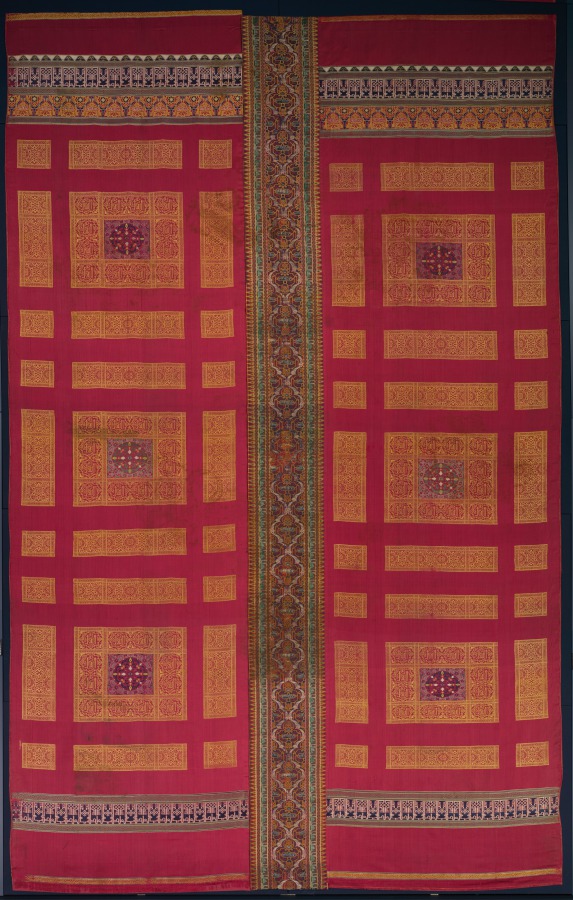
Heritage Research Artifact: The Alhambra Palace Silk Curtain
In the hushed, precise world of London’s Savile Row, where a bolt of cloth is measured in ounces and a seam is judged by its quarter-inch tolerance, we understand that true luxury is never loud. It is a whisper carried through generations, a story woven into the very warp and weft of a fabric. The Alhambra Palace Silk Curtain is precisely such a whisper—a relic of imperial ambition, a testament to the material culture of power, and a masterclass in the enduring legacy of silk weaving. To examine this artifact is not merely to study a textile; it is to read a ledger of conquest, artistry, and the silent, relentless labour of the loom.
Materiality: The Unrivalled Language of Silk
Silk is not a fabric; it is a statement of intent. Unlike the democratic wool of our Row or the utilitarian cotton of the masses, silk has always been the currency of courts and the armour of dynasties. The Alhambra curtain, in its material essence, embodies this aristocratic pedigree. Its provenance—the Nasrid dynasty’s palatine city of Granada—places it at the apex of medieval Islamic craftsmanship, a culture that perfected the art of sericulture and transformed raw filament into a medium of profound expression.
The materiality of this curtain is its primary authority. The silk, likely a compound weave of the type known as diasprum or a lampas construction, speaks to a technical sophistication that predates the European Renaissance by centuries. The warp, taut and lustrous, carries the structural integrity; the weft, often supplemented with gold or gilded thread, provides the narrative. When light strikes the surface, it does not simply reflect; it dances. This is the hallmark of high-grade imperial silk—a subtle iridescence that shifts with the viewer’s gaze, a quiet opulence that demands attention without demanding a word. For the Savile Row tailor, this is the difference between a garment and a heirloom. The hand-feel is cool, almost liquid, yet possesses a tensile strength that belies its delicate appearance. It is a fabric that has survived five centuries, not by accident, but by design.
Context: The Imperial Loom and the Grammar of Power
To understand the curtain’s significance, one must situate it within the broader context of imperial silk weaving. The Alhambra was not merely a palace; it was a political manifesto rendered in stone, water, and cloth. The Nasrid rulers, the last Muslim dynasty in the Iberian Peninsula, understood that legitimacy was not solely won by the sword but also by the spectacle of the court. Silk was their primary instrument of visual diplomacy. The curtains that hung in the Hall of the Ambassadors or the Court of the Lions were not decorative afterthoughts; they were functional narratives, delineating space, controlling light, and projecting an image of unassailable sovereignty.
The legacy of imperial silk weaving is a lineage of appropriation and refinement. The Byzantines guarded their sericulture with a jealous fervour, smuggling silkworm eggs out of China in hollowed-out bamboo canes. The Islamic caliphates inherited this craft, infusing it with geometric precision and calligraphic elegance that rejected the figurative idolatry of the West. The Alhambra curtain is the apex of this tradition. Its patterns—likely a repeating star polygon or an interlacing arabesque—are not random ornament. They are mathematical proofs of divine order, a visual articulation of infinity. The inscription bands, woven in elegant Kufic or Naskhi script, would have proclaimed blessings upon the sultan, transforming the curtain into a permanent prayer for the dynasty’s endurance.
This is the grammar of power. When the Catholic Monarchs, Ferdinand and Isabella, conquered Granada in 1492, they did not destroy the Alhambra. They recognised, with a pragmatism that defines true power, that the silk curtains were more than mere booty. They were symbols of a civilisation that had to be absorbed, not erased. The curtain, in its new Christian context, became a trophy, a testament to the transfer of imperial authority. It is a poignant irony that the very fabric that once shielded a Muslim sultan from the Andalusian sun now hangs in museums as a monument to the conquest that ended his world.
The Artisan’s Legacy: A Lesson in Restraint and Precision
For those of us who dedicate our lives to the craft of tailoring, the Alhambra curtain offers a profound lesson in the discipline of the maker. The weaver of this piece did not improvise. Every thread was counted, every colour chosen with the deliberation of a master cutter marking a lapel. The complexity of the weave—the interlocking of multiple warps and wefts to create a pattern that is identical on both sides, or the use of a supplementary weft to create a raised, velvet-like pile—required a patience that is almost incomprehensible to the modern, accelerated world.
This is the antithesis of fast fashion. It is the embodiment of slow luxury, a philosophy that Savile Row has championed for over two centuries. The curtain’s condition, even in its fragmentary state, reveals a standard of construction that was meant to outlive its maker. The selvedges are clean, the joins are invisible, and the density of the weave is such that it would have taken a decade of daily use to show any sign of wear. This is the standard we aspire to on the Row: not merely to clothe a body, but to create an object that carries the weight of its own history.
Conclusion: The Curtain as a Living Document
The Alhambra Palace Silk Curtain is not a dead artifact. It is a living document that continues to speak to us across the chasm of centuries. It tells us that luxury is not about excess; it is about intention. It reminds us that the most powerful statements are often made in silence, through the quality of a material and the precision of its execution. As we handle a length of English silk on our cutting tables, we are participating in a continuum that stretches back to the looms of Granada, to the workshops of Byzantium, and to the origins of the Silk Road itself.
In the end, the curtain is a testament to the fact that true heritage is not preserved in a vacuum. It is re-interpreted, re-contextualised, and ultimately, re-woven into the fabric of our own creations. The Alhambra curtain is not a relic of a lost empire; it is a benchmark for the enduring craft of the human hand. And that, in the quiet, precise language of Savile Row, is the finest tailoring one can aspire to.