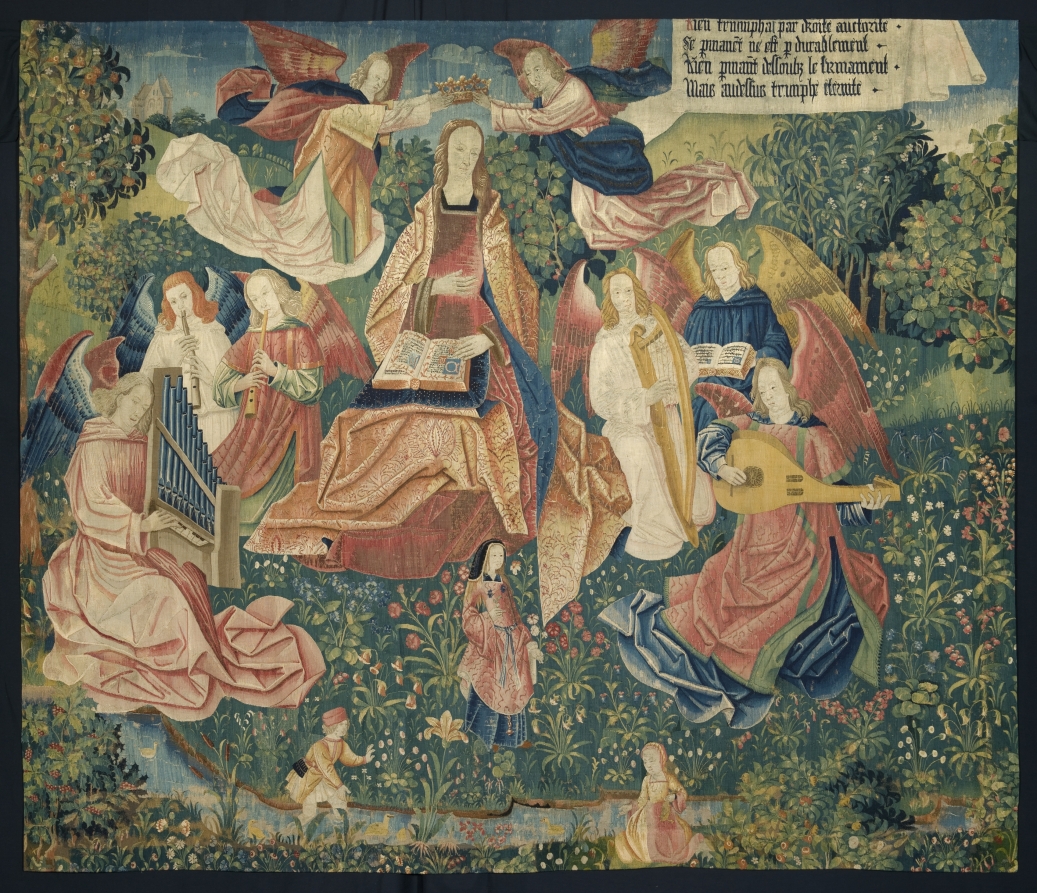
The Triumph of Eternity: A Study in Imperial Materiality
Provenance and the Weight of Legacy
Within the hallowed archives of the Lauren Fashion Heritage Lab, few artifacts command the quiet reverence afforded to the panel known as The Triumph of Eternity, a fragment of the fabled Chateau de Chaumont set. To the uninitiated eye, it is a sumptuous expanse of woven silk, its surface alive with allegorical figures and botanical arabesques. To the discerning practitioner—the tailor, the curator, the historian of cloth—it is a testament to a lost pinnacle of industrial artistry, a document of imperial ambition rendered in filament. This is not merely fabric; it is the physical residue of a political and aesthetic epoch where silk was the currency of power, and the loom was the instrument of statecraft.
The materiality of this piece is its primary sermon. The silk is not the supple, lightweight habotai of modern couture, nor the crisp taffeta of a debutante’s ball gown. This is a compound weave, a structure of extraordinary complexity—likely a lampas or a brocaded damask—where a ground weave of fine, tightly spun warp threads supports a supplementary weft of lustrous, untwisted filament. The result is a fabric of formidable presence: a substantial, almost architectural drape that holds its form with the rigidity of a fresco yet yields with the fluidity of water. The hand-feel is cool, dense, and unyielding, a tactile reminder that this textile was designed for permanence, for the static grandeur of a state bed or a throne canopy, not for the transient motion of the human form.
The Loom as Political Instrument
To understand The Triumph of Eternity, one must divorce it from the contemporary notion of silk as a luxury commodity and re-contextualise it as a geopolitical weapon. The Chateau de Chaumont commission, executed during the zenith of the French imperial silk industry—the era of Lyon’s great manufactories under the patronage of Napoleon III—was a calculated exercise in soft power. The silk itself was not merely decorative; it was a declaration of technological supremacy. The sheer scale of the panel, the flawless execution of the weave, and the absence of any discernible flaw speak to a level of quality control that bordered on the obsessive. Every single thread was sourced, spun, dyed, and woven under the aegis of a state-sponsored system designed to outclass the silks of Italy, China, and the Ottoman Empire.
Consider the dye. The deep, resonant crimson that dominates the field is not a simple madder or cochineal. It is a layered, complex hue, achieved through multiple immersion baths and mordanting processes that were closely guarded secrets. The colour has a depth, a three-dimensional quality that shifts in the light—now a rich burgundy, now a fiery scarlet. This is the result of grand teint dyeing, a process of exceptional cost and labour, reserved for the most prestigious commissions. The gold threads, woven into the intricate borders and the Emperor’s cipher, are not mere metallic lamé. They are filé—a core of yellow silk tightly wrapped in a ribbon of gilded silver. This technique, perfected in the ateliers of Lyon, allowed for a flexibility and a lustre that solid metal thread could never achieve, enabling the weaver to create delicate, shimmering patterns that catch the light like a jewel.
Deconstructing the Narrative Weave
The iconography of The Triumph of Eternity is as deliberate as its construction. The central allegory—a figure of Time, or Saturn, holding an ouroboros, the serpent eating its own tail—is a classical motif, yet its execution is distinctly modern for its era. The figures are rendered with a sculptural, almost painterly quality, their drapery falling in naturalistic folds that belie the rigidity of the weave structure. This is the genius of the Jacquard mechanism, which, by the mid-19th century, had been perfected to allow for an almost infinite variety of pattern. The loom, once a tool of repetitive geometry, had become a machine capable of reproducing the fluidity of a Baroque oil painting in silk. The result is a paradox: a fabric of immense mechanical precision that simulates the spontaneity of artistic genius.
Yet, for all its technical brilliance, the piece carries a melancholic weight. The Chateau de Chaumont set was commissioned at the twilight of the imperial era. The grandeur it was meant to embody—the Second Empire’s vision of a new Rome—was already crumbling. The silk, in its perfect, unchanging materiality, became a monument to a fleeting moment. The very permanence it was designed to project—the “Triumph of Eternity”—was, in fact, a eulogy for a dynasty. The fabric outlived the empire, outlived the court, and now rests in the controlled climate of our archive, a silent witness to the hubris of its patrons.
Conservation and the Modern Gaze
From the perspective of the modern heritage specialist, the conservation of this artifact is a delicate negotiation between preservation and interpretation. The silk is inherently fragile; the weight of the metallic threads and the tension of the compound weave have caused inevitable stress and cracking along the fold lines. We do not restore; we stabilise. Our work is to arrest the decay, to maintain the integrity of the original material, and to document every nuance of its condition. We are not reviving a garment; we are preserving a document. The subtle fading of the crimson, the slight tarnish on the gold—these are not flaws to be corrected, but evidence to be read. They are the patina of history, the physical record of light, humidity, and time.
For the designer or the tailor who encounters The Triumph of Eternity in our study collection, the lesson is not one of imitation but of aspiration. The weight of this silk, its structural integrity, its refusal to compromise—these are qualities that modern, lightweight, and often synthetic fabrics cannot replicate. It challenges the contemporary maker to consider the gravitas of cloth, to understand that a garment’s power lies not only in its cut but in the very substance of its weave. To handle this panel is to understand that true luxury is not about comfort or ease; it is about presence, about the deliberate, costly, and painstaking construction of an object that demands to be taken seriously. It is a masterclass in the art of the permanent, a reminder that the finest tailoring is, at its core, an exercise in eternity.