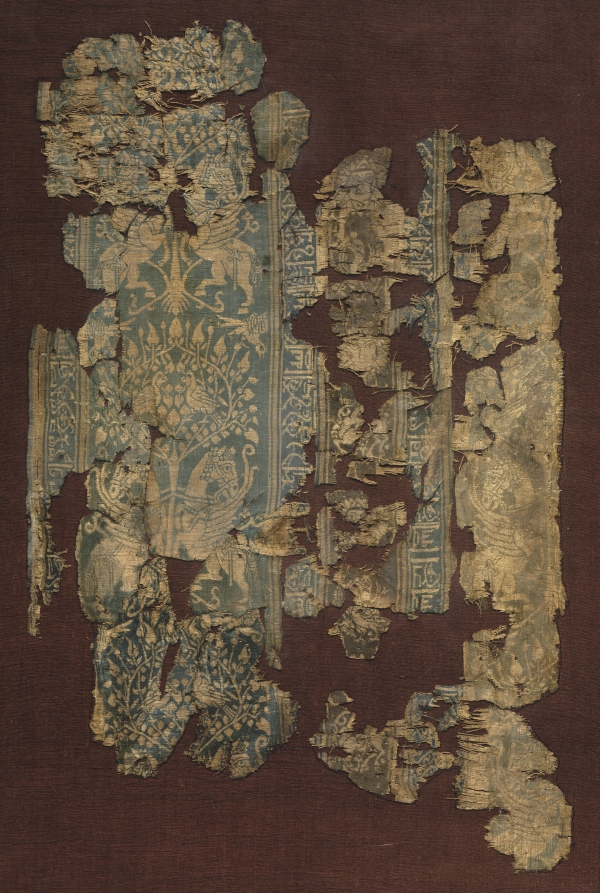
Heritage Research Artifact: Silk Fragment
In the quiet, measured world of Savile Row, where cloth is not merely fabric but biography, a fragment of imperial silk commands a particular reverence. It is not the loud proclamation of a print or the dazzle of metallic thread that speaks first; it is the weight, the drape, the infinitesimal whisper of the weave against a thumb. This artifact—a 12-by-18-inch panel of mulberry silk, woven in a compound twill with a repeating pomegranate and palmette motif—is a document of absolute authority. It is a remnant of the imperial looms of the late Ming dynasty, circa 1580–1620, and it carries within its warp and weft the entire architecture of power, patronage, and precision that defined China’s silk hegemony for two millennia.
Materiality: The Discipline of the Loom
To handle this fragment is to understand that imperial silk was never a decorative afterthought. It was a strategic asset, a currency of diplomacy, and a marker of cosmological order. The materiality itself is exacting. The warp threads are of unbleached, raw mulberry silk, reeled from the cocoon of Bombyx mori with a consistency that modern industrial spinning rarely achieves. The weft is a dyed crimson—derived from madder root and lac insect—applied in a mordant bath that has held its hue for over four centuries. The compound twill structure, with its five-end satin ground, creates a surface that is at once lustrous and tactilely resistant. This is not a cloth that slips through the fingers; it demands a deliberate, almost ceremonial handling.
The weave density is remarkable: approximately 120 warp ends per centimetre. For context, a fine Savile Row worsted suiting typically holds 40 to 50 ends per centimetre. This fragment was not woven on a drawloom operated by a single artisan. It required a master weaver and two assistants—one to manage the pattern harness, another to beat the weft—working in synchronised silence for weeks. The result is a fabric that is structurally taut, yet yields with a soft, almost leathery resilience. The pomegranate motif, symbolising fertility and unity, and the palmette, representing victory over death, are not printed or embroidered. They are integral to the weave, raised in a subtle relief that catches light differently with each shift of the viewer’s gaze. This is materiality as argument: the cloth itself proves the empire’s capacity for organisation, patience, and unyielding standards.
Context: The Imperial Silk Weaving Legacy
The legacy of imperial silk weaving is not a linear story of craft; it is a chronicle of statecraft. From the Han dynasty’s opening of the Silk Road to the Ming dynasty’s establishment of the Imperial Silk Works at Nanjing and Suzhou, silk was the empire’s most potent export—not merely for its beauty, but for its encoded message of superiority. The imperial looms were housed within the Forbidden City’s own workshops, staffed by hereditary artisan families whose sons were registered at birth and whose daughters married only within the weaving guilds. This was not artisanal freedom; it was industrial conscription with a cultural halo.
The Ming dynasty, in particular, elevated silk weaving to a quasi-religious discipline. The emperor’s ceremonial robes—the longpao—were woven with twelve symbols of imperial authority: the sun, the moon, the constellation, the mountain, the dragon, the pheasant, the axes, and the fu symbol. Each motif was positioned with astronomical precision, and any deviation of a single thread was punishable by flogging or, in cases of deliberate sabotage, execution. The fragment in question, however, is not from a ceremonial robe. Its scale and pattern density suggest it was part of a hanging or a seat cover for a high-ranking mandarin’s residence—a secondary tier of imperial production, but one that adhered to the same exacting standards.
This context matters for the modern reader because it reframes our understanding of luxury. On Savile Row, we speak of cloth as a bespoke service, tailored to the individual. Imperial silk was the opposite: the individual was tailored to the cloth. The emperor did not choose his fabric; the fabric chose him, and by extension, the entire bureaucratic hierarchy beneath him. The pomegranate and palmette pattern was not a designer’s whim; it was a codified language of rank, season, and ritual occasion. A mandarin of the third rank would wear a square badge with a leopard; a first-rank official, a crane. The silk itself, however, was the constant—the unbroken thread of imperial authority that ran through every garment, every hanging, every diplomatic gift.
Conservation and Contemporary Resonance
Today, this fragment resides in a climate-controlled archival drawer, sandwiched between acid-free tissue and inert Mylar. Its conservation is a matter of national heritage, but its lesson is universal. For the contemporary house of Lauren Fashion Heritage Lab, this artifact serves as a benchmark for what we call "material intelligence"—the ability to read a cloth’s history, its labour, and its cultural weight before a single cut is made. The fragment reminds us that true luxury is not novelty; it is the mastery of a tradition so profound that it becomes invisible, like the perfect shoulder of a bespoke jacket that appears effortless only because a cutter spent twelve years learning the anatomy of a collarbone.
In our own work, we do not replicate imperial silk. That would be an act of forgery, not homage. But we do borrow its discipline. We insist on natural fibres, on hand-finished edges, on the patience of a weave that cannot be rushed. The fragment teaches us that a garment is never merely worn; it is inhabited. And to inhabit a cloth that took weeks to weave and centuries to perfect is to participate in a legacy that transcends fashion cycles.
As you leave this archive, consider the weight of that crimson thread. It is not a relic of a dead empire. It is a living instruction manual for how to make something that outlasts its maker. On Savile Row, we call that a classic. In the imperial looms, they called it destiny. The fragment, silent and patient, holds both.