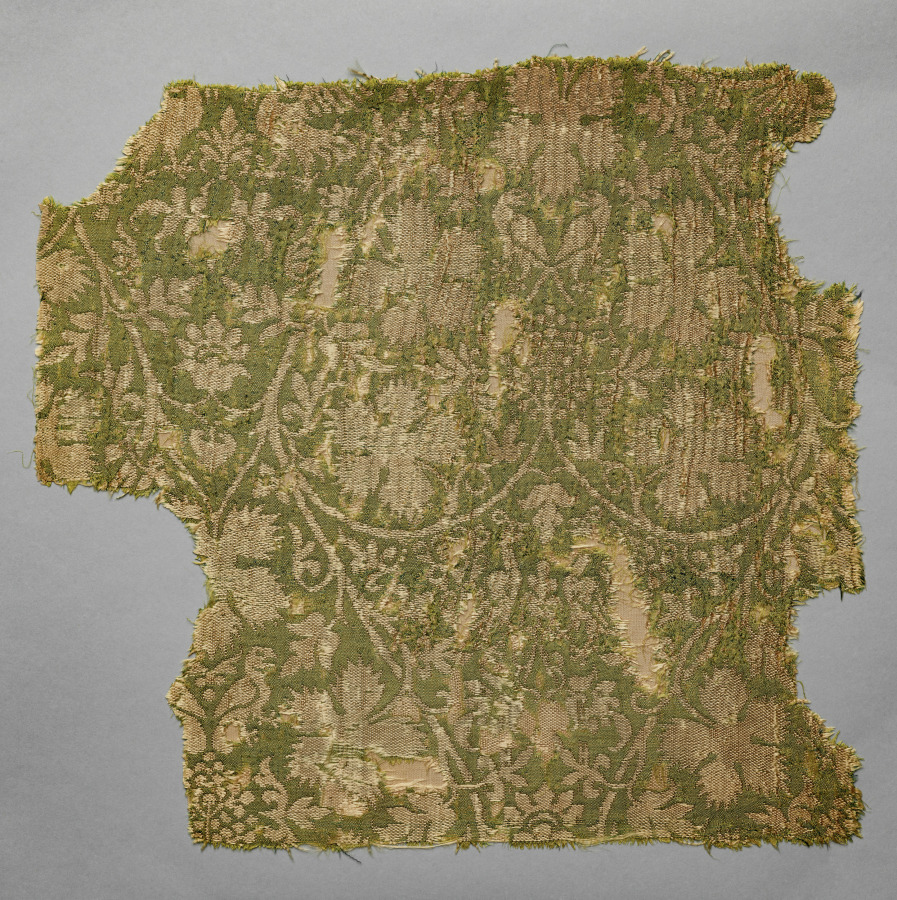
Heritage Research Artifact: Silk Fragment with Scrolling Vines, Grape Leaves, Grapes, and Birds
Within the hushed, measured world of Savile Row—where cloth is not merely purchased but commissioned, where a bolt of fabric carries the weight of lineage and the promise of permanence—there exists a quiet reverence for provenance. The artifact under examination, a fragment of woven silk bearing a motif of scrolling vines, grape leaves, ripe grapes, and attendant birds, is not simply a textile. It is a surviving chapter of an imperial narrative, a whisper from the looms of a dynasty that understood cloth as a language of power, and ornament as a form of statecraft.
To approach this fragment is to approach a paradox. It is at once fragile and formidable. The silk, now aged to a patina of muted golds and deep umber, retains a structural integrity that speaks to the extraordinary discipline of its creation. This is not the silk of a provincial workshop; this is imperial silk, woven under the auspices of a court that demanded perfection as a matter of political identity. The materiality itself—the fine, unbroken filaments, the density of the weave, the subtle play of light across the surface—tells us we are in the presence of a masterwork, a piece intended for a setting of immense consequence, be it a ceremonial robe, a palace hanging, or a sacred altar cloth.
The Grammar of the Vine: Motif as Imperial Lexicon
Let us consider the iconography with the same scrutiny one would apply to a bespoke suit’s lapel or the set of a shoulder seam. The scrolling vine is not a casual flourish. In the lexicon of imperial silk, the vine represents continuity, the unbroken line of succession, the enduring strength of the ruling house. It twists and turns with deliberate, rhythmic precision, a visual cadence that mirrors the ordered harmony of the court itself. The grape leaves, rendered with a botanical accuracy that borders on the scientific, are not merely decorative. They are symbols of abundance, of a realm that flourishes under benevolent governance. The grape cluster, heavy with fruit, is the apotheosis of this promise—a tangible emblem of prosperity, of the harvest that sustains the nation and, by extension, the throne.
Yet it is the birds that elevate this fragment from the merely opulent to the deeply symbolic. In the imperial canon, birds are messengers, intermediaries between the earthly and the celestial. Their presence among the vines suggests a dynamic equilibrium—the natural world in harmonious dialogue with the cultivated, the wild acknowledging the hand of the sovereign. The specific rendering of the birds, their poised stances and attentive gazes, implies not mere presence but participation. They are witnesses to the abundance, their song an invisible accompaniment to the visual feast. This is not a static still life; it is a living tableau, a frozen moment of a thriving, ordered cosmos.
The Loom as Sceptre: Craft and Consequence
To truly appreciate this artifact, one must understand the instrument of its creation. The imperial silk loom was not a tool; it was an institution. Operated by a cadre of master weavers whose skills were passed down through generations, these looms were capable of producing fabrics of a complexity that defies modern replication. The pattern we see—the interlocking curves of the vine, the subtle shading of the grape leaves, the precise placement of each bird—required a level of technical mastery that bordered on the sacerdotal. Each thread was a commitment; a single error could compromise the entire length of cloth, rendering it unfit for imperial use. The weaver, therefore, was not an artisan but an executor of a sacred trust, his hands guided by decades of training and an almost spiritual devotion to the craft.
This context is crucial. When we examine the fragment’s weave, we are not merely observing a pattern. We are observing the result of a system—a hierarchical, meticulously managed system that viewed silk production as a matter of national security. The finest mulberry silkworms were cultivated under imperial supervision. The dyes, derived from minerals and plants, were formulated to achieve hues that were not only beautiful but also encoded with meaning—the imperial yellow, the deep purples, the celadon greens. The fragment’s surviving palette, though faded, hints at this original chromatic authority. The silk was not simply a commodity; it was a currency of power, a means of rewarding loyalty, of forging alliances, and of projecting an image of unassailable grandeur to both domestic subjects and foreign emissaries.
From Palace to Archive: The Modern Resonance
For the contemporary observer—particularly one versed in the exacting standards of Savile Row—this fragment offers a profound lesson in the value of patience and precision. In an age of fast fashion and disposable textiles, this silk stands as a rebuke. It represents hours, days, perhaps weeks of singular focus, all in service of a piece of cloth that was intended to outlive its creator. The motif of the vine, the grape, and the bird is not a fleeting trend; it is a timeless statement of order and fecundity, a message that remains legible across centuries.
The legacy of imperial silk weaving is not confined to museum vitrines. It persists in the very DNA of fine tailoring. The weight of a well-made garment, the way it drapes, the integrity of its construction—these are echoes of the imperial loom. When a tailor on Savile Row discusses the “hand” of a fabric, he is speaking of a quality that the imperial weavers understood implicitly. They knew that cloth is not a passive surface but an active participant in the wearer’s presence. This fragment, with its confident motif and impeccable construction, embodies that principle. It is a garment that commands a room, not through noise, but through the quiet, unassailable authority of its making.
In preserving and studying this artifact, we do more than catalogue a historical curiosity. We engage in a dialogue with the past, acknowledging that the pursuit of excellence is a timeless endeavor. The scrolling vines speak of endurance. The grapes speak of reward. The birds speak of a world in balance. And the silk itself—this remarkable, enduring material—speaks of a civilization that understood that true power is woven, thread by thread, with intention, skill, and an unwavering vision of permanence. It is a fragment, yes, but it is a fragment of a much larger, more magnificent whole—a legacy that continues to inform and inspire the rarefied world of bespoke craftsmanship today.