← BACK TO ARCHIVES
Silk
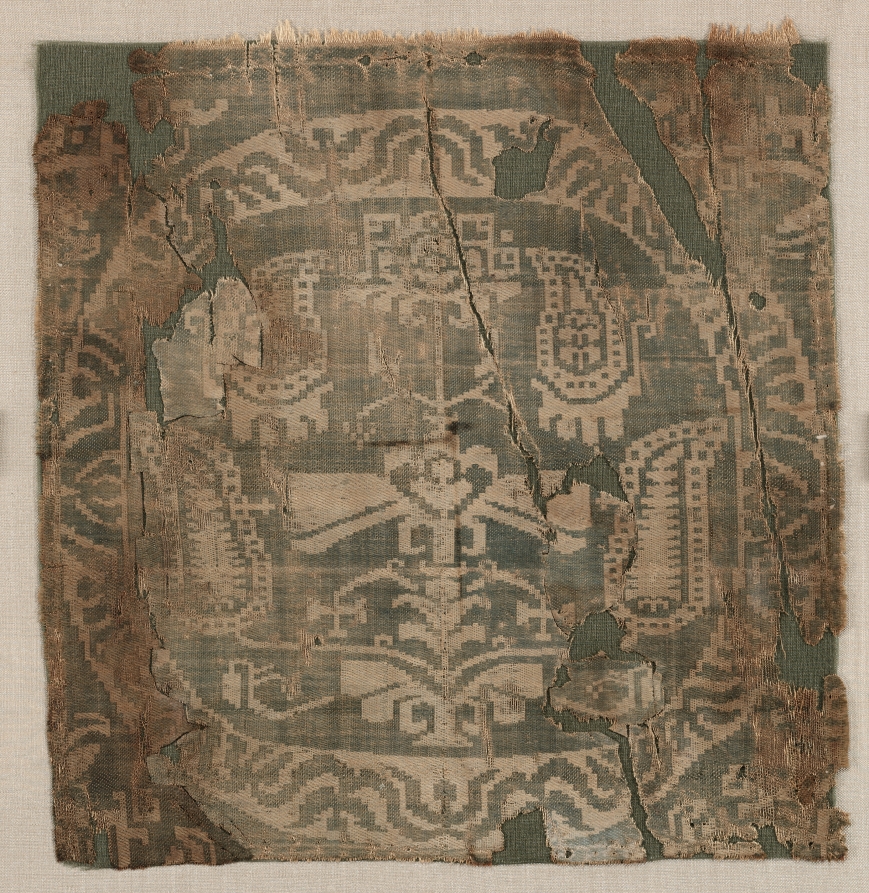
Heritage Synthesis: Roundel from a Tunic with Palmette Tree
Curated on Aug 28, 2026 // Node: LDN-01
Provenance and the Weight of Thread
In the rarefied atmosphere of London’s Savile Row, where a bolt of cloth is never merely fabric but a ledger of intent, the roundel from a tunic bearing a palmette tree commands a particular reverence. This is not a fragment; it is a deposition. The materiality—silk, and silk alone—speaks first. Before pattern, before iconography, there is the filament itself, extruded from the mulberry worm’s mouth in a single, unbroken gesture of biological luxury. To hold this roundel is to hold the residue of an imperial economy that understood thread as currency, as diplomacy, and as divine mandate.
The Grammar of the Loom: Silk as Imperial Syntax
The legacy of imperial silk weaving is not a matter of nostalgia; it is a matter of structural power. In the courts of Byzantium, Tang China, and later the Sasanian and early Islamic empires, the silk loom was a state instrument. The weaver was not an artist in the Romantic sense but a technician of statecraft, operating within guilds that were as tightly regulated as any modern financial institution. The roundel itself—a circular medallion—is the visual equivalent of a royal seal. Its geometry is deliberate: the circle denies the linear, the temporal, the mundane. It asserts permanence.
The palmette tree at its centre is not a botanical study. It is a hieratic symbol, a stylised abstraction of life, renewal, and arboreal sovereignty. In the imperial lexicon, the tree—often flanked by symmetrical creatures or, as here, rendered as a central axis—signifies the axis mundi, the point where heaven and earth transact. The weaver has not depicted a tree; he has encoded a cosmology. The silk does not merely carry this image; it *is* the image. The lustre of the thread, the density of the weave, the way light catches the weft—these are not decorative accidents. They are the material proof of imperial reach. A lesser fibre would flatten the symbol. Silk elevates it to doctrine.
Materiality as Method: Reading the Thread
Let us examine the physical object with the same scrutiny one would apply to a bespoke suit’s lapel. The silk is likely a compound weave, possibly a samite or a taqueté, where multiple warp and weft systems interlace to create pattern and ground simultaneously. This is not a printed imitation. This is a structure. The palmette tree is formed by the weft floats—long, unbroken passes of coloured silk that sit on the surface, catching light with a plush, almost metallic sheen. The ground, in contrast, is a tighter, darker weave, receding into shadow. The effect is one of bas-relief, a sculptural presence that invites the fingertip as much as the eye.
This technical complexity is the true legacy of imperial weaving. It required a horizontal drawloom, an apparatus of such sophistication that it was considered a state secret in many courts. The pattern was not drawn on the cloth; it was encoded in a system of cords and heddles, a binary precursor to the punch card. The weaver, often working from a cartoon provided by a court painter, translated that design into thousands of individual thread manipulations. The margin for error was negligible. A single broken warp could unravel not just the cloth but the weaver’s life. This is the context of the roundel: it is a product of absolute precision under absolute authority.
The Palmette Tree: A Motif of Diplomatic Currency
The palmette itself has a genealogy that spans continents. It originates in the ancient Near East, migrates through Hellenistic art, and finds its most refined expression in Sasanian Persia, where it became a standard motif on royal textiles. When the Islamic caliphates absorbed Sasanian workshops, they inherited not just the looms but the visual grammar. The palmette tree in this roundel is thus a palimpsest of conquest and continuity. It is a symbol that survived regime change because it was too valuable to discard.
In the context of imperial gift-giving, such roundels were not sold; they were bestowed. A tunic bearing this roundel would have been a diplomatic missive, a wearable treaty. The recipient—a foreign dignitary, a tributary king—would understand the message immediately: *You are in the presence of a power that can command the worm, the loom, and the artist. Your own resources are provincial by comparison.* The silk does not merely clothe; it intimidates. This is the unspoken language of luxury, and it is a language that Savile Row, in its own secular way, still speaks fluently.
Conservation and the Ethics of Fragility
To handle this roundel today is to confront the paradox of preservation. Silk is a protein fibre, and protein decays. The very qualities that made it imperial—its fineness, its tensile strength—are also its vulnerabilities. Light, humidity, and even the oils of a human fingertip are agents of destruction. The roundel we study is likely a survivor of centuries of burial, reuse, or careful storage in a monastic or royal treasury. Its survival is not an accident; it is a testament to the value placed upon it by successive generations.
As heritage specialists, our duty is not to restore it to a fictional original state but to document its current truth. We must read the creases, the fading, the subtle shifts in hue where the dye has surrendered to time. These are not flaws; they are annotations. The roundel has a biography, and that biography is as important as its iconography. We must ask: Who wore this tunic? Under what conditions did it travel? Was it cut down and repurposed, a common fate for imperial silks? Each alteration is a chapter.
The Savile Row Parallel: Tailoring as Imperial Practice
The connection to Savile Row is not a contrivance. The Row’s founding principles—bespoke construction, the use of the finest materials, the subordination of ornament to structure—are direct inheritors of the imperial weaving tradition. A Savile Row suit is not off-the-rack; it is a negotiation between the client’s body and the tailor’s eye, executed in cloth that is often woven in small batches, sometimes to the client’s exclusive specification. The roundel’s weaver and the Savile Row cutter share a philosophy: that the garment is a site of meaning, and that the maker’s hand is invisible but absolute.
The palmette tree, in this context, becomes a metaphor for the bespoke process itself. The tree is a central axis from which all branches—all measurements, all seams, all choices of lining and button—extend. The tailor, like the imperial weaver, works within a strict grammar of proportion and balance. Deviation is not innovation; it is error. The roundel’s symmetry is its strength. So too is the suit’s.
Conclusion: The Thread That Binds
This roundel is not a relic. It is a living argument. It argues for the primacy of material over concept, of craft over intention, of structure over whim. In an age of fast fashion and digital reproduction, it stands as a rebuke. The silk remembers the worm, the loom, the court, and the hand that guided the shuttle. To study it is to enter into a conversation with that hand, across centuries, in a language that has not changed: the language of thread, tension, and pattern.
The legacy of imperial silk weaving is not merely historical. It is operational. It teaches us that true luxury is not abundance but precision. It teaches us that a symbol, when executed with absolute technical mastery, becomes a fact. The palmette tree does not represent sovereignty; it *is* sovereignty, woven into a material that outlasts the empire that commissioned it. And that, in the end, is the finest tailoring of all: to create something so perfectly constructed that it outlives its maker, its owner, and its era, and still speaks with authority.
Heritage Lab Insight
Lab Insight: CMA Silk Archive Node integration.