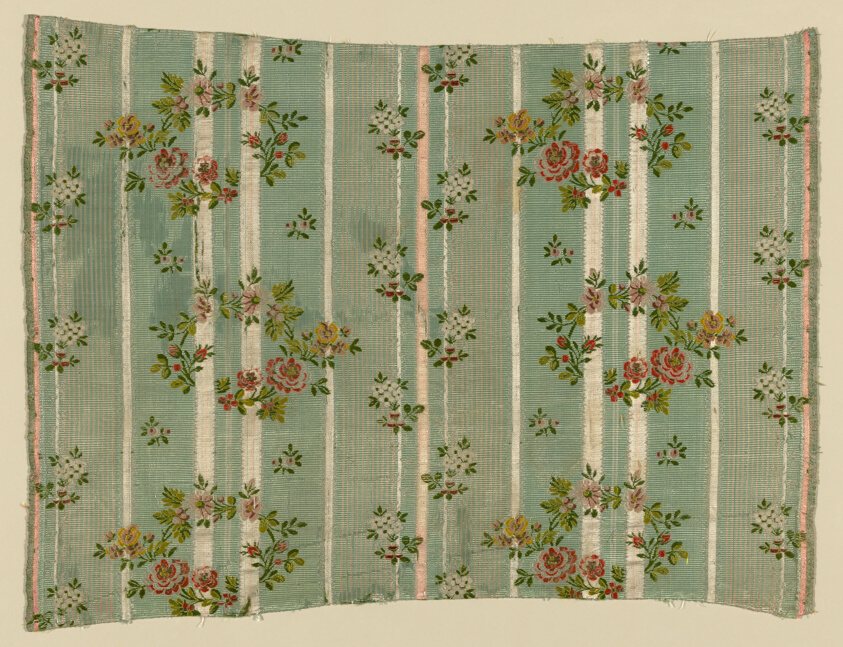
An Analysis of Structural Virtuosity: The Panel as a Testament to Ordered Opulence
To consider the silk panel presented for examination is to engage with a document of profound technical ambition. It is not merely a textile, but a deliberate and sophisticated orchestration of material, method, and aesthetic intent. The foundational proposition—fluid elegance—is not here achieved through whimsy or ethereal suggestion, but through the most rigorous and calculated means. This is elegance engineered, its fluidity a direct consequence of structural certainty. The specimen embodies a dialogue between discipline and display, where the luxurious potential of silk is not simply exploited, but governed by a masterful hand.
The Architectural Foundation: Warp and Weft as Load-Bearing Elements
The core of the panel’s character is established in its primary weave structures, which function as the tailored canvas upon which embellishment is laid. The use of stripes of warp-float faced satin weave is a statement of intent. The satin weave, with its long floats of warp threads dominating the surface, creates zones of unbroken, luminous reflection. This is the silk in its most quintessential state: a deep, light-capturing expanse that speaks of purity of material and confidence in its inherent virtue. It is the sartorial equivalent of a superfine wool broadcloth—a flawless ground asserting quiet authority.
Adjacent, the stripes of two-colour complementary weft plain weave introduce a contrasting rhetoric. Where the satin is about surface sheen, the complementary weave is about structural integrity and subtle, binary logic. The plain weave, the most fundamental and robust, is here made complex through the strategic use of two weft colours, creating a subdued, linear pattern born entirely from the fabric’s essential architecture. This stripe grounds the luminosity of the satin, providing a visual and textural counterpoint that prevents opulence from becoming mere ostentation. It is the careful waistcoat to the satin’s dress shirt.
The Grammar of Ornamentation: Supplementary Elements as Bespoke Detail
Upon this disciplined ground, the narrative ascends to a higher register of complexity. The panel employs not one, but two distinct systems of supplementary threads, a decision denoting a workshop operating at the zenith of its craft. The supplementary patterning warps represent a vertical intervention. These threads, integral yet distinct from the ground warp, allow for the introduction of linear, warp-wise motifs. Their effect is one of precision and elongation, a subtle striation or delicate, vertical tracery that guides the eye along the fabric’s length without disrupting the horizontal flow of the stripes. It is a detail akin to bespoke pick-stitching—visible only upon considered inspection, yet fundamentally enhancing the garment’s line.
More declarative, yet no less integrated, are the supplementary brocading wefts. This is where the fabric’s most explicit patterning resides. These discontinuous, often brilliantly coloured threads are inlaid across specific widths to form discrete motifs, floating over the ground cloth. Crucially, their introduction is paired with areas of self-patterned by ground weft floats. This technique reveals the panel’s most ingenious conceit: the ground weft itself is periodically commandeered to become part of the ornament. By allowing these foundational threads to float over several warps, they create a pattern that is born from the fabric’s very substance, a raised texture that is intrinsic rather than applied. The brocading wefts then sit alongside and interact with this raised texture, creating a dialogue between applied embellishment and structural patterning. The result is a richness that feels earned and inherent, never glued-on or superficial.
Contextual Synthesis: Classic Craftsmanship as the Apotheosis of Control
Within the context of classic silk craftsmanship, this panel must be recognised as a peerless example of controlled extravagance. Every element, however lavish, submits to the greater order of the whole. The stripes provide a rhythmic, architectural framework. The satin weave offers expanses of reflective calm. The complementary plain weave supplies textural depth. The supplementary warps contribute linear refinement, and the brocading wefts—in concert with the self-patterning ground weft—deliver focal points of intricate beauty.
The promised fluid elegance is the ultimate outcome of this control. The fabric possesses a weight and a drape dictated by the density and complexity of its construction. It will not flutter aimlessly, but fall with the decisive, graceful swing of a well-tailored coat. Its patterns, though elaborate, are born of its structure and thus move with it, integral to its being. This is the essence of the Savile Row philosophy applied to the loom: a profound understanding of material, a reverence for time-honoured technique, and a relentless pursuit of perfection where every constituent thread is accountable to the integrity of the final form. The panel is not simply fabric; it is a treatise on how luxury is most convincingly expressed not through abundance alone, but through abundance mastered.