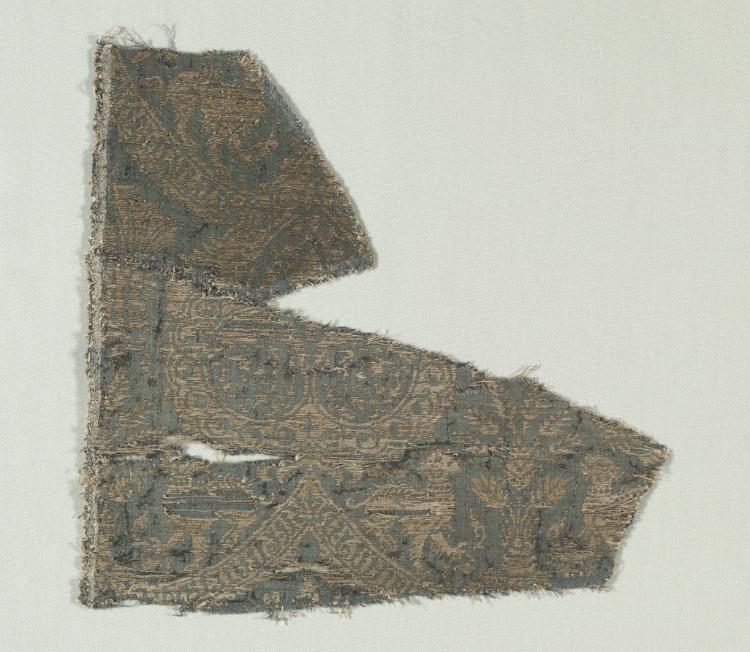
An Heirloom of the Loom: Deconstructing the “Silk with Dogs and Arabic Script in Swaying Bands”
In the hushed, wood-panelled ateliers of Savile Row, where a tape measure is a sceptre and a basted seam a promise, we speak of cloth not merely as fabric, but as biography. A bolt of worsted tells of Yorkshire’s grit; a length of cashmere, of Himalayan highlands. Yet, there exists a rarefied stratum of textile—one that transcends tailoring to enter the realm of imperial cartography and cultural diplomacy. The artifact under our loupe today, a length of silk bearing the enigmatic motif of dogs and Arabic script within undulating, swaying bands, is precisely such a piece. It is not a garment; it is a document. It is a testament to the zenith of imperial silk weaving, where the loom became a loom of state, and the thread, a filament of power.
Materiality and the Imperial Loom
Let us first attend to the substrate: the silk itself. This is not the flimsy, mercerised imitation that adorns high-street fast fashion. This is a compound weave, likely a lampas or a samite, constructed on a drawloom of formidable complexity. The ground is a tightly spun, high-twist silk, offering a crisp, almost papery handle—a quality that speaks to a warp-faced structure designed for durability, not drape. The pattern, however, emerges from a supplementary weft of un-twisted, lustrous filament, creating a subtle relief, a chiaroscuro of sheen that shifts with the light. This is the hallmark of imperial workshops, where the materiality of silk was not merely decorative but symbolic. The fibre’s natural luminosity was understood as a metaphor for the divine light of the sovereign, a concept deeply embedded in both Persian and Ottoman court cultures, from whose looms this piece likely descends.
The “swaying bands” are not accidental. They are a deliberate structural and aesthetic choice, executed with mathematical precision. These bands, undulating in a rhythmic, serpentine motion, are not merely decorative borders. They function as a narrative scaffold, a visual cadence that organises the field. Within these bands, the Arabic script is woven with a calligraphic fluency that rivals the pen of a master scribe. The letters are not static; they bend, stretch, and curl to accommodate the fabric’s undulation, demonstrating a profound understanding of the interaction between text and textile. This is not a printed imitation of script; it is script as weave, where the weft thread becomes the ink and the warp, the paper.
Iconography: The Dog and the Divine
The presence of dogs within this sacred, scriptural framework is a point of profound scholarly interest. In the Western tailoring tradition, a dog motif might evoke hunting scenes or pastoral idylls. Here, however, the canine is a far more complex signifier. In Persian and Mughal iconography, the dog is often associated with fidelity, vigilance, and healing. It is the companion of the mythical hero, the guardian of the threshold. More specifically, in Sufi allegory, the dog is sometimes a symbol of the soul’s base nature, which must be trained and disciplined—a fitting metaphor for the imperial project of civilising and ordering the world. The juxtaposition of this earthly creature with the divine word of the Arabic script creates a deliberate tension: the material and the spiritual, the mundane and the celestial, held in perfect balance by the loom.
One might also consider the specific breed depicted. The slender, greyhound-like forms suggest the Saluki, the royal hound of the Middle East, a creature of aristocratic lineage. Their inclusion is not incidental; it is a heraldic statement. To weave the royal hound alongside the royal script is to assert a dual sovereignty: dominion over the natural world (the hunt) and dominion over the spiritual world (the word). This is the language of empire, spoken not in steel and stone, but in silk and thread.
Context: The Legacy of Imperial Silk Weaving
To fully appreciate this artifact, one must place it within the broader legacy of imperial silk weaving. From the Byzantine workshops of Constantinople to the Safavid looms of Isfahan and the Ottoman factories of Bursa, silk was the currency of power. It was a diplomatic gift, a tribute payment, and a marker of rank. The imperial silk weaving tradition was not a cottage industry; it was a state apparatus, guarded by secrecy and staffed by artisans who were themselves considered treasures. The patterns they produced were often dictated by court decree, ensuring that only the sovereign and his closest circle could wear such complex iconography.
This particular piece, with its fusion of Arabic script and figural imagery, sits at a fascinating crossroads. It suggests a period of cultural synthesis, likely from the 16th or 17th century, when Persian and Ottoman courts were engaged in a vibrant exchange of artistic ideas. The script, which may be a poetic verse or a royal title, is woven with a level of technical bravura that was the exclusive province of the imperial atelier. The “swaying bands” themselves are a stylistic signature, a departure from the rigid, geometric cartouches of earlier periods, indicating a shift toward a more fluid, baroque sensibility within the Islamic textile canon.
Conclusion: A Cut Above Time
For the discerning connoisseur, this silk is more than a collector’s item; it is a primary source. It is a physical record of a civilisation’s highest aspirations, its technical genius, and its philosophical depth. When we handle such a piece—and I use the word ‘handle’ with the reverence of a cutter who knows that a garment’s soul lies in its cloth—we are not merely touching a fabric. We are touching the mind of an emperor, the hand of an artisan, and the soul of an era. The dogs run their eternal course through the swaying bands; the script whispers its ancient prayers. And we, the custodians of this legacy, are tasked with preserving not just its fibres, but its story. In a world of disposable fashion, this silk stands as an immutable rebuke: a reminder that true luxury is not about novelty, but about permanence, meaning, and the unbroken thread of human artistry.