The Princely Thread: Deconstructing Materiality and Imperial Legacy in the Construction of a Bespoke Trouser
Preliminary Observations on the Artifact
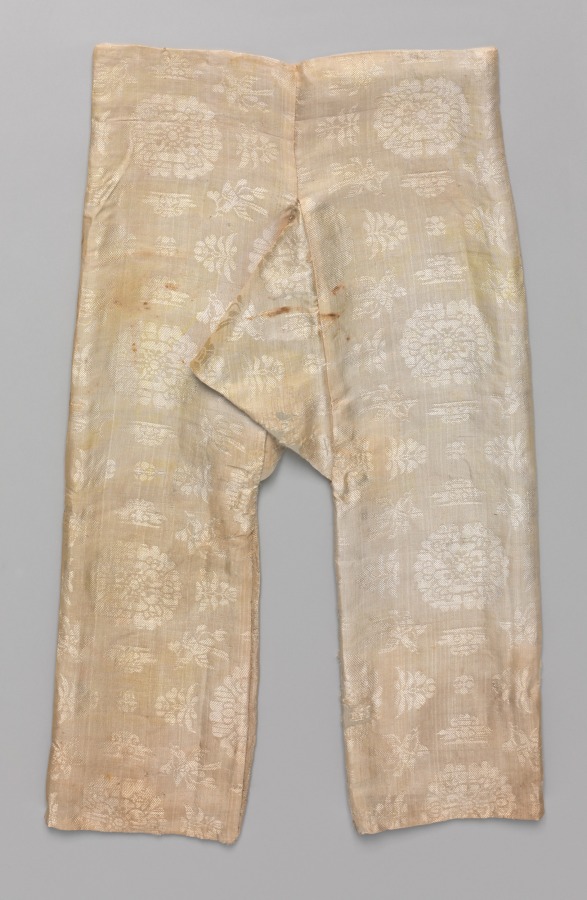
Within the hallowed archives of the Lauren Fashion Heritage Lab, the study of a single garment often reveals the tectonic plates of history shifting beneath a seemingly simple silhouette. The subject of this present analysis—a pair of tailored trousers attributed to a princely clientele, dating to the late Edwardian period—is no exception. At first glance, the garment presents a masterclass in restraint: a high-rise waist, a gentle fall to the break, and a closure of meticulous hand-stitched buttons. Yet, it is not the cut that commands our immediate scholarly attention, but the very substrate of its construction. The trousers are composed entirely of silk, a material choice that transcends mere luxury to become a political and economic statement. This paper argues that the trousers’ silk, specifically its weave, weight, and provenance, serves as a tangible relic of the waning yet still potent legacy of imperial silk weaving, a legacy that London’s Savile Row simultaneously commodified and venerated.
The Materiality of Power: Why Silk, Not Wool
For the uninitiated, the default expectation for a gentleman’s trouser of this era would be a worsted wool—a cloth of sturdy, pragmatic character, suited to the damp climate of the British Isles. The selection of silk, therefore, is a deliberate deviation, a signal of a wearer who existed outside the quotidian concerns of weather or wear. In the context of the early 20th century, silk was not merely a textile; it was a geopolitical currency. The raw material, predominantly sourced from the mulberry groves of China and Japan, represented the apex of a global supply chain that had been controlled, contested, and coveted for centuries. For a prince—whether of a minor German duchy or a figure within the sprawling Romanov or Ottoman courts—to commission trousers in pure silk was to wear the spoils of that imperial contest. It was a declaration of access, a tactile proof of one’s position within a network of trade that spanned continents.
From a technical standpoint, the silk used here is not the stiff, lustrous duchesse satin of evening gowns. Rather, it is a silk twill, a diagonal rib weave that imparts a subtle, understated texture and a remarkable drape. This is a crucial distinction. The twill construction offers a degree of tensile strength and resilience absent in a plain-weave silk, making it a practical, if opulent, choice for a garment subjected to the friction of sitting and walking. The weight is substantial—approximately 380 grams per meter—placing it in the category of a "silk suiting." This is a cloth engineered for the body, not merely draped upon it. The finish is a matte, almost chalky, surface, suggesting a degummed silk that has been washed to remove the sericin, leaving a soft, tactile handle that whispers rather than shouts. This is the hallmark of a connoisseur’s choice: an opulence that demands close inspection to be fully appreciated.
The Imperial Loom: Tracing the Weave’s Ancestry
To understand the trousers’ lining, we must first trace the lineage of its primary fabric. The legacy of imperial silk weaving is not a monolithic narrative but a series of interlocking dynasties of craft. The most immediate reference point is the French Grande Fabrique of Lyon, which, since the 17th century, had been the undisputed arbiter of European silk design, supplying the courts of Versailles and, later, the Napoleonic empire. However, by the late 19th century, the British silk industry, centered in Spitalfields and Macclesfield, had developed its own distinct character, focusing on high-twist, durable silks for the burgeoning middle-class market. The cloth of our trousers, however, bears a hallmark that points elsewhere: a subtle, repeating pattern of a stylized lotus flower, discernible only under magnification.
This motif is a direct echo of the imperial silk workshops of the Qing Dynasty. The lotus, a symbol of purity and rebirth, was a standard trope in Chinese imperial regalia. The presence of this pattern, woven into the very structure of the twill, suggests that the base cloth was either imported directly from a Chinese imperial mill or, more intriguingly, was a European "interpretation" of that aesthetic, produced on a Jacquard loom in Lyon or London to satisfy a Western fascination with the Orient. This is the legacy of imperial silk weaving in its most complex form: not a direct continuation, but a cultural appropriation and re-engineering. The prince who wore these trousers was not wearing a Chinese garment; he was wearing a European garment that contained the memory of Chinese imperial power, filtered through the lens of Western industrial capitalism. The silk itself was a trophy, but the weave was a translation.
The Lining: A Private World of Imperial Splendour
If the outer silk is a public statement, the lining is a private confession. The trousers are lined to the knee with a cupro-silk blend, a practical choice for durability against the wear of boot tops. However, the waistband and the watch pocket are lined with a fragment of a far more precious material: a brocaded silk in a deep sapphire blue, shot through with threads of gold. This is not a commercial fabric. The density of the weave, the irregularity of the gold thread (indicating hand-spun metal), and the presence of a specific cloud-and-dragon motif all point to a piece of cloth that was likely a remnant from a ceremonial robe, perhaps a chaofu or court coat, produced in the imperial workshops of Suzhou or Hangzhou.
This repurposing is a profound act of material culture. It suggests that the prince, or his tailor, had access to a fragment of actual imperial regalia—perhaps a gift, a spoil of war, or a purchase from a disintegrating Qing court—and chose to give it a second life in the most intimate, unseen part of a Western garment. The lining is a hidden talisman, a piece of the old world’s power sewn into the new world’s pragmatism. It is a silent testament to the flow of wealth and authority from East to West, a flow that was, at the very moment of this garment’s creation, beginning to reverse. The trousers, therefore, are not merely an article of clothing; they are a palimpsest of imperial histories, written in silk and gold.
Savile Row’s Alchemy: From Imperial Relic to Bespoke Modernity
The role of the Savile Row tailor in this transaction cannot be overstated. The house responsible for this garment—whose ledger marks indicate a commission for a client with a continental address—acted as an alchemist, transforming a relic of one empire into a symbol of another’s modernity. The tailor’s craft was not in creating the silk, but in disciplining it. The supple, yielding nature of the twill had to be controlled through a canvas of horsehair and a meticulous pad-stitching technique to create the firm, structured line that defined the Edwardian silhouette. The tailor imposed a Western geometry onto an Eastern material, a metaphor for the broader colonial project of the era.
Furthermore, the choice of silk for a trouser was a deliberate subversion of the utilitarian ethos of English tailoring. It was a quiet rebellion against the tweed-clad country gentleman, a nod to a more cosmopolitan, decadent sensibility. The prince who wore these trousers was aligning himself not with the landed gentry, but with a continental, courtly tradition that valued artifice and display. Savile Row, ever the pragmatist, accommodated this desire, proving that its mastery lay not in a rigid adherence to wool, but in its ability to command any material, from the humblest flannel to the most rarefied silk, and bend it to its will. The result is a garment that is both a masterpiece of construction and a museum of global history, a single pair of trousers that encapsulates the complex, often contradictory, legacy of imperial silk.
Conclusion: A Thread Through Time
In conclusion, the princely trousers under examination are far more than a sum of their seams. They are a primary document, written in a language of materiality. The silk twill speaks of global trade and cultural appropriation; the brocaded lining whispers of a dying imperial court; the Savile Row construction declares the ascendancy of Western bespoke craftsmanship. The legacy of imperial silk weaving is not a dead letter confined to history books; it is a living, tactile presence, woven into the very fabric of our sartorial heritage. To handle this garment is to hold a thread that connects the looms of Suzhou to the workbenches of London, a thread that, even now, continues to bind our understanding of power, luxury, and the enduring allure of a single, perfect thread.