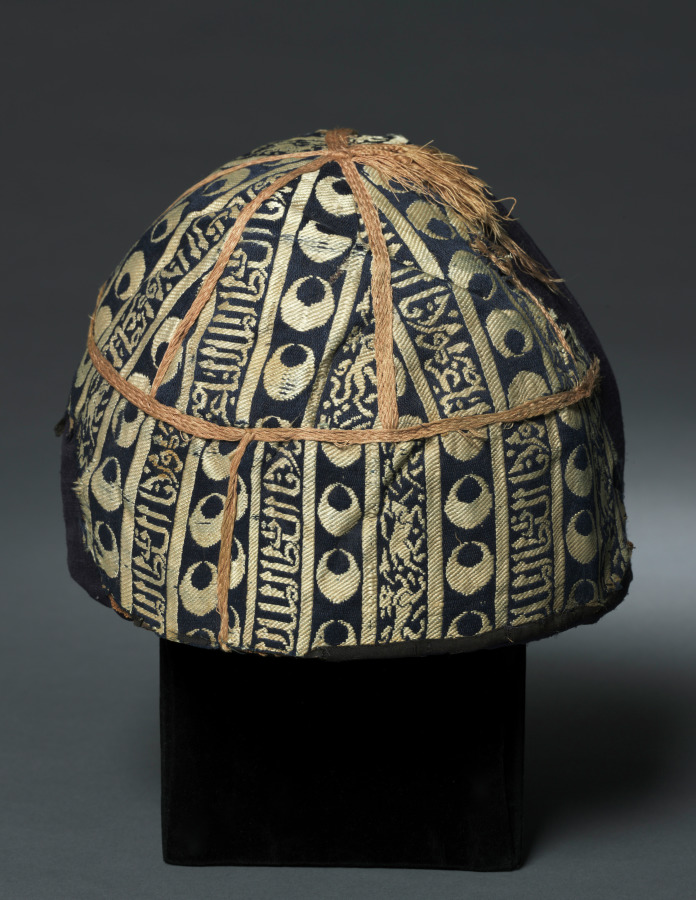
An Artifact of Imperial Lineage: The Cap with Striped Inscribed Silk
Provenance and Material Presence
Within the hushed, wood-panelled archives of Lauren Fashion Heritage Lab, we encounter an object that defies the ephemeral nature of fashion: a cap, unassuming in silhouette yet formidable in its material declaration. Constructed from striped inscribed silk, this piece is not merely a head covering; it is a palimpsest of imperial ambition, a textile document that speaks to the very genesis of luxury as we understand it in the West. The silk itself, with its subtle, repeating warp-faced stripes, is a testament to a weaving tradition that predates the industrial revolution by millennia. The “inscription,” rendered in a delicate, discontinuous supplementary weft, is not a modern logo but a classical marker of provenance—a woven signature that once denoted the loom house, the region, and the patron for whom the cloth was destined.
To handle this cap is to appreciate the profound difference between *fabric* and *cloth*. The former is a utilitarian product; the latter is a cultural artifact. The silk’s hand—its tactile resistance and fluid drape—reveals a filament reeled from the cocoon of *Bombyx mori* with a precision that borders on the obsessive. The stripes, far from being mere decoration, are a structural dialogue between the warp and weft, creating a rhythm that is both optical and physical. This is not the flimsy, mass-produced silk of the modern high street; this is a cloth of state, a material that once clothed emperors and their courts, carrying with it the weight of ceremony and the unspoken authority of the loom.
The Legacy of Imperial Silk Weaving
The context of this artifact is the legacy of imperial silk weaving, a lineage that stretches from the secretive mulberry groves of ancient China to the grand ateliers of Lyon and Spitalfields. For centuries, silk was not merely a commodity; it was a diplomatic currency, a religious offering, and a symbol of sovereign power. The technical mastery required to produce a cloth with such precise striping and intricate inscription was a closely guarded state secret. The weavers were not artisans in the modern sense; they were custodians of a sacred craft, their skills passed down through generations, their output reserved for the highest echelons of society.
This cap, therefore, is a fragment of that vast, silent history. Its striped pattern—a motif we might now associate with the understated elegance of a Savile Row suit—finds its antecedent in the formalized repetitions of imperial court dress. The inscription, which we might read as a mark of personalization, echoes the imperial seals and reign marks that authenticated royal textiles. To wear such a cap was to participate in a visual language of power, to signal one’s place within a rigid hierarchy where cloth was a primary signifier of rank and allegiance. The very act of wearing it was a performance, a silent assertion of connection to the throne and its divine mandate.
From Imperial Court to Savile Row: A Dialogue of Restraint
It is here, in the transition from the imperial court to the discerning clientele of London’s Savile Row, that the true resonance of this artifact emerges. The Row, with its ethos of understated luxury and bespoke precision, shares a philosophical kinship with the imperial weavers. Both traditions reject ostentation in favor of subtlety; both prize the integrity of the material and the perfection of the cut over fleeting trends. The striped silk of this cap, with its quiet authority, would not look out of place in a contemporary Mayfair boardroom, yet its provenance imbues it with a gravitas that no modern fabric can replicate.
The Savile Row tailor understands that true luxury is not about shouting; it is about whispering with authority. This cap whispers. Its stripes are not loud; they are a quiet cadence. Its inscription is not a brand; it is a signature of a lost world. In this sense, the cap serves as a bridge between two distinct but kindred philosophies: the imperial mandate of the East and the gentlemanly restraint of the West. Both recognize that cloth is a form of armor, a means of projecting an identity that is both personal and profoundly social. The cap is a lesson in the enduring power of material culture—a reminder that the clothes we wear are never neutral; they are always speaking, even when we are silent.
Preservation and the Contemporary Gaze
As a heritage artifact, this cap presents a unique challenge to the modern conservator and curator. Its value lies not in its pristine condition but in its evidence of use and its narrative density. The slight fading of the silk, the subtle distortion of the crown, the faint traces of wear at the brim—these are not defects; they are the physical records of a life lived. They invite us to imagine the individual who wore it, the occasions it attended, the hands that adjusted its fit. To preserve this cap is to preserve not just a textile but a story, a moment in the long and complex history of human adornment.
For the contemporary designer and the discerning consumer, this artifact offers a profound counter-narrative to the disposable culture of fast fashion. It reminds us that quality is a function of time, skill, and intention. The striped inscribed silk of this cap is not a trend; it is a standard. It challenges us to consider the provenance of our own clothing, to ask who wove it, who wore it, and what story it will tell when it passes to the next generation. In an age of digital reproduction and synthetic mimicry, this cap stands as a testament to the irreplaceable value of the authentic, the handcrafted, and the historically significant. It is, in the truest sense, a piece of wearable heritage—a legacy stitched in silk and time.