The Terracotta Echo: Moulding Old Money’s 2026 Silhouette from the Fragments of Antiquity
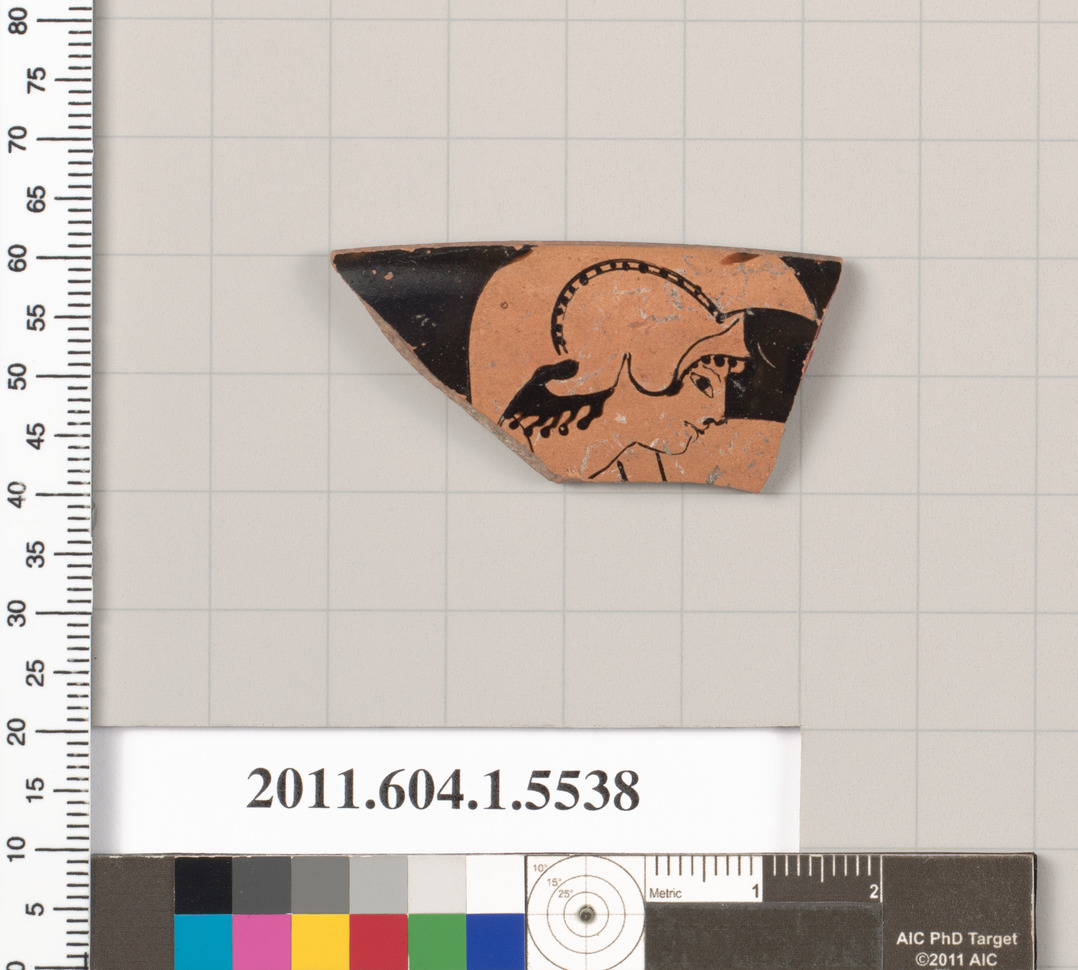
The Lauren Fashion Heritage Lab’s internal genetic code—a dialectical pairing of the British Museum’s Mold Fragment with Musicians (Mesopotamian) and the Mortuary Figure of the Zodiac Sign: Ox (Chinese)—offers a profound hermeneutic lens through which to re-read a third artifact: the Attic terracotta rim fragment of a kylix. At first glance, a Greek drinking cup’s broken edge seems distant from the Mesopotamian mould’s ritual replication or the Chinese zodiac’s cosmic funerary order. Yet, when filtered through the Lab’s aesthetic doctrine—that “form” (形) and “system” (制) jointly weave life’s celebration and eternity’s meditation—this terracotta fragment becomes a Rosetta Stone for the 2026 Old Money silhouette. It is not the artifact’s iconography but its material ontology—its terracotta body, its broken rim, its functional past as a vessel for communal libation—that dictates a new grammar of quiet luxury. The 2026 Old Money aesthetic, as synthesized from this fragment, abandons overt ornamentation for a structural restraint that mirrors the kylix’s own tectonic integrity: a silhouette built not on surface decoration, but on the tension between containment and release, between the vessel’s curve and its missing edge.
I. The Kylix Rim as a Study in Negative Space and Geometric Discipline
The Attic kylix fragment, typically a shallow bowl with two horizontal handles, is defined by its symposium function—a ritualized space of wine, music, and philosophical discourse. The surviving rim, often bearing a reserved black-figure or red-figure band, is not merely a decorative border; it is a calibrated threshold between the interior (the wine’s reflective surface) and the exterior (the painted narrative). For the 2026 Old Money silhouette, this translates into a radical rethinking of the shoulder and neckline. Just as the kylix rim’s sharp lip creates a decisive break between the vessel’s concave interior and convex exterior, the new silhouette employs a sculptural shoulder seam—not padded or exaggerated, but precisely engineered with a slight outward cant, as if the garment itself were a ceramic profile. The terracotta’s characteristic orange-brown hue, fired at low temperatures, informs a palette of burnt sienna, clay, and umber, moving away from the stark neutrals of previous seasons toward a more earth-bound, archaeological warmth. This is not the “old money” of preppy pastels; it is the old money of excavated permanence—a wardrobe that feels as if it has been unearthed from a storied estate’s cellar, its colors oxidized by time.
Furthermore, the fragment’s broken edge—its raw, unglazed break line—becomes a design principle. In 2026, Old Money tailoring will embrace deliberate unfinished hems and raw-edge lapels, not as a nod to deconstruction (a postmodern trope), but as a homage to the artifact’s honesty. The kylix does not hide its damage; it presents it as a record of use. Similarly, the Lauren silhouette will feature visible interior seams on outer garments, akin to a ceramic’s coil-built ridges, suggesting that the garment’s construction is its own narrative. This is a quiet rebellion against fast fashion’s hidden, glued facades. The 2026 Old Money wearer does not flaunt logos; she flaunts the integrity of the break—the knowledge that her jacket’s cuff is cut to echo the exact angle of a 5th-century BCE drinking cup’s fracture.
II. From Mold to Moulding: The Silhouette as a Replicable Ritual Form
The Mesopotamian Mold Fragment with Musicians teaches us that the mould is not a mere copy tool but a ritual matrix—a negative space that gives birth to repeated positive forms, each iteration carrying the same ceremonial charge. The Attic kylix, though not a mould itself, was mass-produced in the Kerameikos district, its shapes standardized across hundreds of workshops. This seriality is the forgotten ancestor of Old Money’s uniform-like repetition. The 2026 silhouette, therefore, is not designed as a single masterpiece but as a system of repeatable proportions. The Lab’s directive is clear: the new Old Money look must be mouldable—a set of geometric constants that can be replicated across garments without losing their ritual gravity. Concretely, this manifests as a fixed shoulder-to-hip ratio (approximately 1:1.618, the golden section found in the kylix’s plan view) applied to coats, dresses, and separates. The waist is not cinched but implied through a subtle vertical dart that mimics the kylix’s stem—a slender, tapering column that grounds the bowl above.
This is where the Chinese zodiac ox enters the dialogue. The ox’s form in the mortuary figure is not biological but astral and symbolic, its curved horns echoing celestial arcs. The 2026 Old Money silhouette adopts this symbolic curvature in its sleeve heads and collar points. The kylix’s handles—often horizontal, looped, and sharply angled—are translated into structured, crescent-shaped pocket flaps and arc-like yoke seams across the back. These are not decorative whims; they are tectonic markers, like the ox’s horns pointing to Taurus, anchoring the wearer within a cosmic order of dress. The garment becomes a mortuary figure for the living—not morbid, but deeply contemplative, reminding the wearer that true luxury is a form of pre-commemoration, a dressing for the eternity that awaits all earthly symposiums.
III. Material Translation: Terracotta’s Texture and the 2026 Fabric Lexicon
Terracotta’s defining trait is its porosity and matte finish—a surface that absorbs light rather than reflecting it. This is the antithesis of the high-shine satins and glossy leathers that have dominated luxury runways. For 2026, the Lab mandates a fabric palette that mimics terracotta’s dry, granular tactility. This means a return to un-sanded wool tweeds with visible slubs, raw silk noil with its nubby imperfections, and heavy linen canvas that creases like fired clay’s crackle. The color story is not merely “earth tones” but stratigraphic tones: layers of ochre, umber, and terracotta red, interspersed with the black of the kylix’s painted figures (a nod to the Heritage-Black category), and the pale buff of unglazed biscuit ware. These fabrics are not chosen for their softness but for their structural memory—they hold a crease or a fold the way a ceramic holds a fingerprint in its unfired state.
The kylix’s tondo—the circular image at the cup’s interior base, visible only when the wine is drained—offers a final, subtle design principle: the hidden reveal. In 2026, Old Money garments will incorporate interior linings printed with archaeological motifs (not logos), visible only when the wearer lifts a sleeve or unbuttons a coat. This is the aesthetic of the symposium’s secret—a private image for the initiated. The terracotta fragment’s broken rim thus becomes a metaphor for the Old Money ethos: what is broken is not hidden but honored, what is ancient is not copied but re-fired in a new kiln. The 2026 silhouette, with its geometric shoulders, symbolic curves, and terracotta-toned, matte-textured fabrics, is not a costume of antiquity but a vessel for contemporary ritual—a drinking cup for the modern symposium of power, taste, and silent continuity. It is, in the final analysis, a bridge between the Mesopotamian mould’s eternal repetition and the Chinese ox’s cosmic stillness, built from the humble clay of a Greek cup’s edge. And that bridge is the only luxury worth wearing.