← BACK TO ARCHIVES
Silk
Heritage Synthesis: Samite fragments with double-headed eagles, from the tomb of Saint Bernard Calvo
Curated on Aug 29, 2026 // Node: LDN-01
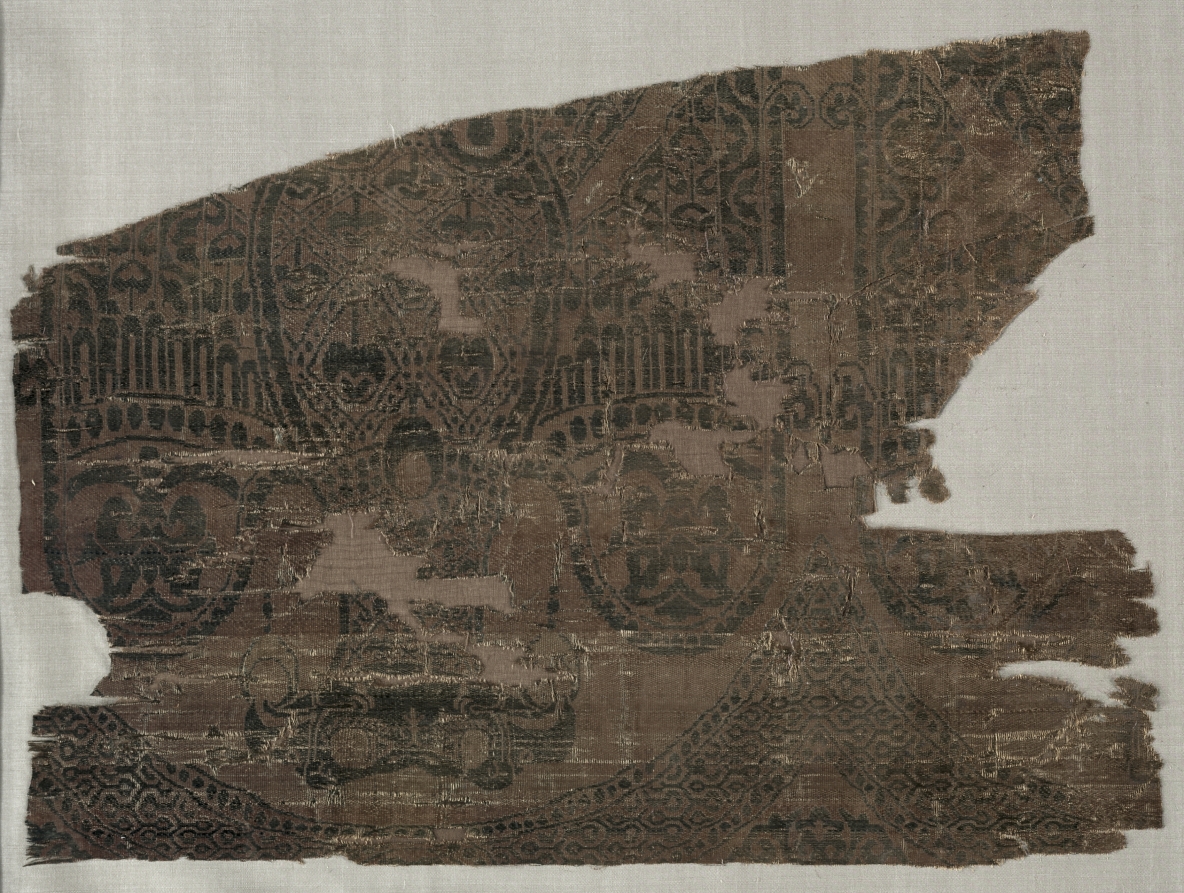
The Imperial Thread: Samite Fragments of Saint Bernard Calvo
In the hushed, climate-controlled vaults of ecclesiastical treasuries, one encounters objects that transcend mere textile classification. The samite fragments recovered from the tomb of Saint Bernard Calvo, Bishop of Vich in Catalonia, are not simply remnants of medieval luxury; they are a material testament to the enduring political and artistic authority of the Byzantine Empire, woven into the very fabric of Western Christendom’s spiritual life. These fragments, preserved not by design but by the sanctity of their burial context, offer a rare, tactile connection to a world where silk was not merely cloth, but a diplomatic currency, a sacred offering, and a statement of imperial supremacy.
Materiality and the Language of Silk
The term *samite* itself, derived from the Greek *hexamiton* (meaning "six threads"), denotes a heavy, luxurious silk weave of twill construction. Unlike the simpler tabby weaves of everyday textiles, samite’s dense, compound structure allowed for the creation of intricate, polychromatic patterns. The fragments from Saint Bernard’s tomb are executed in a palette of deep, resonant hues—faded madder reds, indigo blues, and the unmistakable shimmer of gold-wrapped threads. The gold, drawn into fine lamella and wound around a silk core, was not merely decorative. It was a deliberate assertion of divine and imperial light, a material metaphor for the uncreated radiance of the Byzantine court, both earthly and celestial.
The weave itself is a marvel of technical sophistication. The warp-faced twill structure, with its floating wefts, creates a surface that is at once durable and remarkably supple. The pattern, rendered in a repeating motif of double-headed eagles, is not printed or embroidered but woven directly into the fabric’s structure. This is a crucial distinction. The design is intrinsic to the cloth’s very being, a testament to the skill of the Constantinopolitan weavers who controlled the production of such imperial-grade silks. The double-headed eagle, a heraldic symbol of immense potency, signifies the dual sovereignty of the Byzantine Emperor—over both the Eastern and Western spheres of the Roman inheritance. Its presence on a textile destined for the tomb of a Catalan bishop is no accident; it is a deliberate, albeit silent, political statement.
Context: The Legacy of Imperial Silk Weaving
To fully appreciate these fragments, one must understand the monopolistic control the Byzantine Empire exerted over sericulture and silk weaving for centuries. From the time of Justinian, who famously smuggled silkworm eggs from China, Constantinople became the undisputed center of the luxury textile trade. The *gynaecea*, the imperial weaving workshops, produced fabrics of such quality and symbolic complexity that they were strictly regulated. The use of specific colors, particularly Tyrian purple, and specific motifs, such as the double-headed eagle, was reserved for the imperial family and those upon whom the Emperor chose to bestow his favor.
These silks were not commodities in the modern sense. They were diplomatic gifts, political tools, and sacred offerings. When a Western monarch or a high-ranking prelate received a gift of imperial silk, they were not merely receiving a beautiful object; they were being incorporated, symbolically, into the Byzantine sphere of influence. The presence of such a textile in the tomb of Saint Bernard Calvo, who died in 1243, suggests a profound connection. It is plausible that the silk was a gift from the Latin Emperor of Constantinople, Baldwin II, or perhaps a diplomatic offering from the Nicaean Empire, which sought Western alliances against the Latin occupiers. The bishop, as a figure of considerable regional authority, would have been a worthy recipient of such imperial largesse.
The journey of these fragments from the imperial workshops of the Bosphorus to a Catalan tomb is a narrative of medieval connectivity. It speaks to the complex web of trade routes, diplomatic missions, and ecclesiastical networks that linked the Mediterranean world. The silk would have traveled by ship, perhaps from Constantinople to Venice or Genoa, and then overland through the Rhone Valley into the Iberian Peninsula. Its final resting place, tucked within the vestments or wrappings of a venerated bishop, transformed it from a symbol of earthly power into a relic of spiritual significance. The double-headed eagle, once an emblem of imperial might, became a silent guardian over the saint’s remains, its gold threads catching the faint light of votive candles in the cathedral’s crypt.
Materiality as Historical Document
For the heritage specialist, these fragments are a primary source of extraordinary value. They offer empirical evidence of the technical capabilities of Byzantine weavers, the trade networks of the thirteenth century, and the cultural transmission of imperial iconography. The condition of the silk—its fading, its fraying, its very fragility—is itself a form of information. The degree of wear suggests that the textile was used, perhaps as a pall or a ceremonial hanging, before being repurposed for the bishop’s burial. This secondary use is a poignant reminder that in the medieval world, objects were not static; they were living, functional entities with their own biographies.
The choice of the double-headed eagle motif is particularly telling. By the thirteenth century, this symbol had been adopted by various Western powers, including the Holy Roman Empire. However, the specific rendering on these fragments—the stylized feathers, the rigid heraldic posture, the use of gold-wrapped thread—is unmistakably Byzantine in origin. It is a product of the imperial *ateliers*, and its presence in Catalonia underscores the enduring prestige of Constantinopolitan craftsmanship even as the empire itself was in political decline. The silk, in a sense, outlived the empire that produced it, becoming a lasting testament to a legacy that transcended borders and centuries.
In conclusion, the samite fragments from the tomb of Saint Bernard Calvo are far more than archaeological curiosities. They are a material embodiment of the complex interplay between power, faith, and artistry in the medieval world. They speak to the enduring influence of Byzantine silk weaving, a legacy that shaped the aesthetic sensibilities of Europe and continues to inform our understanding of medieval luxury. To hold such a fragment, even through the glass of a museum case, is to touch a thread that connects us directly to the imperial past—a past woven in silk, gold, and the enduring symbolism of the double-headed eagle.
Heritage Lab Insight
Lab Insight: CMA Silk Archive Node integration.