A Treatise on the Hwarot: Imperial Silk and the Architecture of Ceremony
To consider the bridal hwarot is to engage not merely with a garment, but with a profound statement of legacy, woven from the very fibre of statecraft and social order. It represents a pinnacle of sartorial engineering, where the material—imperial-grade silk—is inseparable from its message. The cloth is the contract; the weave, the covenant. Our examination, therefore, begins not at the hem, but at the loom of history, in the rarefied ateliers where silk transcended commerce to become currency of the court.
The Foundation: Silk as a Instrument of State
One must first apprehend the foundational truth: in the Joseon context, silk was never simply a textile. It was a meticulously regulated instrument of governance. The Jujagwon, the Royal Silk Weaving Bureau, operated with a precision and exclusivity that would be recognised in any bespoke establishment of consequence. It dictated the hierarchy of weave, colour, and motif with an edict as firm as any legal code. This was sartorial law. The finest silks—those of a weight, lustre, and complexity deemed suitable for the royal family and the highest echelons of the yangban aristocracy—were, by their very existence, declarations of authority. To clothe a bride in such material was to drape her in the visible, tangible essence of lineage and sanctioned power. The silk of the hwarot was, in every sense, the legacy of imperial weaving made manifest.
The Architecture of the Garment: Form Dictated by Function and Symbolism
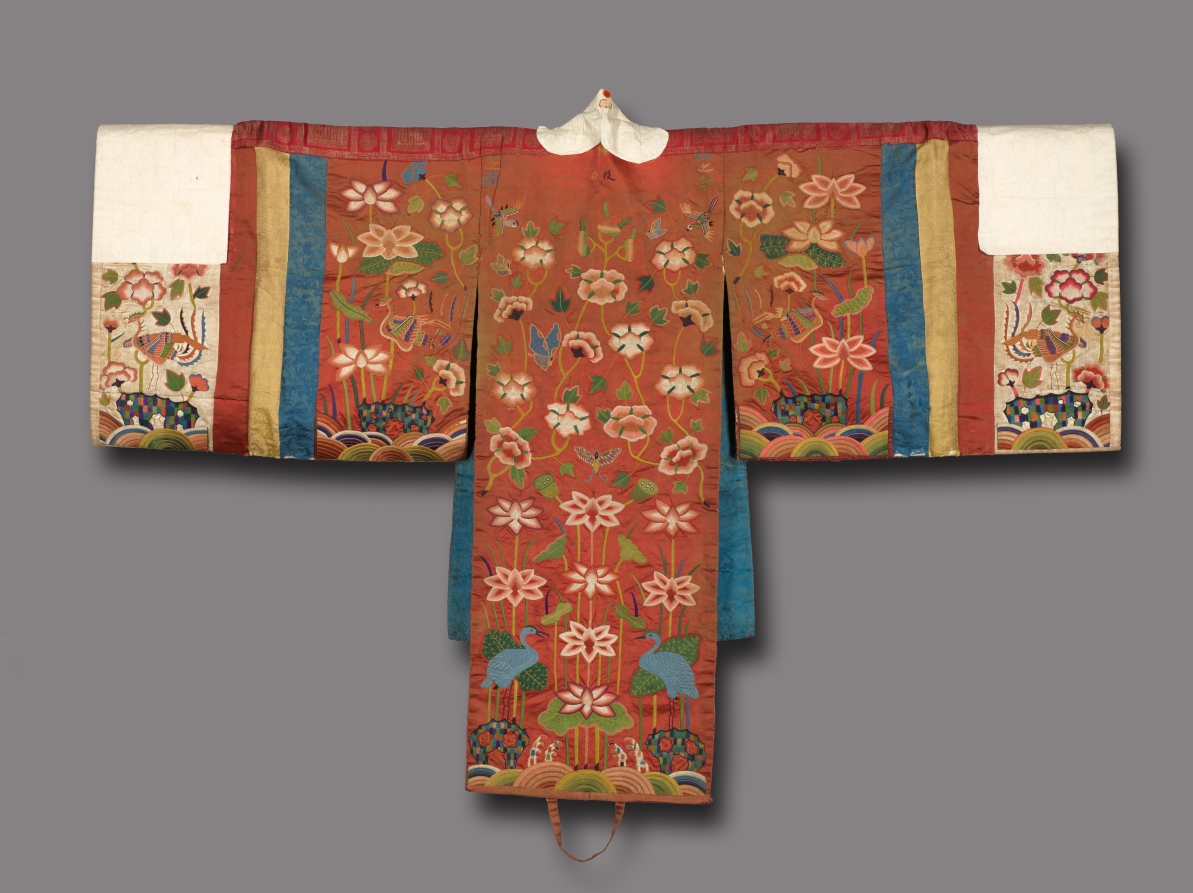
The hwarot’s construction is a masterclass in purposeful design. Its defining characteristic—the sweeping, wing-like sleeves—is no whimsical flourish. These are architectural elements, designed for the theatre of ceremony. In motion, they create a silhouette of majestic breadth, a visual amplification of the bride’s transition. They are canvases, and upon them is painted a cosmology of hope. The traditional motifs are not decorative; they are heraldic. The paired mandarin ducks (won-ang), eternally faithful; the peonies, blooming with prosperity and honour; the phoenixes, rising in auspicious rebirth—each is a stitch in a narrative of continuity. This symbolism is rendered in embroidery so dense it becomes a form of low-relief sculpture, a textural counterpoint to the fluid ground of silk. The garment is heavy, deliberately so. Its weight is a physical reminder of the gravity and substance of the union it celebrates.
A Palette of Authority: The Chromatic Code
Colour, here, is a strict language. While later iterations saw the introduction of vibrant hues, the most authoritative hwarot, particularly those with courtly connections, adhered to a rigorous chromatic code. The predominant crimson, derived from precious safflower or sappanwood dyes, was more than festive. It was apotropaic, a shield against malign forces at a vulnerable threshold of life. This red spoke of vitality, of bloodlines, and of a protective vigour. Its application was never flat; the genius of the dyer’s art ensured it held depth, a luminous quality that caught the light differently at each drape. Accented with the azure of kingfisher feathers or the gold of couched thread, the colour scheme was a balanced assertion—both passionate and dignified, a perfect allegory for the conjugal and social compact being entered into.
The Modern Legacy: A Question of Patrimony in Thread
In the contemporary atelier, the hwarot presents a fascinating dilemma of heritage. The true, court-sanctioned silks and the painstaking techniques of the jujagwon are a patrimony largely confined to museums and a handful of designated Living National Treasures. The modern interpretation, therefore, operates in a space between reverence and adaptation. The question becomes: how does one honour the architectural integrity and symbolic lexicon of the original while acknowledging a changed world? The answer lies in a philosophy akin to that of a modern bespoke tailor respecting the cut of a Victorian frock coat. The silhouette—the sweeping sleeves, the elongated line—remains sacrosanct, the essential grammar of the form. The silk, while perhaps not from royal looms, must possess a commensurate dignity: a heavyweight habotai with a substantive hand, a crisp organza for structured volume, or a duchess satin that holds colour with a regal depth.
The embroidery, the most time-intensive element, is where patrimony is most acutely felt. The choice between the sublime, minute perfection of hand-embroidery—a fading art of immense cost—and the precision of modern technical aids is a fundamental one. The former is an heirloom process, the latter a pragmatic translation. Yet, even within adaptation, the symbolic language must remain coherent; the motifs are not to be played with lightly, for they are the very text of the garment.
Conclusion: The Garment as Covenant
Ultimately, the bridal hwarot endures because it is a garment of profound literacy. It is woven from the threads of history, coloured by the codes of state, and embroidered with the hopes of a lineage. Its materiality—the imperial silk—is the bedrock of its meaning. To commission or study a hwarot today is to engage in a dialogue with that legacy. It is to understand that this is not a dress for a day, but a covenant in cloth, a ceremonial shell constructed to armour and celebrate a pivotal human transition. In its weight, its symbolism, and its majestic sweep, it asserts that some traditions are too significant to be merely worn; they must be inhabited, with all the gravity and hope that their legacy demands.