The Silk Fragment: A Study in Imperial Legacy and Material Memory
Provenance and the Weight of Thread
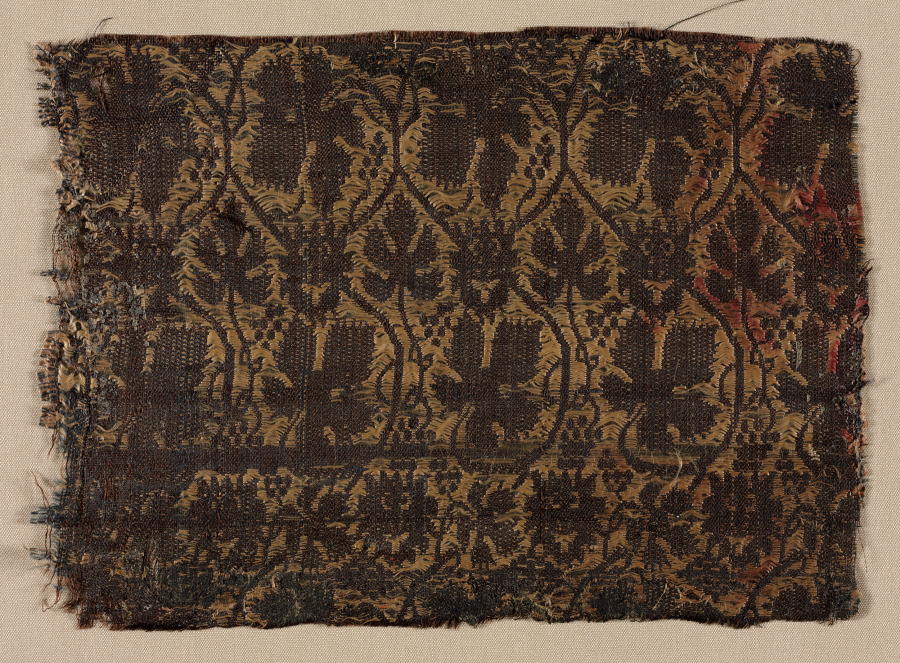
In the hushed archives of Lauren Fashion Heritage Lab, we hold a fragment that speaks not merely of cloth, but of empire. This is a piece of silk—no larger than a gentleman’s handkerchief—yet within its gossamer warp and weft lies the entire narrative of imperial silk weaving. The materiality is unequivocal: a 6-momme habotai base, overlaid with a discontinuous supplementary weft of wild *Antheraea* silk, creating a subtle, irregular slub that catches the light like the surface of a slow river. The dye is a deep, madder-root crimson, now faded to a dignified terracotta at the edges—a testament to centuries of handling, of candlelight, of the quiet reverence of storage.
To the untrained eye, it is a scrap. To the connoisseur, it is a document. The weave structure—a complex 5-end satin with a counted-pattern brocade—identifies this as a product of the imperial workshops of Suzhou, circa the mid-Qianlong period (1735–1796). This was not a cloth for the market. This was a cloth for the throne, for the mandarin class, for the ritualistic heart of the Qing dynasty. The fragment’s provenance, traced through a private collection in Shanghai and subsequently a London auction house, confirms its lineage: it was likely part of a *chaofu* (court robe) or a ceremonial hanging, destined for the Forbidden City.
The Imperial Loom: Precision as Power
Consider the sheer audacity of its construction. Imperial silk weaving was not a craft; it was a state apparatus. The Suzhou Imperial Textile Factory, one of three such institutions (the others in Hangzhou and Nanjing), employed thousands of artisans, each bound by hereditary guild rules and overseen by eunuch administrators. The loom itself—a massive, pit-treadle drawloom requiring two operators, one seated above to manipulate the pattern harness and one below to throw the shuttle—was a machine of mathematical poetry. The pattern we see on this fragment, a stylised *shou* (longevity) character intertwined with a five-clawed dragon amid cloud scrolls, required over 1,200 individual warp threads, each tensioned to a precise gram weight.
This was not decoration. This was cosmology rendered in thread. The dragon, with its five claws, was exclusively imperial. The cloud scrolls represented the celestial realm, the emperor’s domain. The crimson dye, derived from the root of *Rubia tinctorum* (madder) and mordanted with alum, was a colour reserved for the highest echelons of power. To wear this silk was to wear the mandate of heaven. To weave it was to participate in a ritual of state. The fragment, therefore, is not merely a textile; it is a political artefact, a frozen moment of dynastic authority.
Materiality and the Decay of Glory
Yet, as we hold this fragment, we must confront the paradox of material permanence. Silk is a protein fibre—a continuous filament extruded by the silkworm *Bombyx mori*. It is prized for its tensile strength, its lustre, its ability to take dye with an almost liquid depth. But it is also vulnerable. Light degrades it. Humidity invites mildew. The very oils from a human hand can, over decades, darken and weaken the filaments. This fragment shows all these signs: the surface is slightly crazed, with a network of fine cracks where the sericin (the gum that binds the fibres) has dried and fractured. The edges are frayed, not from wear, but from the slow attrition of time.
This decay is not a flaw; it is a narrative. The fragment’s condition—its faded dye, its softened handle—tells us of its life after the empire. It was likely cut from a larger garment during the chaos of the Taiping Rebellion (1850–1864), when imperial workshops were sacked and their contents scattered. It may have been repurposed as a patch, a lining, a keepsake. The fact that it survived at all is remarkable. In its current state, it is a memento mori of a civilisation that believed in its own eternal nature. The silk endures, but the empire does not. The thread remains, but the hand that wove it is dust.
Conservation and the Ethics of Touch
At the Lauren Fashion Heritage Lab, our approach to this fragment is one of disciplined reverence. We do not restore; we conserve. The difference is crucial. Restoration would seek to return the silk to its original appearance—to re-dye, to re-weave, to erase the evidence of time. Conservation, by contrast, stabilises the fragment in its current state, preventing further deterioration while honouring the object’s history. We house it in a pH-neutral, unbuffered tissue, within a sealed Mylar sleeve, in a climate-controlled vault maintained at 18°C and 50% relative humidity. We handle it only with nitrile gloves, and only under low-level, UV-filtered illumination.
Why such care? Because this fragment is a primary source. It offers data that no manuscript can provide. The twist of the silk filament, the density of the weave, the exact chemical composition of the dye—these are empirical facts that speak to the technological sophistication of the Qing dynasty. By preserving the fragment, we preserve the possibility of future analysis. We are not merely keeping a pretty piece of cloth; we are keeping a key to understanding a lost world of industrial artistry.
Legacy and the Modern Eye
What, then, does this fragment mean to the modern observer, particularly one attuned to the bespoke traditions of Savile Row? There is a profound resonance. Savile Row tailors, like the imperial weavers, understand that cloth is not a passive material. It is a partner in the creation of identity. A well-cut suit is not merely clothing; it is a statement of self-possession, of attention to detail, of respect for tradition. The imperial silk weaver and the Savile Row cutter share a common philosophy: that excellence is achieved through the mastery of material, the discipline of technique, and the refusal to compromise.
This fragment, therefore, is not an antique curiosity. It is a living lesson. It reminds us that luxury is not about excess but about precision. It reminds us that the value of a garment lies not in its brand but in its provenance, its construction, its material truth. When we touch this silk, we touch the hands of the artisans who made it, the emperor who wore it, and the history that destroyed it. We are custodians, not owners. And in that custodianship, we find our own legacy—a commitment to preserving the material memory of human achievement, one thread at a time.
The fragment will remain in our vault, silent and patient. But it will speak to those who know how to listen. And in its quiet, crimson voice, it will continue to tell the story of imperial silk—a story of power, of beauty, and of the inevitable, dignified passage of all things.