← BACK TO ARCHIVES
Heritage-Black
Heritage Synthesis: Terracotta fragment of a kylix (drinking cup)
Curated on Aug 29, 2026 // Node: LDN-01
The Dialectics of Containment: Terracotta Fragmentation and the 2026 Old Money Silhouette
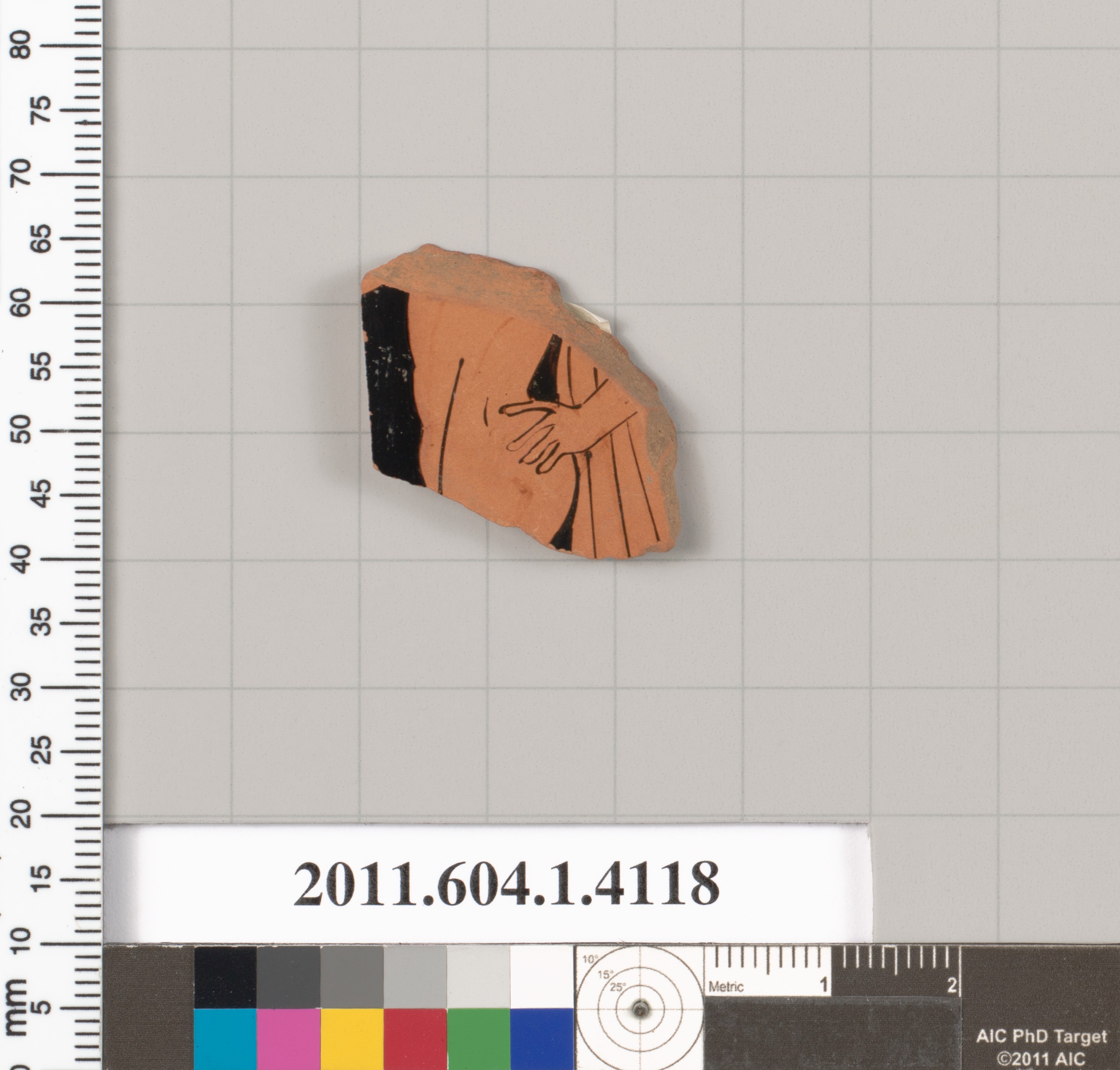
The internal genetic code of Lauren Fashion Heritage Lab—rooted in the visual interrogation of spiritual and material paradox—finds an unexpected yet profound resonance in a fragment of an Attic kylix, a Greek terracotta drinking cup. At first glance, this shard of a symposion vessel appears distant from the Buddhist temple plaque and the painted garment chest that anchor our Eastern aesthetic lineage. Yet, when read through the lens of “空性” (emptiness) and “实在” (substantiality), this terracotta fragment becomes a critical hermeneutic tool for decoding the 2026 Old Money silhouette. The kylix, like the Udumbara flower plaque, is an object of *containment*—not of sacred truth, but of social ritual. Its broken state, however, transforms it from a vessel of use into a relic of *duration*, a visual paradox that directly informs how we drape, cut, and finish garments for the coming season.
The Fragment as a Temporal Aesthetic
The terracotta kylix, in its original form, was a low, wide bowl designed for communal drinking—an object of horizontal circulation, much like the painted flowers on the garment chest that “水平蔓延,拥抱人性.” Its painted figures, typically red-figure or black-figure, depicted gods, athletes, and revelers in states of ecstatic presence. But what remains is a fragment: a broken rim, a piece of a handle, a section of a tondo. This is not a loss; it is an *aesthetic compression*. The fragment performs the same rhetorical operation as the Udumbara flower carved on the temple plaque—it freezes a moment of “即将绽放” (about to bloom) into a permanent state. The kylix no longer holds wine; it holds *absence*. The viewer’s eye completes the circle, imagining the full vessel, the symposium, the laughter. This act of imaginative completion is precisely the mechanism of Old Money dressing in 2026: the silhouette must suggest a totality that is never fully revealed.
For the 2026 Old Money silhouette, this translates into a deliberate *incompleteness* in construction. We are not designing garments that are merely tailored; we are designing garments that *imply* a history of wear, of repair, of quiet accumulation. The terracotta fragment teaches us that true luxury is not in the pristine, but in the *patina of the partial*. A jacket shoulder that sits slightly off—not as a mistake, but as a nod to a hand-finished garment that has been worn by generations. A hem that falls with a subtle irregularity, echoing the broken edge of the kylix. This is not deconstruction in the postmodern sense; it is *reconstruction through memory*. The Old Money customer does not buy a new coat; she inherits a *condition*.
From Symposion to Silhouette: The Horizontal and the Vertical
The kylix’s form is fundamentally horizontal—a shallow bowl that extends outward, inviting communal reach. This horizontal axis contrasts with the verticality of the temple plaque, where the Udumbara flower rises toward the divine. In the 2026 Old Money silhouette, we must synthesize these axes. The terracotta fragment suggests a broadening of the shoulder line and a softening of the waist—not the aggressive power shoulder of the 1980s, but a *reclined width*, as if the garment itself were a vessel resting on a table. Think of a cashmere overcoat with a dropped shoulder and a gently flared skirt that moves like the tondo of a kylix when the wearer turns. This is not a silhouette that commands a room; it is a silhouette that *holds* a room, like a cup waiting to be filled with conversation.
The internal code’s reference to “器以载道” (the vessel carries the Way) is crucial here. The kylix was not merely a drinking vessel; it was a carrier of *social ethics*—the rules of the symposium, the hierarchy of seating, the moderation of wine. In 2026, the Old Money garment must carry a similar ethical weight. The silhouette must communicate *restraint* and *competence*. A terracotta-informed palette—burnt sienna, ochre, deep umber, and the black of the figure painting—becomes the foundation. These are not loud colors; they are *earth tones that have absorbed centuries of light*. The fabric, whether wool or brocade, should have a matte finish, never a sheen, because the fragment’s surface is unglazed, porous, and honest.
The Paradox of the Broken Vessel and the Whole Garment
The most radical lesson from the terracotta fragment is the *legitimacy of the break*. In Western fashion, a flaw is a defect. In the Eastern aesthetic code we have internalized, the crack is a site of *wabi-sabi*—the beauty of impermanence. The kylix fragment, displayed in a museum, is not a tragedy; it is a *curated truth*. For the 2026 Old Money silhouette, this means we must design for *graceful degradation*. A garment should not be engineered to last forever in a static state; it should be engineered to *age beautifully*. The wool will pill slightly; the silk will develop a subtle sheen at the elbows; the gold-thread embroidery will tarnish in a way that catches the light differently. These are not failures; they are the garment’s own “Udumbara moment”—a flowering that occurs only after three thousand days of use.
This is a direct challenge to the fast-fashion paradigm of disposability. The Old Money silhouette of 2026, informed by the kylix, is a *rebuttal to the new*. We will cut a coat with a slightly longer sleeve, not for fashion, but to allow for the cuff to be turned back, revealing a different lining—a hidden layer, like the interior of the kylix that was never fully seen. We will line a jacket with a brocade that echoes the painted figures of the Greek vessel, but abstracted into geometric forms, so that only the wearer knows the secret. This is the “空性” of the fragment: the garment is not what it appears to be; it is a vessel for the wearer’s own narrative.
Conclusion: The Fragment as a Whole Philosophy
The terracotta kylix fragment, when placed alongside the temple plaque and the garment chest, completes a triptych of containment. The plaque contains the divine; the chest contains the material; the kylix contains the social. All three are broken or partial in some way—the plaque’s flower is eternally unbloomed, the chest’s paintings are fading, the kylix is shattered. Yet each achieves a higher form of *presence* through its *absence*. For the 2026 Old Money silhouette, this is the ultimate directive: we do not design clothes; we design *vessels for time*. The shoulder is a fragment of a column; the skirt is a tondo of a cup; the color is the terracotta earth that has witnessed empires rise and fall.
The wearer of this silhouette is not a consumer; she is a *curator* of her own life. She understands that the true luxury of the Old Money aesthetic is not in the cost of the fabric, but in the *silence* the garment creates around her. Like the kylix fragment in its museum case, she is complete in her incompleteness. And in this, she finds the same peace as the devotee beneath the Udumbara plaque and the woman who opens her painted chest to fold away the day’s linen. The fragment teaches us that the whole is not the sum of its parts, but the *resonance* between them. This is the 2026 silhouette: a resonance, not a shape. A memory, not a trend. A vessel, not a display.
Heritage Lab Insight
Genetic Bridge: Archive node focusing on Heritage-Black craftsmanship.