← BACK TO ARCHIVES
Heritage-Black
Heritage Synthesis: Terracotta fragment of a kylix (drinking cup)
Curated on Aug 29, 2026 // Node: LDN-01
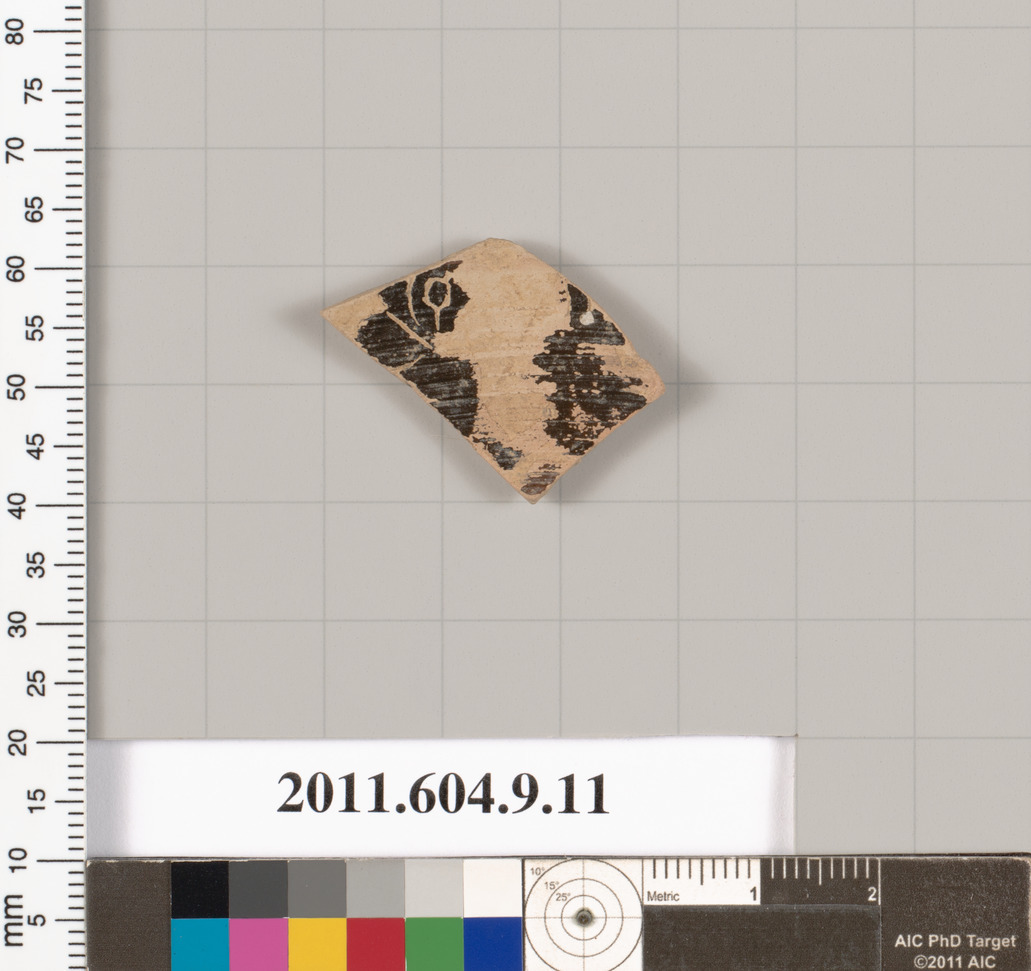
The Dialectics of the Void: Laconian Terracotta and the Architecture of Old Money Restraint
In the hushed ambivalence of a Kyoto temple, a wooden plaque inscribed “Udumbara Flowers” hangs opposite a porcelain “Cup and Stand,” together forming a silent koan about presence, absence, and the sacred economy of offering. The udumbara—a flower that blooms once every three millennia in Buddhist scripture—is rendered in carved wood so intricate that its petals seem to exhale. Across the room, the cup’s eggshell-thin body and lotus-like stand await not liquid, but a metaphysical infusion. These artifacts do not compete; they converse. Their shared thesis is that the most profound materiality is one that negates itself—that carves away its own substance to make room for the immaterial.
Now, consider a far older fragment: a terracotta shard of a Laconian kylix, a Greek drinking cup from the 6th century BCE. At first glance, this broken ceramic—utilitarian, unglazed, its painted figures faded to ghostly silhouettes—shares nothing with Kyoto’s refined devotional objects. Yet when placed within the lineage of Lauren Fashion’s heritage codes, this fragment becomes a crucial interlocutor. For the 2026 Old Money silhouette, the Laconian kylix is not a source of ornament but a blueprint for a specific kind of restraint—one that privileges structure over surface, volume over decoration, and the quiet power of what is left unsaid.
I. The Laconian Ethos: Severity as Status
Laconian pottery, produced in Sparta and its periphery, was anomalous among Greek ceramics. While Athenian vases exploded with red-figure drama, mythological frenzy, and ornamental excess, Laconian wares maintained a laconic austerity—a term, tellingly, derived from the region itself. The kylix fragment we hold reveals a shallow bowl, a low stem, and handles that flare with geometric precision. Its decoration, where it survives, is sparse: a band of dots, a single animal frieze, or a figure rendered in stark black against the clay’s natural ochre. This was not a failure of skill but a philosophical choice. Spartan culture valorized brevity, endurance, and the rejection of superfluity. A cup meant for communal libations was not a canvas for ego but a vessel for shared ritual.
This ethos of *severity as status* is the genetic ancestor of the Old Money aesthetic. Old Money does not announce itself through logos, embroidery, or chromatic excess. It asserts through cut, drape, and the invisible precision of construction. The 2026 silhouette, informed by this Laconian fragment, rejects the fast-fashion grammar of appliqué and slogan. Instead, it embraces the *negative space* of the garment—the way a shoulder seam falls, the exact drop of a trouser break, the unbroken plane of a cashmere overcoat. Just as the kylix’s value lies in its disciplined emptiness, the Old Money garment’s luxury lies in what it refuses to add.
II. Materiality and the Erasure of Self
The terracotta fragment’s surface—rough, porous, fired at low temperatures—speaks to a materiality that does not aspire to illusion. Unlike the Kyoto cup’s porcelain, which mimics the translucency of jade, or the udumbara plaque’s wood, which transforms into floral apparitions, Laconian terracotta remains stubbornly itself. It is earth, shaped and burned. This honesty is its nobility. In the 2026 Old Money context, this translates into a renewed reverence for *unfinished* or *raw* luxury: wool suiting that retains a slight tooth, linen that wrinkles with dignity, silk twill that whispers rather than shines. The fabric does not pretend to be anything other than what it is—yet its provenance, its weave density, and its finishing techniques are of museum-grade quality.
This is the paradox the kylix teaches: true refinement is the erasure of the maker’s ego, not the display of it. The Laconian potter did not sign his work. The Old Money garment, likewise, bears no external label. Its brand is legible only to those who know how to read the fall of a lapel or the hand-rolled edge of a buttonhole. The terracotta fragment, broken and incomplete, also reminds us that *imperfection* is a form of heritage. The 2026 silhouette will not be obsessed with pristine newness. Instead, it will embrace the *patina of use*—a slightly faded herringbone, a softened collar, a pair of loafers whose leather has molded to the foot. This is not decay; it is the material accumulating time, much like the udumbara plaque’s worn edges, which anchor the ephemeral flower in the thickness of history.
III. The Cup as Architecture: Volume, Void, and the Body
The Laconian kylix is fundamentally an architectural object. Its shallow bowl creates a wide, open plane—a *horizontal void*—while its stem and foot establish a vertical axis. When held, the cup becomes an extension of the hand, its weight distributed so precisely that the drinker forgets the vessel itself. This is the same principle that governs the 2026 Old Money silhouette: the garment must disappear into the body’s architecture. Shoulder pads, if present, are sculptural but not aggressive. Trousers are cut with a gentle taper that elongates the leg without clinging. Coats are built with internal canvas structures that create a *shell* of space between fabric and skin—a void that allows movement, breath, and a sense of unencumbered dignity.
The kylix’s fragmentary state further underscores this. We do not see the whole cup; we see its *trace*. Similarly, the Old Money silhouette is not about the body’s display but about the body’s *implication*. A high-necked knit, a floor-sweeping skirt, a glove that covers the wrist—these garments do not reveal; they suggest. They create a negative space around the wearer, a zone of quiet authority that, like the udumbara flower, is all the more powerful for being unseen. The terracotta fragment, with its broken rim and missing handle, becomes a metaphor for this aesthetic of *incompletion*—the idea that elegance is not a finished statement but an ongoing, restrained dialogue between the wearer and the world.
IV. Synthesis: From Libation to Legacy
The Greek kylix was used for libations—pouring wine to the gods, a ritual of offering that mirrors the Kyoto cup’s role as a vessel for the sacred. Both objects are *instruments of giving*, not of holding. Their value lies in what passes through them, not what they retain. The 2026 Old Money silhouette, drawing from this lineage, must therefore be understood as a *conduit* rather than a container. It does not seek to trap the gaze but to direct it—toward the wearer’s composure, their gesture, their presence. The garment is the cup; the personality is the libation.
In practical terms, this translates to a wardrobe of *essential forms*: a single-breasted overcoat in undyed camel, a ribbed turtleneck in black merino, a wide-leg trouser in charcoal flannel, a silk scarf in a muted paisley. Each piece is a kylix—simple, structural, and devoid of excess. Yet each is also an udumbara—rare, precisely crafted, and carrying the weight of centuries. The terracotta fragment, with its earthy palette and unpretentious texture, also anchors the 2026 color story: not the bright whites of new money, but the *bone, ecru, taupe, and slate* of aged stone and sun-dried clay. These are colors that do not shout; they resonate.
V. Conclusion: The Gift of the Void
The Laconian kylix and the Kyoto udumbara plaque, separated by a millennium and a continent, converge on a single truth: the most luxurious offering is the one that erases itself. The cup’s emptiness and the flower’s ephemerality are not absences but presences of a higher order. For Lauren Fashion’s 2026 Old Money silhouette, this means a return to *essentialism*—not minimalism as a trend, but as a philosophical stance. The garment must be so well-proportioned, so perfectly executed, that it becomes invisible, leaving only the wearer’s *aura* in its wake.
This is the heritage artifact we must honor: not a pattern, not a fabric, but a *discipline of restraint*. The terracotta fragment teaches us that even in breakage, there is nobility. The udumbara teaches us that even in the fleeting, there is eternity. The 2026 silhouette is the meeting point—a garment that is both a vessel and a flower, a fragment and a whole, a gift that gives by withholding. In this, it achieves the ultimate Old Money ambition: to be so quietly present that it becomes unforgettable.
Heritage Lab Insight
Genetic Bridge: Archive node focusing on Heritage-Black craftsmanship.