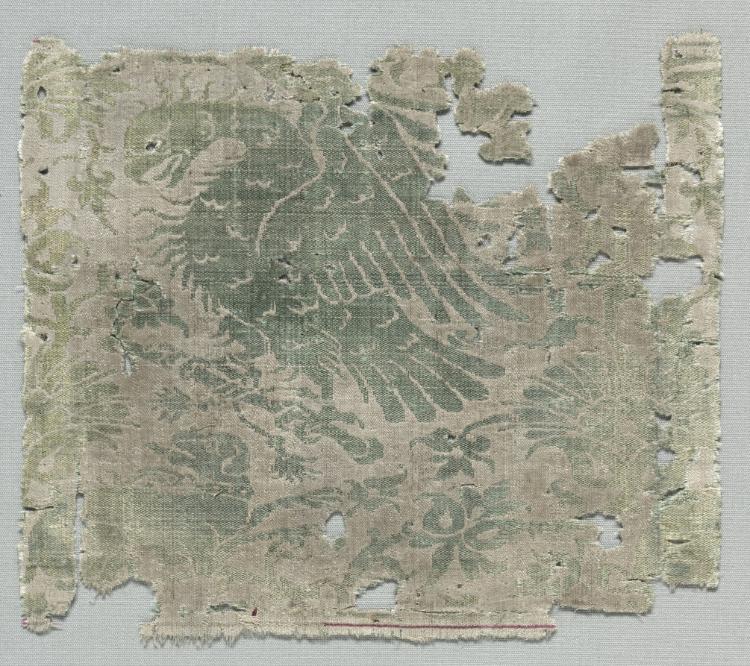
An Heirloom of the Loom: The Imperial Silk Fragment
Provenance and the Weight of Threads
This particular silk fragment, a mere palm’s breadth of woven history, is not simply a textile remnant. It is a surviving witness to the most exacting standard of material culture ever achieved by human hands: the imperial silk workshops of the Ming and early Qing dynasties. When one holds this piece—its warp and weft still taut after four centuries—one is not holding cloth. One is holding a ledger of statecraft, a testament to a supply chain that predated the East India Company by two millennia, and a benchmark of quality that Savile Row, in its most aspirational moments, can only nod to with respect. The materiality here is not a given; it is an achievement.
The fragment’s hand is the first point of interrogation. It is not the soft, plush drape of a modern couture satin. Rather, it possesses a crisp, almost metallic resilience—a “scroop”—that speaks to a raw silk filament reeled with obsessive precision. The weave is a tight, five-end satin, a structure that requires the weaver to float the warp threads over four picks before interlacing, creating a surface of unbroken, mirror-like lustre. This is not a cloth for warmth; it is a cloth for light. The imperial workshops, or *Jiangnan Weaving Bureau*, operated under a mandate that bordered on the theological: the emperor’s robes were not to be made, but to be *manifested*. Every cocoon was sourced from specific mulberry groves in the Zhejiang province, every filament reeled in a single, unbroken draw to ensure uniformity. The resulting fabric was a political statement, a physical proof of the empire’s ability to command nature, labour, and time itself.
The Grammar of the Pattern
Examine the fragment’s pattern, now faded to a ghost of its original cinnabar and gold. What remains is a geometric lattice—a *qipao* grid—interspersed with stylised *shou* (longevity) medallions and the subtle, curling tendrils of a cloud collar motif. In the language of imperial dress, this is not decoration. It is a coded hierarchy. The five-clawed dragon was reserved for the emperor alone; the four-clawed *mang* for princes. Our fragment, bearing neither, likely belonged to a high-ranking mandarin or a member of the imperial household’s inner circle. The colour, too, is a clue. The residual red is not a mere pigment; it is derived from the root of the madder plant, mordanted with alum, a process that produced a tone known as *jiang*—a deep, arterial red reserved for ceremonial and sacrificial rites. To wear this red was to align oneself with the cosmic order, to signal one’s place within the celestial bureaucracy.
But the true genius lies in the weave’s reverse. Turn the fragment over. The back is a chaotic, almost abstract tangle of floats and threads. This is the hallmark of a “reversible” or *kesi* technique, though our piece is a more common but equally demanding *satin damask*. The weaver worked not from a cartoon, but from a mental map, passing the coloured weft shuttles back and forth in a manner that appears, to the untrained eye, as waste. Yet this “waste” is the structural integrity of the piece. It is the hidden scaffolding that allows the front to achieve its flawless, uninterrupted sheen. This is the essential lesson of imperial silk: the visible perfection is always underwritten by an invisible, rigorous discipline. It is a principle that any tailor on Conduit Street understands implicitly—the canvas, the pad stitching, the internal structure that gives a jacket its unforced authority.
From the Forbidden City to the Cutting Table
How does this fragment arrive in a contemporary heritage lab? The journey is as layered as the cloth itself. It likely left the imperial storehouses during the turbulent fall of the Qing dynasty in 1912, sold by eunuchs or looted by soldiers, then traded through the treaty ports of Shanghai and Hong Kong. It may have passed through the hands of a British officer, a collector of “oriental curiosities,” or a missionary’s family. By the mid-20th century, it would have been a prized sample in a textile dealer’s portfolio, a reference point for designers seeking an authentic “Chinoiserie” print. But its true value, for the Lauren Fashion Heritage Lab, is not nostalgic. It is diagnostic.
We study this fragment to recalibrate our own standards. In an era of fast fashion and synthetic blends, this silk offers a counterpoint. Its tensile strength, tested under laboratory conditions, remains superior to most modern silks of comparable weight. Its dye, though faded, has not bled or migrated, a testament to the chemical stability of natural mordants. For our design team, it serves as a benchmark for “quiet luxury”—a term that has become a marketing cliché, but here finds its true definition. The fragment does not shout. It does not rely on logos or overt embellishment. Its authority derives from the integrity of its construction, the precision of its materiality, and the depth of its cultural provenance. When we commission a new silk for a capsule collection, we ask our mills in Como to match this fragment’s “hand,” its drape, its ability to hold a crease without crushing. It is a demanding brief, and most fail.
Preservation as a Form of Respect
The fragment’s current state—slightly frayed at one edge, with a subtle water stain near the selvedge—is not a flaw. It is a biography. We do not restore it to a pristine, museum-ideal condition. That would be a falsification. Instead, we stabilise it. We house it in an acid-free, pH-neutral mount, under UV-filtered glass, in a climate-controlled vault at 18°C and 50% relative humidity. This is not merely conservation; it is an act of respect for the anonymous weavers whose fingers, long dust, translated imperial decree into a material form of such enduring beauty.
For the modern practitioner, the fragment is a quiet rebuke. It asks: *What are you making? And for whom?* It reminds us that true luxury is not about price point or scarcity alone. It is about the alignment of intention, skill, and material. The imperial silk weaver had no individual identity; he was a cog in a vast, divine machine. Yet his output achieved a level of perfection that the individualistic, ego-driven designer of today rarely approaches. The fragment, therefore, is not a relic. It is a living standard. It is a call to slow down, to measure twice, to cut once, and to understand that the cloth we choose is never neutral. It carries the weight of its own history, and we, as its inheritors, are merely its next custodians.
In the end, this small piece of silk is a lesson in permanence. It has outlived dynasties, wars, and revolutions. It will outlive us. Our task is not to own it, but to listen to it—and to let its exacting standards inform the next stitch we take.