← BACK TO ARCHIVES
Heritage-Black
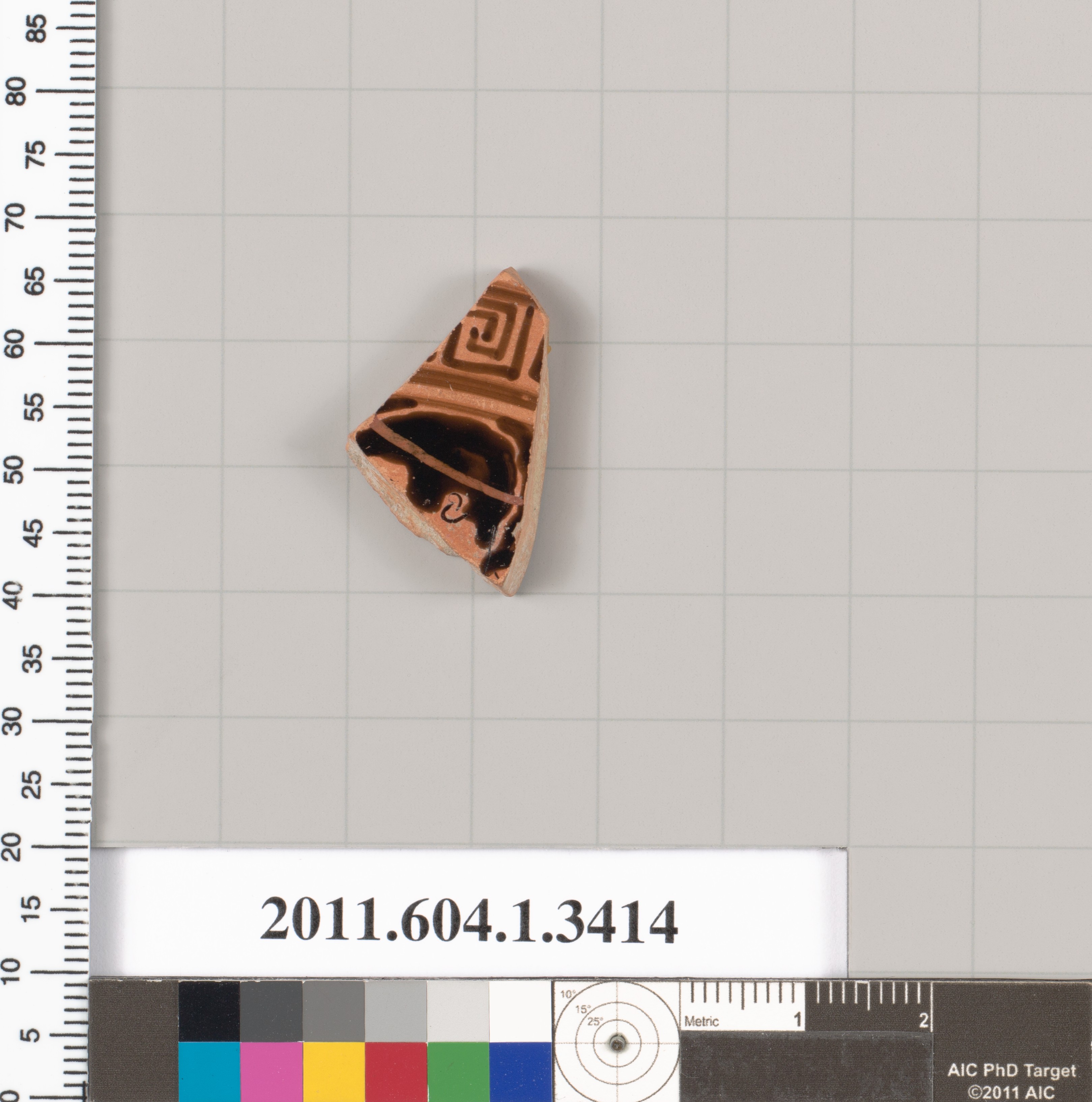
Heritage Synthesis: Terracotta fragment of a kylix (drinking cup)
Curated on Aug 29, 2026 // Node: LDN-01
The Mirror and the Kylix: Reconsidering Restraint in the 2026 Old Money Silhouette
In the quiet galleries of the Lauren Fashion Heritage Lab, where the internal archives of Liru meet the broader canon of global material culture, we often return to a singular question: what constitutes timelessness? The answer, as revealed through the juxtaposition of two seemingly disparate objects—a Han dynasty bronze mirror, the *Divine Beast Chariot and White Tiger Mirror*, and a Greek Attic terracotta kylix fragment—is not found in ornament, but in the philosophical architecture of restraint. The internal genetic code of our house, which speaks of the “empty” beauty of the *Udumbara* temple plaque and the “full” dynamism of the bronze mirror, finds an unexpected yet profound resonance in the fragmented clay of a Greek drinking cup. For the 2026 Old Money silhouette, this synthesis yields a directive: heritage is not a costume, but a discipline of negative space, a study in the “image beyond the image” (*象外之象*).
The Terracotta Fragment: A Study in Controlled Imperfection
The museum artifact in question—a terracotta fragment of an Attic kylix—is, at first glance, a study in loss. Its once-vibrant black-figure or red-figure decoration is now chipped, its handles absent, its circular tondo broken into an irregular arc. Yet, this very fragmentation is its greatest pedagogical asset. The kylix was designed for the symposium, a ritualized space of philosophical discourse and measured intoxication. Its shallow bowl and twin handles encouraged a reclining posture, a languid reach, and a communal passing of wine. The painted figures—perhaps a reveler, a god, or a chariot scene—were not mere decoration but narrative prompts, intended to spark dialogue on virtue, mortality, and the divine.
For the 2026 Old Money aesthetic, the kylix fragment teaches us the power of the *incomplete narrative*. Unlike the fast-fashion impulse to shout, the Old Money wardrobe whispers. It does not seek to display the full scene, but to hint at a life lived with depth. The fragment’s broken edge is not a flaw; it is a boundary that invites the imagination to fill the void. This is the Western cousin of the Chinese aesthetic principle of *liu bai* (留白), or “reserved white.” Just as the temple plaque’s wooden grain breathes within the ink, the kylix’s exposed terracotta body—the raw, unglazed clay—breathes between the painted figures. In our 2026 silhouettes, this translates to garments that are deliberately unfinished in their storytelling: a jacket with a hand-rolled lapel that does not announce itself, a trouser with a break that suggests a bespoke tailor’s quiet confidence, a coat whose internal structure is felt but never seen.
The Mirror and the Cup: Dialectics of Fullness and Emptiness
The Han bronze mirror, with its *man gong* (满工) or “full work” composition, presents a dense cosmology: the Queen Mother of the West enthroned, chariots in flight, a white tiger rearing. Every millimeter of the mirror’s back is occupied, yet the mirror’s function is to reflect emptiness—the face of the beholder. The kylix, conversely, offers a painted exterior but a hollow interior; its purpose is to hold liquid, to be emptied and refilled. One object is a plenum of imagery; the other is a vessel of absence. Yet both converge on the same philosophical point: meaning arises from the *interface* between the object and the observer.
For the 2026 Old Money silhouette, this dialectic resolves into a principle of *structural dualism*. The suit is our mirror—its surface must be immaculate, its pattern (if any) must be a controlled density, like the mirror’s chariot wheels, suggesting motion without chaos. The shirt, the blouse, the inner layer—these are our kylix. They are the hidden symposium, the private discourse. The 2026 silhouette therefore prioritizes the *interior finish* as a luxury marker. A silk lining with a hand-stitched pick-stitch, a hidden placket with corozo buttons, a waistband that is taped and pressed to a razor’s edge—these are the “painted figures” on the inside of the cup, unseen by the public but felt by the wearer. This is not mere ostentation; it is the material manifestation of the “empty” temple plaque, where the absence of external noise allows the internal spirit to resonate.
From Kylix to Coat: The 2026 Silhouette Defined
How, then, does a broken Greek cup shape a coat for 2026? The answer lies in the *shoulder line* and the *fabric weight*. The kylix’s tondo—the circular space at the bottom of the bowl—was the focal point of the painter’s art. It was a contained universe. Our 2026 overcoat borrows this geometry. The shoulder is not padded into aggressive width (a 1980s power silhouette) nor dropped into slouch (a 1990s grunge echo). Instead, it is a *softly engineered tondo*: a natural shoulder line that is subtly extended by a sleeve head of hand-sewn roping, creating an arc that suggests the curve of the kylix bowl. The fabric—a dense, 18-ounce wool from an Italian mill, or a brushed cashmere from Inner Mongolia—must have a *terracotta weight*: substantial enough to hold a drape, yet pliable enough to move with the body like the fragment’s broken edge.
The color palette for 2026 is drawn directly from the artifact’s materiality: not the glossy black of the painted figures, but the *raw sienna* and *burnt umber* of the exposed clay, the *ash grey* of weathered stone, and the *deep oxblood* of aged wine. These are not “trend” colors; they are *archaeological* tones, evoking the earth from which the kylix was excavated. In the Old Money context, these hues signal permanence. They do not fade with the season; they deepen with wear, much like the patina on the bronze mirror. The 2026 silhouette, therefore, is a study in *chromatic restraint*—a single, rich tone for the outer layer, with the “painted figures” of the ensemble relegated to the interior: a striped silk scarf, a jacquard vest, a hand-embroidered monogram.
The Philosophical Tailoring of “Image Beyond Image”
The internal genetic code of Lauren Fashion Heritage Lab reminds us that the true aesthetic goal is not “formal resemblance” but *xieyi* (写意)—the spirit-writing that captures the rhythm of the cosmos. The kylix fragment, in its brokenness, achieves this. It does not show us the entire symposium; it shows us a shard of a foot, a fragment of a lyre, a suggestion of a garland. Our 2026 garments must do the same. A lapel’s gorge is not merely a seam; it is a line that suggests the flight of the white tiger’s mane. A pocket’s besom is not just an opening; it is the negative space of the temple plaque, a void that holds the potential for a hand, a card, a gesture.
In practice, this means the 2026 Old Money silhouette rejects all forms of *loud branding*. There are no visible logos, no oversized hardware, no graphic prints. Instead, the “image beyond the image” is achieved through *proportion and movement*. The coat is cut with a slightly longer skirt, allowing it to move like a chariot’s drapery when the wearer walks. The trouser is cut with a high rise and a gentle taper, echoing the kylix’s stem and foot. The shirt collar is cut with a specific roll that, when unbuttoned, reveals a triangle of skin—a deliberate “empty” space that is more provocative than any décolletage. This is the *Udumbara* flower, blooming once every three thousand years, appearing not in the fabric’s print but in the *moment* the wearer turns, and the light catches the twill’s diagonal.
Conclusion: The Eternal Return to the Fragment
As we project into 2026, the Old Money aesthetic faces a critical juncture. In a world of algorithmic fast fashion and disposable trends, the allure of heritage can easily curdle into pastiche—a superficial donning of tweed and pearls. The kylix fragment, however, offers a corrective. It reminds us that heritage is not about completeness but about *survival*. The fragment survives because it was made with integrity; its clay was well-levigated, its paint was well-fired, its form was well-conceived. Our 2026 garments must be made with the same integrity, not to be displayed in a museum, but to be worn, broken in, and eventually passed down.
The bronze mirror and the terracotta kylix, the temple plaque and the drinking cup, are not opposites. They are two halves of a single truth: that the highest form of luxury is the ability to suggest the infinite within the finite. The 2026 Old Money silhouette, therefore, is not a new design. It is a *re-excavation* of an ancient principle. It is a coat that holds the memory of a chariot’s speed in its static drape. It is a trouser that contains the silence of a temple in its pressed crease. It is, ultimately, a fragment of a larger story—a story that the wearer completes through their own life, their own motion, their own quiet confidence. In this, we find the true *heritage-black*: not the color of mourning, but the color of depth, the color of the void from which all form emerges, and to which all form returns.
Heritage Lab Insight
Genetic Bridge: Archive node focusing on Heritage-Black craftsmanship.