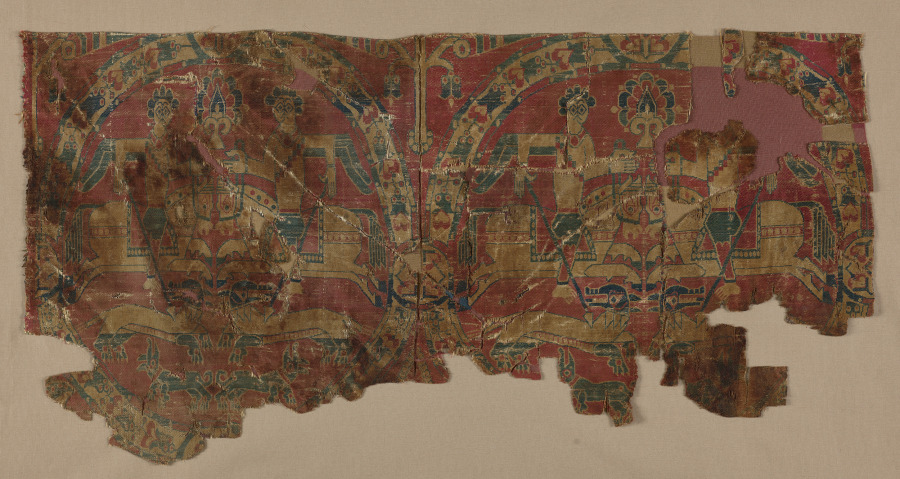
The Roundel and the Rule: A Study in Imperial Silk
Provenance and the Language of the Loom
In the hushed, timber-lined ateliers of Savile Row, we speak of cloth as one might speak of a trusted colleague—with a degree of reverence, a measure of caution, and an unerring eye for provenance. The roundel, a perfect circle of woven narrative, is not merely a decorative motif; it is a declaration of sovereignty, a frozen moment of the hunt, and a testament to the absolute mastery of the imperial silk loom. When we examine a fragment of silk bearing the roundel with hunters, we are not looking at a piece of fabric. We are looking at a legal document, a deed of power, written in warp and weft.
The materiality of this artifact is paramount. Silk, in its raw, unspun state, is a filament of extraordinary tensile strength, yet its final character is dictated entirely by the hand of the weaver. In the imperial workshops of the Safavid, Ottoman, and Mughal courts, silk was not a commodity; it was a currency of prestige. The production of a single yard of such cloth could consume months, requiring the coordination of dyers, throwsters, and master weavers who operated the great drawlooms with the precision of a surgeon. The result is a fabric that possesses a unique drape—a liquid, almost metallic fall that catches the light with a subdued, oily sheen. This is not the brittle, papery silk of modern mass production. This is a silk that has weight, a silk that whispers of the hands that dressed it, a silk that carries the scent of cedar and the dust of centuries.
The Iconography of the Chase: Power in Motion
The roundel itself is a geometric constraint, a circle that imposes order upon the chaos of the natural world. Within this bounded field, the hunter is depicted in perpetual pursuit. The iconography is consistent across the great weaving traditions: a mounted horseman, often a prince or a member of the royal guard, draws his bow against a lion, a deer, or a mythical beast. The composition is dynamic, with the animal’s body contorted in a graceful arc of flight, while the hunter’s posture remains rigid, controlled, and utterly assured. This is not a scene of survival; it is a scene of dominion.
Consider the technical challenge. To render the musculature of a galloping horse, the tension of a bowstring, and the intricate trappings of a royal saddle within a circle of perhaps twelve inches in diameter requires a level of technical virtuosity that borders on the obsessive. The weaver had to translate the painter’s brushstroke into a grid of interlaced threads. The result is a stylized, almost heraldic representation. The hunter’s face is often rendered in profile, with a serene, impassive expression. He is not sweating, not straining. He is the embodiment of *furusiyya*—the Islamic code of chivalry that fused martial skill with courtly refinement. The hunt was not a sport; it was a rehearsal for war, a display of the ruler’s ability to protect his realm from both external enemies and the internal chaos of the wild.
The Imperial Workshop: A Legacy of Control
The legacy of imperial silk weaving is fundamentally a legacy of control. The establishment of royal manufactories, such as the *karkhanas* of the Mughal emperor Akbar or the *naqshkhana* of the Safavid shahs, was a deliberate act of political centralization. By bringing the most skilled artisans under direct royal patronage, the sovereign ensured that the finest materials and the most sophisticated designs remained the exclusive property of the crown. The roundel with hunters was not a pattern that could be purchased by a merchant in the bazaar. It was a state secret, a visual signature of the dynasty.
This control extended to the very structure of the cloth. The use of continuous supplementary wefts, often in gold or silver thread, created a fabric of immense richness and rigidity. These are not soft, draping silks for intimate garments. They are stiff, architectural textiles intended for ceremonial robes, throne canopies, and wall hangings. The roundels would be arranged in a repeating grid, creating a rhythm of power across the surface of the garment. When the Shah or the Padishah moved, the roundels would catch the light in a shimmering cascade, reinforcing the aura of divine right. The silk did not merely clothe the ruler; it armored him in a narrative of legitimacy.
Materiality and the Modern Eye
For the contemporary connoisseur on Savile Row, a fragment of this silk is a profound lesson in the value of patience. We are accustomed to speed, to the instant gratification of a digital print. This cloth demands a different temporality. To handle it is to feel the weight of the hours it took to create. The slight irregularities in the weave, the subtle variations in the dye lot—these are not flaws. They are the fingerprints of the artisan, the evidence of a human hand working in concert with a machine of immense complexity.
The roundel with hunters speaks to a universal truth: that true luxury is the antithesis of ease. It is the product of immense skill, rigorous discipline, and a deep understanding of material limits. As we consider how to incorporate such a heritage artifact into a modern wardrobe—perhaps as a lining for a dinner jacket, or a bespoke smoking jacket in a deep aubergine—we must do so with humility. We are not improving upon the original; we are borrowing its authority. We are taking a piece of imperial history and giving it a new context, a new life, but we must never forget the loom that made it, the hunter who rides within its circle, and the empire that demanded such perfection. The silk endures. The hunt continues. And the rule of quality remains absolute.