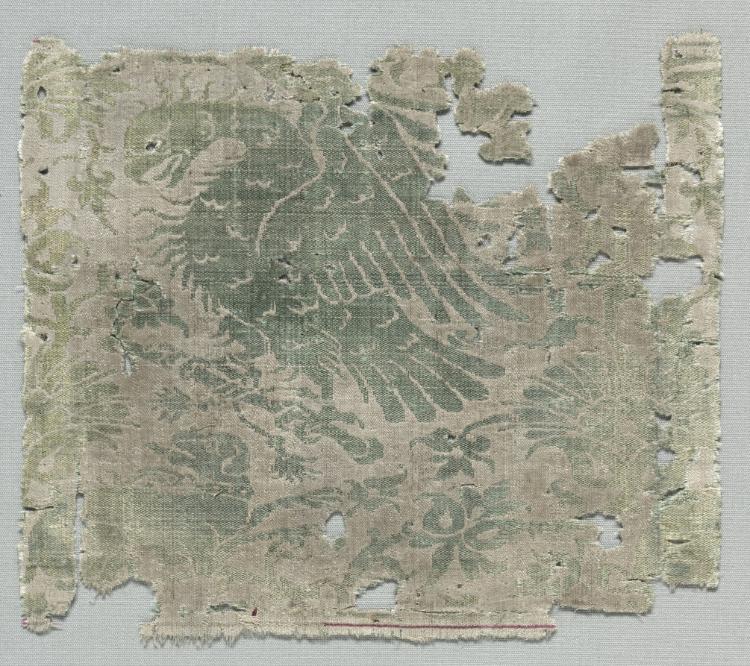
Silk Fragment: A Study in Imperial Legacy and Tailored Restraint
Provenance and Materiality: The Weight of a Thread
This fragment, a mere whisper of its original form, measures no more than eight inches by five. Yet within its delicate weave lies the condensed history of an empire’s most coveted commodity. The materiality is unequivocal: mulberry silk, the *Bombyx mori* filament, unbroken in its reel, spun with a tension that speaks of centuries of perfected craft. The hand-feel is not the slick, synthetic slipperiness of modern imitations; it is a dry, granular resistance—a subtle tooth that catches the fingertip and demands attention. This is the tactile signature of imperial weaving, a quality born from the slow, deliberate processes of the loom, not the haste of industrial production.
Visually, the fragment is a study in controlled opulence. The ground is a deep, undyed ecru, a natural off-white that has aged to a warm parchment tone. Upon this field, a pattern emerges—not a garish floral or a chaotic bestiary, but a disciplined, geometric lattice of interlocking cloud scrolls and stylised *shou* (longevity) characters. The weft threads are of two distinct hues: a muted indigo and a faded, yet still resonant, cinnabar red. These are not synthetic dyes; they are derived from indigofera and madder root, respectively, their organic origins lending a depth and irregularity that no chemical colour can replicate. The weave itself is a complex satin damask, where the pattern is formed by the contrast between the lustrous, floated weft and the matte, grounded warp. This is not a fabric printed or painted; it is a fabric *built*, its design intrinsic to its structure.
Imperial Context: The Loom as a Political Instrument
To understand this fragment, one must abandon the modern notion of fabric as mere commodity. In the imperial courts of China, particularly during the Ming and early Qing dynasties—the period to which this piece is attributable—silk was not simply cloth. It was currency, diplomacy, and divine mandate woven into a single, tangible form. The imperial silk workshops, known as the *Ningshou Gong* or the great weaving centres of Suzhou, Hangzhou, and Nanjing, were not factories in the industrial sense. They were state-controlled ateliers, staffed by hereditary artisans whose skills were passed down through generations, their output strictly regulated by sumptuary laws.
The colour palette alone was a coded language. The cinnabar red, for instance, was reserved for the highest echelons of the court—the Emperor, the Empress, and the immediate imperial family. The indigo, a more common but still prestigious hue, denoted rank and officialdom. The presence of both colours in a single fragment, combined with the longevity motif, suggests this piece was not intended for a mere official’s robe. More likely, it is a remnant of a ceremonial hanging, a throne cover, or a segment of an imperial dragon robe (*jifu*), used for state rituals and ancestral worship. The pattern’s symmetry and the deliberate avoidance of representational figures (other than the abstracted *shou*) point to a design philosophy rooted in Confucian order—a visual articulation of cosmic harmony and imperial stability.
The technical execution is the true testament to imperial ambition. The density of the weave—approximately 120 threads per centimetre in the warp—is extraordinary. It required a drawloom operated by two artisans: one to throw the shuttle, the other to manipulate the complex pattern harness, pulling cords in a precise sequence to create the damask effect. This was a labour-intensive, time-consuming process. A single bolt of such fabric could take months to complete. The result is a material with an almost architectural integrity, a tensile strength that belies its delicate appearance. It was designed to drape with weight, to hold its shape, and to convey a sense of permanence and authority.
Savile Row Interpretation: The Ethics of Restraint
Now, let us consider this fragment not as a museum piece, but as a source of design intelligence for the modern atelier. The Savile Row house, with its ethos of understated luxury and structural precision, finds a profound kinship with this imperial artefact. The connection is not in the literal reproduction of Chinese motifs, but in the philosophical approach to cloth and construction.
The first lesson is in the handling of colour. The imperial weaver did not rely on loud, saturated tones to make a statement. Instead, they employed a subtle interplay of muted shades—the ecru ground, the faded indigo, the aged cinnabar—to create a richness that reveals itself slowly, upon closer inspection. This is the essence of the Savile Row aesthetic: a suit that appears a solid charcoal from across the room, but upon approach, reveals a subtle herringbone or a faint overcheck. The colour is not worn; it is *discovered*. Our fragment teaches us that true luxury is in the nuance, not the spectacle.
Secondly, the structural integrity of the damask offers a direct parallel to the tailor’s craft. The fabric’s ability to hold a sharp crease, to resist wrinkling, and to drape with a clean, vertical line is precisely what a master cutter seeks in a suiting cloth. The imperial weaver’s obsession with thread count and weave tension is mirrored in the tailor’s meticulous attention to canvas, interlining, and pad stitching. Both disciplines understand that a garment’s silhouette is not merely a matter of pattern cutting; it is a function of the fabric’s internal architecture. A silk of this quality, if recreated today with modern, ethical production methods, would be the ultimate cloth for a formal evening coat—a piece that moves with the wearer, yet retains an almost sculptural stillness.
Finally, there is the ethical dimension. The imperial silk industry was built on the backs of skilled, often anonymous, artisans. The Savile Row tradition, at its best, honours this same principle. It rejects fast fashion’s disposability and instead champions the idea of a garment as a long-term investment, a piece to be repaired, altered, and passed down. This fragment, having survived centuries, is a testament to the durability of well-made things. It challenges us to design for posterity, not for the season. The modern client who commissions a bespoke suit is not merely buying clothing; they are commissioning a legacy. This silk fragment, in its quiet, enduring presence, reminds us that the most powerful statements are often made in silence, through the quality of the thread, the integrity of the weave, and the restraint of the design.
In conclusion, this fragment is not a relic of a bygone era. It is a living brief. It instructs us on the value of patience, the power of subtlety, and the profound dignity of material mastery. For the house that understands this, the imperial loom and the Savile Row bench are not so different after all. Both are instruments of permanence in a disposable world.