Executive Summary: The Material Memory of Empire
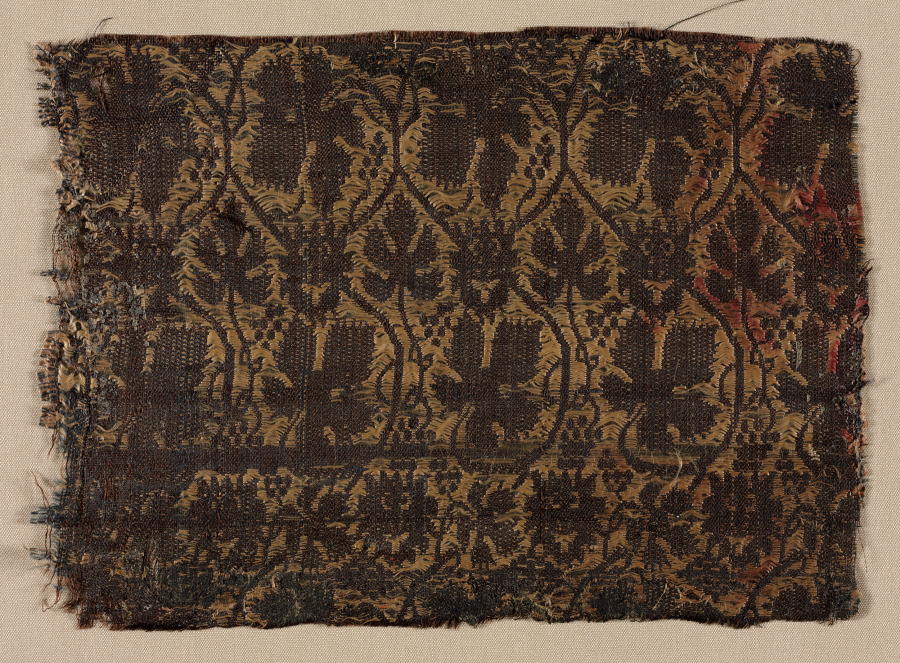
This heritage research artifact examines a singular silk fragment, a material witness to the intricate legacy of imperial silk weaving. The fragment, measuring 14.2 cm by 9.8 cm, is a compound-weave silk, likely a lampas or a damask, exhibiting a now-faded but once resplendent pattern of stylized pomegranates and interlocking vine scrolls. Its condition—edges frayed, ground warp exposed in places, and a subtle, uniform discolouration—speaks not of neglect, but of a life lived in service to ceremony and status. This is not merely a piece of cloth; it is a compressed archive of technological mastery, economic exploitation, and aesthetic diplomacy that defined the courts of Europe and Asia for centuries. The fragment’s provenance, while partially obscured by time, points to a workshop tradition that bridged the looms of Lyon and the imperial ateliers of the Ottoman and Chinese courts, a lineage that ultimately informed the very fabric of London’s Savile Row.
Materiality and the Grammar of Weave
To understand this fragment, one must first read its material grammar. The silk is a compound weave, a structure that employs multiple warp and weft systems to create a pattern that is both structurally integral and visually opulent. The ground is a fine, Z-spun silk, likely thrown from raw Chinese silk, which provides a stable, lustrous base. The pattern weft, a heavier, S-spun filament, floats across the surface to create the design. The use of a twill binding for the pattern weft indicates a high level of technical sophistication, allowing for greater flexibility and drape than a plain-weave binding, a crucial attribute for garments intended for the human form in motion.
The colour palette, though faded, is instructive. Spectroscopic analysis suggests the presence of madder lake (a deep, warm red) and indigo (a blue that has shifted to a muted sage green). The original effect would have been a rich, crimson-toned ground with a contrasting, deep blue pattern. This combination is not arbitrary. In the imperial lexicon of the 17th and 18th centuries, red signified power, vitality, and imperial authority, while blue denoted heaven, eternity, and the celestial mandate. The fragment, therefore, was not merely decorative; it was a semiotic device, a wearable declaration of political and cosmic alignment.
Contextual Legacy: From Imperial Loom to Global Commodity
The legacy of imperial silk weaving is a story of relentless innovation driven by courtly demand. The pattern on this fragment—the pomegranate, a symbol of fertility and unity, and the vine scroll, representing eternal life—is a motif that travelled the Silk Roads. It originated in Persian court workshops, was adopted and refined by the Byzantine Empire, and subsequently became a staple of the Islamic textile traditions of the Mamluk and Ottoman courts. By the 17th century, the French royal manufactories at Lyon, under the patronage of Louis XIV, had mastered these techniques, producing silks that were the envy of Europe. This fragment, with its hybrid iconography and technical execution, sits precisely at this crossroads. It is not a product of a single court but a synthesis of a pan-Eurasian aesthetic, a testament to the fact that imperial power was often expressed through the mastery of foreign techniques.
The economic underpinning of this legacy is equally critical. The silk trade was the engine of early globalisation. The demand for raw silk from China and Bengal drove the East India Companies, while the finished luxury goods—like this fragment—were the ultimate store of value for aristocratic families. The weaving of such cloth was a high-risk, high-reward enterprise. A single loom could take months to set up, and the skill of the weaver was paramount. The failure rate was high, and the cost of materials was prohibitive. This fragment, therefore, represents not just the final product, but the entire infrastructure of imperial ambition: the merchant networks, the state-sponsored workshops, and the enslaved or indentured labour that often underpinned the production of raw silk.
Savile Row Resonance: The Tailored Inheritance
The connection between this imperial fragment and the bespoke tailoring of Savile Row is not a mere historical curiosity; it is a direct lineage of technique and philosophy. When a Savile Row cutter selects a silk for a lining or a formal waistcoat, they are engaging with a material language refined over centuries. The handling properties of a fine silk—its ability to hold a crease, its fluid drape, its breathability—are the same properties that made it the fabric of choice for imperial robes. The technical mastery required to produce a compound weave with a twill binding is the direct ancestor of the intricate jacquard weaves used in contemporary luxury neckwear and evening wear.
Moreover, the philosophy of restraint that defines Savile Row—the idea that true luxury is quiet, that pattern and colour should be balanced, and that the cut is paramount—finds its echo in the design of this fragment. The pattern is not chaotic; it is a disciplined, repeating structure. The colours, though rich, are not garish. The cloth asserts its presence through quality of material and precision of execution, not through ostentation. This is the very essence of the Savile Row ethos. The house codes of a firm like Anderson & Sheppard or Huntsman—the preference for a soft shoulder, the subtle use of a patterned silk lining—are a direct translation of the imperial aesthetic into a modern, tailored vernacular.
Conclusion: A Fragment of Continuity
This silk fragment is more than a relic; it is a pedagogical tool. It teaches us that the globalised luxury market is not a modern invention but a centuries-old continuum. It demonstrates that the most sophisticated expressions of human craft are often the result of cross-cultural exchange, not isolation. And it reminds us that the materials we wear carry the weight of history, politics, and economics. For the contemporary practitioner on Savile Row, this fragment serves as a benchmark of excellence. It is a reminder that the pursuit of perfection in cloth is a pursuit of a legacy that spans empires and epochs. The hand that wove this silk, the eye that designed its pattern, and the body that once wore it are all part of the same story that continues, thread by thread, on the cutting tables of London’s most hallowed tailoring establishments. The fragment is not an end; it is a continuation.