Category: Silk
The Hwarot as a Testament to Imperial Silk Weaving
In the hushed, wood-panelled ateliers of Savile Row, where the language of cloth is spoken with the precision of a legal brief, we understand that a garment is never merely a covering. It is a document. It is a record of trade routes, of dynastic ambition, and of the hands that coaxed a thread from a cocoon into a coronation. The Bridal Robe, or *Hwarot*, is precisely such a document—a masterpiece of materiality, rendered in the most demanding and prestigious medium known to the tailor’s art: silk. To examine the Hwarot is to read the final, gilded chapter of imperial silk weaving, a legacy that stretches back millennia and culminates in this resplendent, ceremonial form.
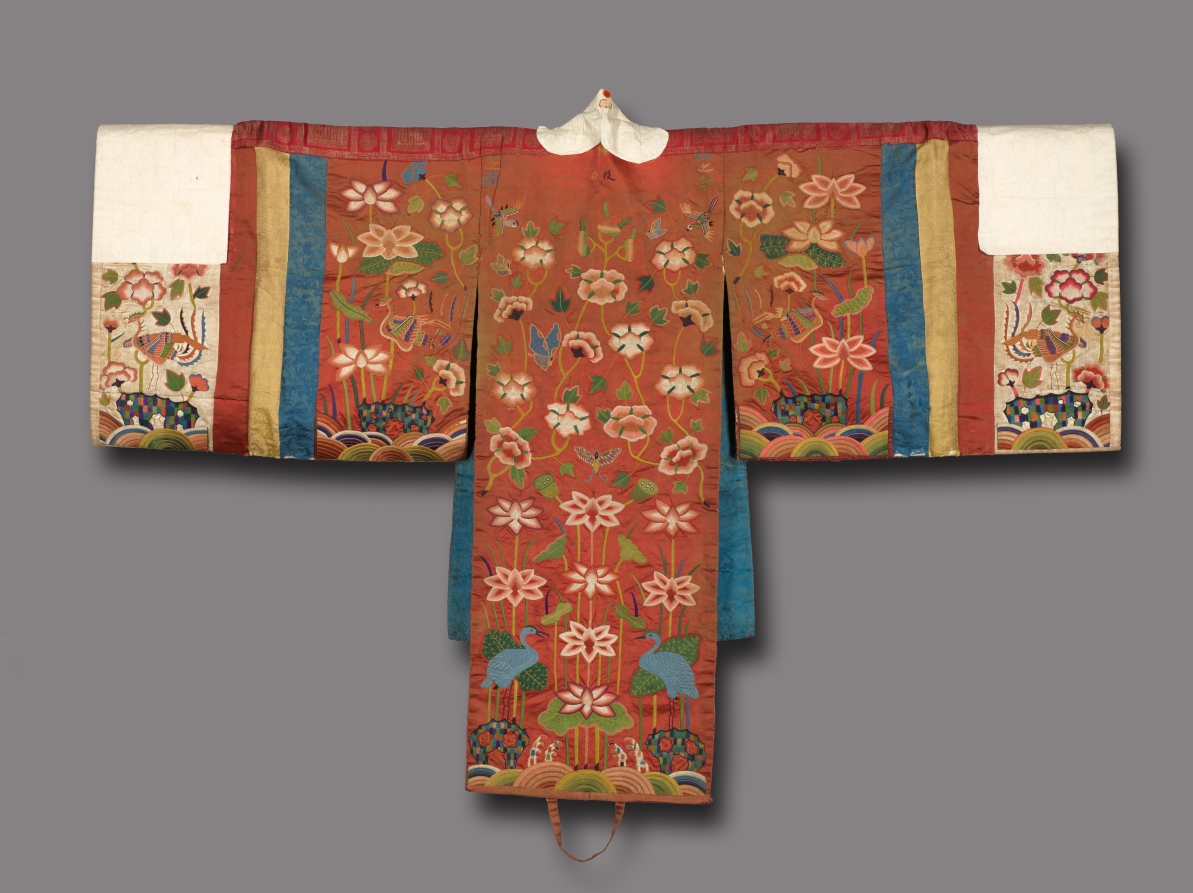
The *Hwarot*, worn by Korean brides during the Joseon dynasty (1392–1897) and into the Korean Empire, is not a simple wedding dress. It is a court robe, a vestige of the *jeogui* worn by queens and princesses, adapted for the nuptial rites of noblewomen. Its very existence is predicated on the imperial silk industry, a state-controlled enterprise of staggering complexity. Unlike the utilitarian wools and cottons of the West, silk was a strategic commodity. The mulberry tree, the silkworm, and the reeling of the filament were guarded processes, and the finest grades—those with the longest, unbroken fibres—were reserved for the royal court. The *Hwarot*’s fabric is the product of this monopoly, a tangible proof of access to the apex of the weaver’s craft.
Materiality and the Language of the Loom
Let us consider the cloth itself. The ground of a true *Hwarot* is typically a high-density silk satin or a fine gauze, but the most coveted examples utilise *dan*—a heavy, lustrous silk damask. The weight is considerable, a deliberate heft that speaks of substance and permanence. In the Savile Row tradition, we judge a cloth by its hand, its drape, and its resilience. Here, the silk is not chosen for softness but for its architectural capacity. The satin weave, with its floating warp threads, creates a mirror-like surface that catches light with an almost metallic sheen. This is not the muted, matte finish of a country tweed; this is the high-polish gloss of a ceremonial state uniform, designed to be seen by torchlight and candlelight, to announce the wearer’s status before a single word is spoken.
The legacy of imperial weaving is most evident in the technical execution. The patterns are not printed or embroidered onto a blank canvas; they are woven into the very structure of the silk. The *Hwarot* employs a compound weave, often a damask or a brocade, where the design—typically auspicious symbols such as the phoenix, peonies, and the character for longevity (*su*)—is created by interlacing multiple sets of warp and weft threads. This is the pinnacle of the drawloom’s capability, requiring a weaver and a drawboy working in perfect synchrony, pulling cords to lift individual warp threads according to a complex pattern draft. The result is a fabric with a distinct, raised relief, a sculptural quality that cannot be replicated by surface embellishment alone. The imperial workshops of Nanjing and Suzhou, which supplied the Joseon court through tribute and trade, perfected this technique over centuries. The *Hwarot* is their swan song, a final, glorious expression of a technology that would soon be rendered obsolete by the Jacquard loom and, later, by industrial mechanisation.
The Semiotics of Imperial Decoration
In the same way a Savile Row suit communicates its wearer’s provenance through a specific cut or a subtle lapel roll, the *Hwarot* communicates through its iconography. The motifs are not merely decorative; they are a codified language of power and blessing. The phoenix, a recurring motif, is the female counterpart to the dragon, symbolising the empress and, by extension, the bride’s elevated status within her new household. The peony, known as the “king of flowers,” represents wealth and honour. The lotus, emerging pristine from murky water, signifies purity and fertility. These are woven into the silk with gold-wrapped threads—*geum*—which are themselves a testament to the imperial silk industry’s mastery of metalwork. The gold is beaten into impossibly thin leaf, cut into strips, and spun around a silk core before being woven into the fabric. This is not a cheap metallic print; it is a precious metal integrated into the textile’s very structure, adding weight, lustre, and an unmistakable aura of opulence.
The colour palette further reinforces the imperial connection. While the bride’s face is framed by a black *jokduri* crown, the robe itself is a riot of primary hues—most commonly a deep, vermilion red, but also royal blue, green, or purple. These colours are derived from natural dyes, many of which were themselves controlled commodities. The red, obtained from safflower or brazilwood, was a symbol of joy and warding against evil. The blue, from indigo, and the purple, from the roots of the gromwell plant, were expensive and laborious to produce, further marking the garment as an object of immense value. In the context of imperial silk weaving, colour was not an aesthetic afterthought; it was a chemical and economic achievement, a marker of the wearer’s proximity to the throne.
The Tailoring of Ceremony
From a tailoring perspective, the *Hwarot* presents a fascinating paradox. Unlike the fitted, structured jackets of the Western tradition, the *Hwarot* is cut on generous, almost architectural lines. It is a voluminous, T-shaped robe with wide, hanging sleeves that terminate in a separate, contrasting inner cuff. This is not a garment designed to follow the body’s contours; it is designed to envelop and transform the wearer into a static, iconic figure. The construction is deceptively simple—straight seams, minimal shaping—yet the effect is monumental. The heavy silk damask, with its inherent stiffness, allows the robe to stand away from the body, creating a silhouette that is both imposing and ceremonial. The bride is not merely wearing a dress; she is inhabiting a portable monument, a living embodiment of her family’s lineage and the state’s enduring power.
The legacy of imperial silk weaving is thus preserved not in a museum case but in the very physics of the garment. The weight of the silk, the precise tension of the gold thread, the structural integrity of the damask weave—these are the results of a production system that was, for centuries, the most advanced in the world. The *Hwarot* is the final, perfected product of that system, a garment that could only exist within the context of an imperial court that commanded the resources of entire provinces. When we handle a *Hwarot* today, we are not just touching a piece of fabric. We are touching the accumulated knowledge of generations of weavers, dyers, and goldsmiths, all of whom were servants to a single, magnificent idea: that cloth could be a vessel for power, beauty, and eternity. And in that, it shares a quiet kinship with the finest garments ever cut on this Row—a shared understanding that true luxury is not about novelty, but about the unbroken, disciplined mastery of one’s material.