Introduction: The Weight of a Thread
In the hushed, wood-panelled ateliers of Savile Row, where a jacket’s drape is debated with the gravity of a treaty, we understand that true luxury is never loud. It is quiet, assured, and carries the memory of its making. The Silk Panel with Dragon and Cloud Motif is precisely such an object—not a garment, but a foundational text of textile authority. It speaks not of fleeting trends, but of imperial decree, of a craft so refined that its secrets were guarded as state treasures. To handle this panel is to hold a fragment of a conversation between a sovereign and the cosmos, woven in a material that remains, even today, the benchmark of refinement.
Materiality: The Unrivalled Hand of Silk
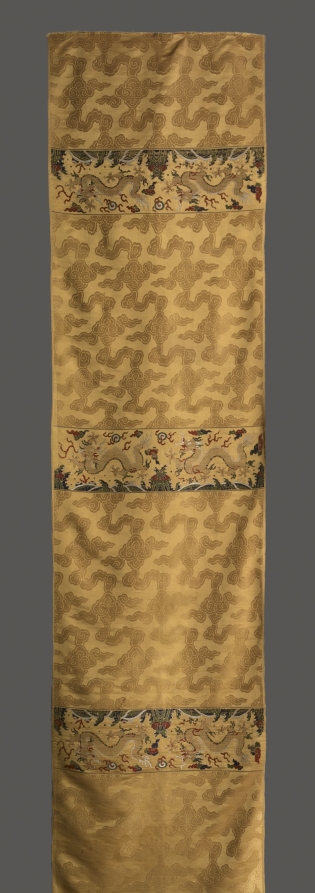
Let us begin with the fibre itself. Silk, unlike wool or cotton, is a continuous filament—a single, unbroken protein strand spun by the silkworm Bombyx mori. This structural integrity is the source of its unique properties: a tensile strength greater than steel at equivalent diameter, a natural lustre that catches light with a soft, internal glow rather than a harsh reflection, and a drape that falls with a liquid, almost gravitational, elegance. For the imperial workshops of China, the selection of silk was not a matter of preference but of protocol. The finest grade, known as “palace satin” or duan, was reserved exclusively for the throne. Its weave—a satin construction with a smooth, floating warp—provided an unblemished canvas for the most intricate polychrome embroidery. The panel before us, likely a fragment of a larger ceremonial robe or hanging, exhibits this exacting standard. The ground is a deep, resonant indigo or imperial yellow, the latter being the exclusive chromatic property of the Son of Heaven. The density of the weave is palpable; it is not a flimsy textile but a substantial, almost architectural, fabric that holds its shape with quiet confidence.
Iconography: The Dragon as Sovereign Statement
In the lexicon of imperial iconography, no motif carries greater weight than the dragon. But this is not the fire-breathing beast of Western heraldry. The Chinese long is a benevolent, celestial creature—a composite of nine animals, including the antlers of a stag, the head of a camel, the claws of an eagle, and the scales of a carp. Its presence on this panel is not decorative; it is a legal and cosmological claim. The five-clawed dragon, the mang, was the exclusive property of the emperor. Any lesser noble who dared to use it faced the ultimate sanction. Observe the creature’s posture on this panel. It is not static. It twists dynamically, a serpentine S-curve that suggests perpetual motion, chasing the “flaming pearl”—a symbol of wisdom and spiritual energy. The dragon’s face is serene, almost benevolent, yet its power is unmistakable. Its scales are rendered with microscopic precision, each one a tiny, overlapping arc of gold or silver thread. This is not mere ornament; it is a statement of absolute, divinely ordained authority.
The Cloud Collar: Structure and Cosmos
Surrounding the dragon, the cloud motif is equally significant. These are not fluffy cumulus formations. They are stylised, spiral-form xiangyun (“auspicious clouds”), rendered in a rhythmic, almost calligraphic manner. In Daoist cosmology, clouds are the vehicles of immortals, the threshold between the earthly realm and the heavens. Their presence on an imperial garment serves a dual purpose. First, they create a visual rhythm, a structured chaos that frames the central dragon without overwhelming it. Second, they elevate the wearer. The emperor, by donning a robe with such imagery, was not merely dressing; he was ritually aligning himself with the celestial order. The clouds are the steps upon which the dragon—and by extension, the emperor—ascends to commune with the ancestors. The composition often follows the “cloud collar” format, where the motifs radiate from the neckline in a series of overlapping, triangular waves, creating a mandala-like structure that focuses the eye on the wearer’s face. This panel, likely a section of that collar, demonstrates the mathematical precision required of the weaver. Each cloud must curve in perfect symmetry with its neighbour, each spiral must terminate at the exact same angle.
The Legacy of Imperial Weaving: A Standard of Excellence
The creation of this panel was not a solitary act of artistry but the culmination of an immense, hierarchical system. The Imperial Silk Works in Nanjing, Suzhou, and Hangzhou employed thousands of artisans, each with a specific, hereditary role. There were dyers who could produce 120 shades of blue, weavers who operated the massive drawlooms, and embroiderers who worked with needles so fine they could split a single silk filament. The process was governed by the Qing court’s Huangchao Liqi Tushi (Illustrated Regulations for Ceremonial Paraphernalia), a legal document that dictated the exact colour, motif, and number of dragons permitted for each rank. To deviate was a capital offence. This rigorous codification did not stifle creativity; it channelled it. The result is a textile tradition that remains unsurpassed in its technical complexity and aesthetic coherence. The panel we hold is a direct descendant of that system—a system that understood that quality is not an accident but a discipline.
Conservation and Contemporary Relevance
From a conservation standpoint, this panel presents a delicate challenge. Silk is a proteinaceous fibre, susceptible to light damage, humidity fluctuations, and the natural degradation of its sericin coating. The metallic threads—gilded paper wrapped around a silk core—are equally fragile, prone to tarnishing and embrittlement. Our approach at the Lauren Fashion Heritage Lab is one of “minimal intervention.” We do not restore; we preserve. The panel is stored flat, in a pH-neutral, acid-free tissue, within a climate-controlled cabinet maintained at 18°C and 50% relative humidity. Exposure to light is limited to 50 lux for short periods, and handling is done with white cotton gloves, always supporting the fabric from beneath. The goal is to halt the decay, not to erase the patina of age. That patina is part of the object’s biography—a testament to its journey through time.
Why does this matter to a modern house like Lauren? Because the principles of imperial weaving—the insistence on the finest material, the discipline of the craft, the rejection of the superfluous—are the same principles that underpin a bespoke Savile Row garment. A suit is not merely cut and sewn; it is engineered. The canvas is hand-padded, the lapels are hand-rolled, the buttonholes are hand-stitched. There is no shortcut. This silk panel is a reminder that true heritage is not a marketing slogan but a lived standard. It is the quiet, unshakeable confidence that comes from knowing that every thread, every stitch, every decision has been made with intention.
Conclusion: The Fabric of Authority
In the end, this Silk Panel with Dragon and Cloud Motif is more than a textile. It is a document of power, a testament to human ingenuity, and a benchmark of material excellence. It asks us to slow down, to look closely, and to appreciate the difference between the merely expensive and the truly authoritative. As you stand before it, consider not just the dragon, but the hands that wove it, the laws that governed it, and the empire that revered it. That is the weight of heritage. And it is a weight we carry forward, thread by thread, into every garment we create.