← BACK TO ARCHIVES
Silk
Heritage Synthesis: Lampas with griffins in roundels, from the Reliquary of Saint Librada in Siguenza Cathedral
Curated on Aug 30, 2026 // Node: LDN-01
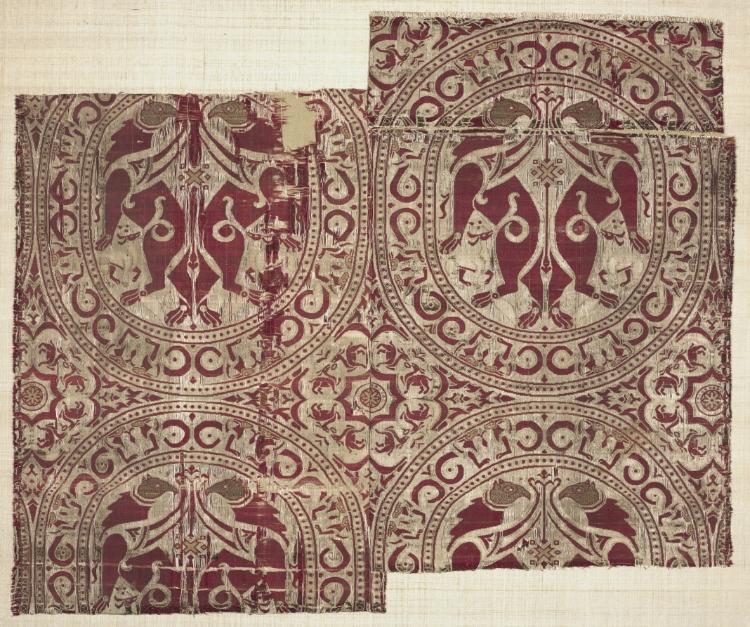
The Imperial Thread: A Study of the Lampas with Griffins in Roundels, Reliquary of Saint Librada
Within the hushed, stone-veined ambulatory of Siguenza Cathedral, a fragment of the divine is preserved not in gold or enamel, but in the tensile strength of a worm’s secretion. The lampas with griffins in roundels, once adorning the Reliquary of Saint Librada, is more than a textile; it is a ledger of power, a diplomatic passport, and a testament to the enduring legacy of imperial silk weaving. To examine this cloth is to read a chapter of medieval geopolitics, where the loom was as mighty as the sword.
Materiality and Technical Mastery
The artifact is a *lampas*, a compound weave of considerable complexity. Unlike simpler tabby or twill weaves, a lampas employs two distinct warp systems and two weft systems. The ground weave, typically a plain or twill structure, provides the structural integrity, while a supplementary pattern weft, often of a higher quality silk, floats across the surface to create the figural design. In this piece, the materiality is unequivocally silk—a fibre so coveted that its trade routes were guarded as fiercely as any border.
The technical virtuosity required to produce such a cloth in the medieval period cannot be overstated. The weaver had to coordinate hundreds of warp threads, each controlled by a complex system of heddles and treadles, to raise and lower them in precise sequence. The result is a fabric of remarkable density and drape, with a lustrous surface that catches the light in a manner that seems almost liquid. The griffins, mythical beasts with the body of a lion and the head and wings of an eagle, are rendered with a crispness that speaks to the weaver’s absolute command of their craft. They are enclosed within perfectly symmetrical roundels, a motif that is both a structural device and a symbolic frame, creating a rhythm of repetition that is both hypnotic and authoritative.
The Imperial Legacy: From Byzantium to the Islamic World
The iconography of the griffin in a roundel is not accidental; it is a direct inheritance from the imperial workshops of Byzantium and, subsequently, the Islamic caliphates. In the Eastern Roman Empire, silk weaving was a state monopoly, and the production of purple-dyed silks with specific motifs was reserved for the imperial family. The griffin, a creature of solar and celestial symbolism, was a common emblem of power, vigilance, and divine protection. When Constantinople fell to the Fourth Crusade in 1204, its master weavers dispersed, carrying their technical knowledge and design vocabulary to the courts of Sicily, Spain, and the broader Mediterranean.
In the Islamic world, particularly in Al-Andalus, the art of silk weaving reached new heights. The *tiraz* workshops, royal factories that produced textiles for the caliph and his court, adopted and refined the Byzantine techniques. The roundel motif, known as *orbiculata* in Latin, became a hallmark of luxury textiles. The griffin, while retaining its protective symbolism, was also integrated into a broader Islamic aesthetic that valued geometric order and arabesque forms. The Siguenza lampas, with its precise roundels and stylised creatures, sits squarely within this tradition. It is a product of the cultural confluence that defined the medieval Mediterranean, where Christian, Islamic, and Byzantine artistic languages intermingled to create something new and profoundly sophisticated.
Context and Provenance: The Reliquary of Saint Librada
The cloth’s function as a covering for the Reliquary of Saint Librada is crucial to understanding its value. Reliquaries were not mere containers; they were architectural monuments to faith, designed to house the physical remains of saints and, by extension, to channel their spiritual power. To cover such an object with an imperial silk was to elevate the saint’s status, aligning their sanctity with the temporal authority of emperors and caliphs. The choice of the griffin, a guardian of treasure and a symbol of Christ’s dual nature (human and divine), was profoundly apt.
The presence of this textile in Siguenza, a cathedral in the heart of Castile, speaks to the vast networks of trade and diplomacy that connected the Iberian Peninsula to the wider world. It may have been a gift from a Muslim ruler to a Christian king, a diplomatic offering designed to cement an alliance. Alternatively, it could have been acquired through the bustling markets of Toledo or Seville, where silks from the East were traded alongside gold and spices. The fact that it was preserved, rather than cut up and repurposed, indicates that it was recognised as a relic in its own right—a material witness to the sacred and the imperial.
The Legacy of Imperial Silk Weaving
The lampas from Siguenza is a tangible link to a legacy that spans millennia. The silk industry, from its origins in China to its refinement in Byzantium and its flourishing in the Islamic world, was the engine of the medieval luxury economy. It drove innovation in dyeing, weaving, and pattern design. It funded empires and financed crusades. The cloth itself, with its intricate structure and powerful imagery, is a microcosm of this vast history.
For the modern observer, the griffins in their roundels are not merely decorative. They are a reminder that the pursuit of beauty and the assertion of power are often inseparable. The silk, which once draped a sacred reliquary, now speaks to us of a time when the loom was a tool of statecraft, and a single bolt of cloth could carry the weight of an empire. In its threads, we find the echo of the weaver’s hands, the ambition of the patron, and the enduring human desire to create something that transcends the mundane. This is not just a textile; it is a document of civilisation, woven in silk.
Heritage Lab Insight
Lab Insight: CMA Silk Archive Node integration.