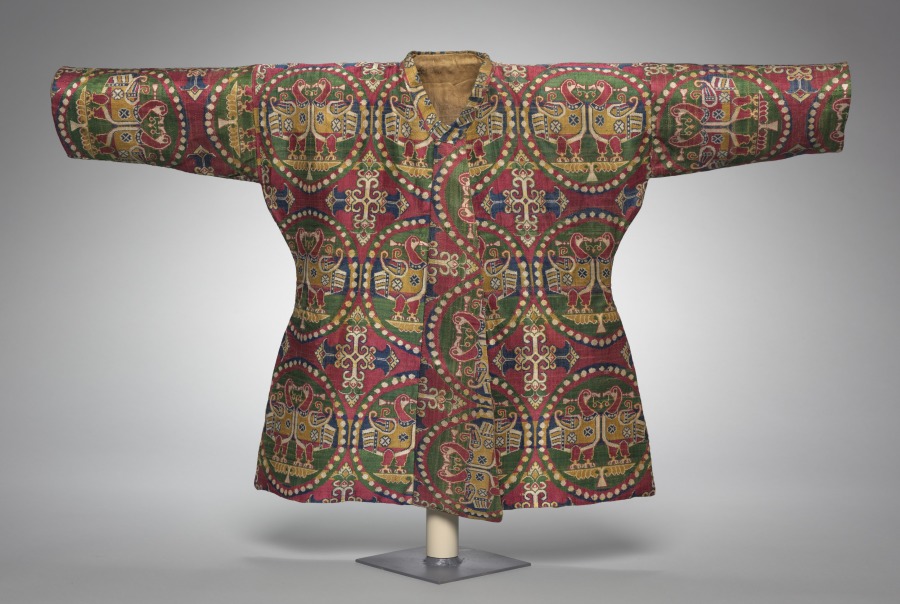
A Consideration of Juvenile Silks: The Legacy of the Imperial Loom in a Minor Garment
To examine a child’s coat is to engage with a particular, and often overlooked, stratum of sartorial history. It is a realm where the profound technical legacy of imperial manufacture intersects with the most intimate expressions of familial aspiration and affection. The specimen under consideration—a child’s coat adorned with ducks within pearl medallions, executed in silk—serves as a singularly eloquent artifact in this regard. It speaks not in the booming voice of state regalia, but in a refined, domestic whisper that nonetheless carries the full authority of centuries of unparalleled textile artistry. Its materiality is its first and most definitive proclamation: this is no ordinary fabric, but the product of a system perfected to serve the apex of power, here deployed for a purpose both tender and symbolic.
The Substrate of Power: Imperial Silk Weaving as Foundational Context
One must first apprehend the foundation upon which this modest garment is built. The legacy of imperial silk weaving, particularly as epitomised by the great Chinese workshops and, later, the state-sponsored ateliers of Europe, represents one of mankind’s most sustained and sophisticated endeavours in material civilisation. It was an enterprise that merged botanical science, zoology, complex mechanical engineering, and sublime aesthetic vision. The silks produced were not merely fabrics; they were engineered substrates of power, encoded with symbolic languages that denoted rank, virtue, and authority. The density of the weave, the complexity of the pattern, the lustre achieved through meticulous dyeing and finishing—these were metrics of control, both technical and political. To clothe a child in such a material was, therefore, a deliberate act of cultural transmission. It was to wrap the next generation in the very substance of legacy, to suggest that the infant, too, was heir to a continuum of refinement and order.
A Closer Inspection: Motif, Medallion, and the Language of Auspice
The specific decorative schema of this coat warrants dispassionate analysis. The use of pearl medallions—rounded, self-contained cartouches—is a direct inheritance from the grand ceremonial silks of imperial courts, where such frames isolated and elevated potent symbols of cosmic and earthly authority. Within these medallions, however, we find not dragons or phoenixes, but ducks. This substitution is of paramount significance. The duck, in numerous Eastern and Western iconographic traditions, is a symbol of conjugal fidelity, happiness, and safe passage. It is a creature of both water and land, embodying adaptability and grace. Its application here transforms the imperial medallion from a vessel of sovereign power into a locket of benevolent hope. The pearl border itself reinforces this: pearls, long associated with purity, wisdom, and spiritual luminance, form a protective ring around the emblematic fowl. The ensemble—ducks in pearl medallions—becomes a tapestry of wishes for the child: a life of harmonious relationships, protected virtue, and serene navigation through the world’s currents. The pattern is not a diminution of imperial style, but a sophisticated recalibration of its grammar for a private, hopeful purpose.
Cut, Construction, and the Concession to Utility
While the fabric and its decoration bear the weight of history, the garment’s cut brings us firmly into the realm of practical, juvenile necessity. The coat’s silhouette, likely a simple A-line or straight cut with wide sleeves, acknowledges the active, growing nature of its wearer. This is where the imperial material meets the nursery floor. The sublime silk, capable of holding the most intricate of woven fantasies, is here tailored for durability and ease of movement. One might consider this a poignant dialogue between the ideal and the real. The silk, a product of immense, almost rigidly controlled industry, is ultimately softened, shaped, and placed into service for the least rigid of human forms—a child at play. This juxtaposition is the artifact’s quiet masterpiece. It demonstrates that true luxury is not merely the application of precious materials, but their intelligent deployment in service of lived experience. The lining, perhaps of a fine cotton or lighter silk, would further illustrate this point: the hidden interior ensuring comfort against youthful skin, a private concession to practicality behind the public face of splendour.
Conclusion: An Heirloom of Dual Inheritance
In final analysis, this child’s coat stands as an heirloom of dual inheritance. It is a tangible fragment of the vast, technical legacy of imperial silk weaving, a direct beneficiary of millennia of innovation in sericulture, loom technology, and decorative arts. Yet, it simultaneously represents the intimate legacy of familial love and social positioning. It is a garment that whispers of parental ambition—not necessarily for power, but for a particular quality of life, for the imbuing of a new generation with the values of beauty, protection, and cultured grace that the silk itself embodies. The ducks in their pearled rounds are more than mere decoration; they are a silent, hopeful oration stitched in thread. To behold this coat is to understand that the most formidable cultural legacies are not only those displayed on the grandest stages, but also those carefully, lovingly folded around the smallest of shoulders. It confirms that the ultimate purpose of any heritage, however imperial its origins, is to be woven into the very fabric of the future, one stitch, one thread, one hopeful duck at a time.