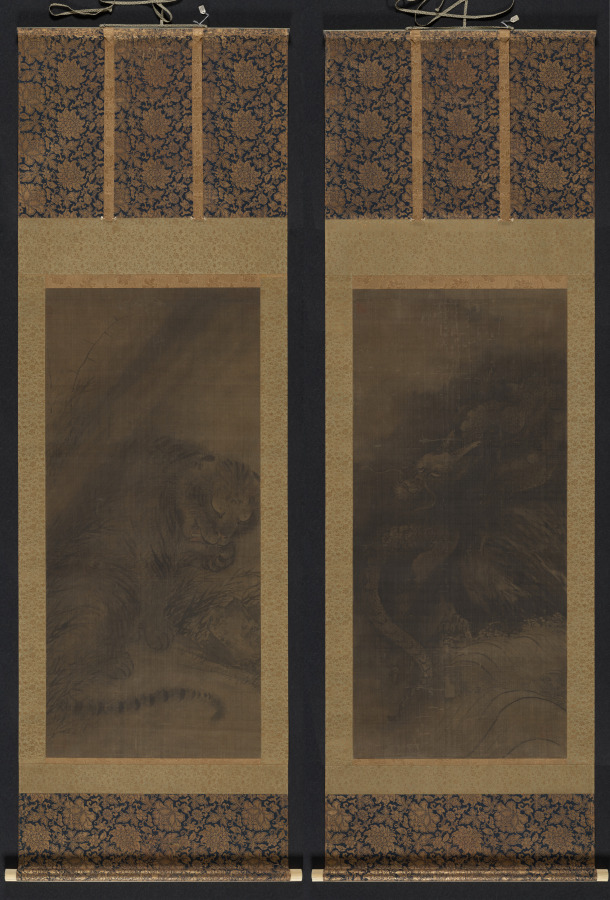
The Imperial Thread: Dragon and Tiger in the Material Culture of Silk
Prologue: The Loom as a Lexicon
In the hushed ateliers of London’s Savile Row, where a tape measure is a sceptre and a chalk mark a decree, we understand that cloth is never mute. It speaks of provenance, of power, and of the hand that guided the shuttle. To examine the dragon and the tiger rendered in imperial silk is to read a manuscript woven in gold and cinnabar—a manuscript that predates our bespoke suits by two millennia. The legacy of imperial silk weaving is not merely a chapter in textile history; it is the foundational grammar of luxury itself. Here, we dissect the materiality of that grammar, focusing on two of its most potent motifs: the celestial dragon and the terrestrial tiger.
The Material Imperative: Why Silk, Why Imperial
Silk was never a mere fabric in the Chinese imperial court; it was a political instrument, a currency of legitimacy, and a metaphysical conduit. The mulberry worm’s filament, unbroken for hundreds of metres, symbolised the unbroken lineage of the Son of Heaven. The imperial silk workshops, particularly those of the Ming (1368–1644) and Qing (1644–1912) dynasties, operated under a draconian protocol. The looms—often requiring two weavers working in tandem, one above and one below—were not machines but extensions of the state’s cosmological order. The materiality of this silk was distinct: a tightly twisted warp, a weft of lustrous, unboiled filaments, and a density that allowed for the intricate weft-faced patterning known as *kesi* (cut silk) or the more common *satin* weave. This was not the soft, drapey silk of a modern scarf; it was a stiff, architectural textile, designed to hold its shape against the rigid formality of court robes. The weight of the fabric, the precision of its weave, and the depth of its dye (using madder for red, indigo for blue, and the precious *huang* from the gromwell root for imperial yellow) were all regulated. To wear such silk was to wear the state itself.
The Dragon: The Sovereign’s Breath
The five-clawed dragon (*mang*), reserved exclusively for the emperor and his immediate male kin, was not a decorative afterthought. It was the emperor’s alter ego, the embodiment of his mandate from Heaven. In the imperial silk workshops, the dragon was rendered with an obsessive anatomical precision that belies its mythical nature. Observe the head: the snout is broad, the whiskers are executed in a single, continuous thread that loops and returns, and the horns are those of a stag, not a ram. The scales—each one a tiny, overlapping crescent of gold or silver thread—are laid in a herringbone pattern that catches light differently with each movement of the wearer. The claws, splayed and aggressive, are not merely drawn; they are built up in raised, couched gold threads, creating a tactile, sculptural relief against the flat silk ground. This is the dragon as a force of nature, its body coiling through clouds that are themselves woven from a lighter, floating weft. The materiality of the dragon is one of tension: the stiff, heavy silk provides the canvas, while the metallic threads—gilt paper wrapped around a silk core—add a brittle, brilliant counterpoint. The dragon does not sit on the robe; it *inhabits* it, its sinuous form following the structural seams of the garment, so that when the emperor turned, the dragon appeared to move, to breathe. This was not art for art’s sake; it was a functional, talismanic armour of legitimacy.
The Tiger: The Martial Counterweight
If the dragon is the sovereign’s celestial breath, the tiger is his terrestrial sinew. In the imperial hierarchy of motifs, the tiger is the fourth rank of military officials, but its presence in silk weaving is far more nuanced. Unlike the dragon’s overtly political symbolism, the tiger in imperial silk represents a raw, disciplined power—the power of the garrison, the hunt, and the frontier. The materiality of the tiger is distinct from that of the dragon. While the dragon is often rendered in gold and yellow, the tiger is depicted in naturalistic tones: ochre, umber, and a deep, burnt orange, often against a ground of dark indigo or black silk. The stripes are not painted but woven, using a technique called *jin* (brocade), where the weft threads are interrupted and re-inserted to create sharp, angular contrasts. The tiger’s musculature is suggested through the density of the weave itself—a tighter, more compact weft under the shoulders, a looser one in the flanks. Its eyes are often picked out in a single, tiny knot of jet-black silk, giving it a startling, living gaze. In contrast to the dragon’s flowing, calligraphic line, the tiger is rendered with a staccato, almost brutalist precision. It is the material embodiment of *wu* (martial virtue), a counterpoint to the dragon’s *wen* (civil virtue). Together, they form a complete cosmology: the dragon above, the tiger below; the dragon in the clouds, the tiger in the bamboo grove. In the imperial wardrobe, a robe might feature the dragon on the front and the tiger on the back, or the tiger as a border motif, guarding the hem against earthly threats. The tiger is the anchor, the weight that prevents the celestial from floating away into mere abstraction.
The Weave of Power: Technique as Hierarchy
The legacy of imperial silk weaving is not just in the motifs but in the *technique* that made them possible. The *kesi* technique, which literally means ‘cut silk’, was the pinnacle of this craft. Unlike brocade, where the pattern is woven on top of the ground weave, *kesi* uses a small, boat-shaped shuttle for each colour area, creating a tapestry-like structure where the pattern is integral to the ground. The result is a fabric that is identical on both sides—a perfect, reversible image. The dragon and tiger rendered in *kesi* are not merely depicted; they are *constructed*. Each scale, each stripe, each whisker is a separate, deliberate insertion of weft. The weaver, often working for months on a single square foot, had to maintain an unbroken tension across the entire piece. A single error—a misaligned thread, a broken filament—would compromise the entire cosmological balance. This technique demanded a level of patience and precision that is almost incomprehensible to the modern, mechanised mind. It is the antithesis of mass production. It is bespoke in its purest form, a garment made for one body, one soul, one mandate. The imperial silk workshops were the Savile Row of their age, but with a crucial difference: our clients choose their cloth; the emperor’s cloth chose him.
Conclusion: A Legacy in the Thread
When we at Lauren Fashion Heritage Lab handle a fragment of imperial silk—a sleeve, a collar, a panel of a dragon’s claw—we are not handling a relic. We are handling a standard. The dragon and the tiger, woven in silk, were not decorations but declarations. They declared the authority of the state, the discipline of the military, and the unbroken continuity of a civilisation. The materiality of that silk—its weight, its sheen, its structural integrity—was the medium through which that declaration was made credible. In our own craft, we seek a similar integrity: a cloth that speaks before a word is uttered, a cut that holds its line, a garment that outlives its maker. The imperial weavers understood this. They understood that power is not worn; it is woven. And in the dragon’s golden claw and the tiger’s striped flank, we see the eternal truth of our trade: that the finest material, in the hands of a master, becomes not just an object but an argument. The argument endures. The thread remains unbroken.