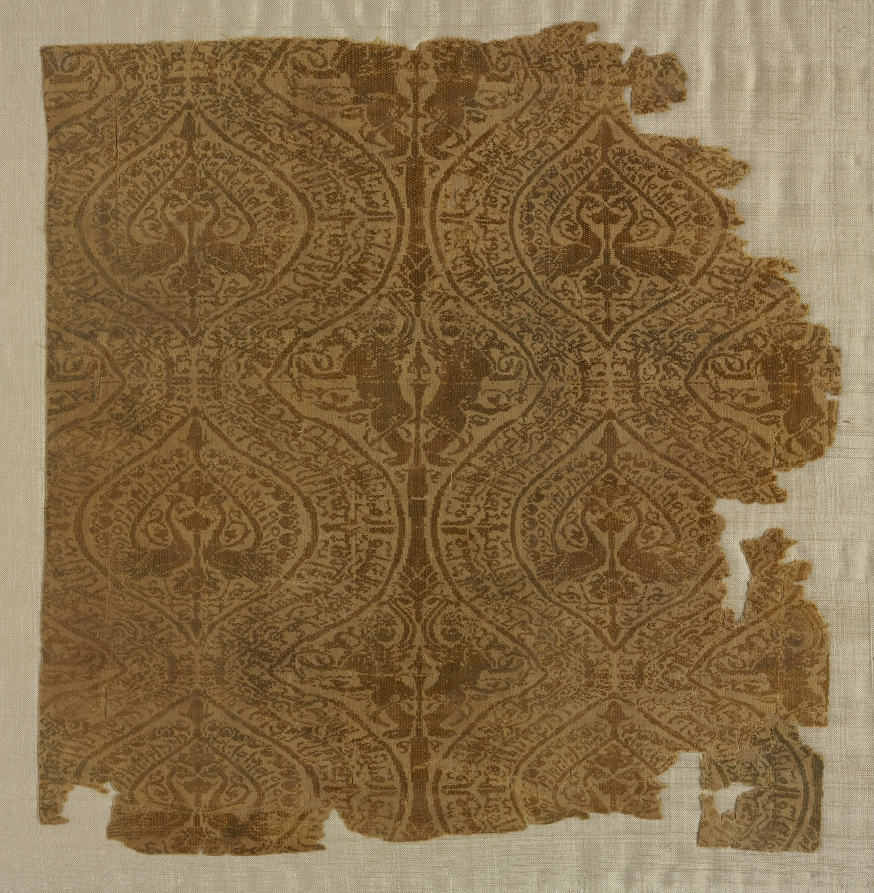
Fragment with Peacocks in Ogival Pattern: A Study in Imperial Silk and the Modern Tailoring Ethos
Provenance and Materiality
Category: Silk
This fragment, a surviving testament to the zenith of imperial silk weaving, presents a study in disciplined opulence. The ground is a tightly woven silk, likely a compound satin or twill, whose technical refinement speaks to the ateliers of a bygone court. The materiality is not merely tactile; it is structural. The warp and weft are held in a tension that suggests a loom of considerable sophistication, one capable of producing a fabric of both substantial drape and luminous surface. The silk’s lustre, though aged, retains a quiet fire—a reminder that this was a material designed to catch candlelight, to move with ceremony, and to signify rank without uttering a word.
In the context of imperial weaving, silk was never simply a textile. It was a currency of power, a diplomatic gift, and a record of technical mastery. The density of the weave indicates a high thread count, a hallmark of courtly production where time was subordinate to perfection. The fragment’s surviving edges suggest it was once part of a larger length, perhaps a robe, a hanging, or a saddle cloth. Its current state—a preserved remnant—invites us to consider the whole from the part, much as a master tailor reads a lapel from a single seam.
The Ogival Architecture
The pattern is anchored in the ogival lattice, a structural motif that has recurred across Persian, Ottoman, and Italian Renaissance silks. Here, the ogive is not merely decorative; it is an architectural armature. The intersecting curves form a series of pointed arches, each framing a central motif. This is a geometry of containment and release—the eye is drawn along the sinuous lines, then held within the compartment, then released to the next. The precision of the repeat suggests a cartoon or template of exceptional accuracy, likely drawn on paper and then transferred to the loom via a drawloom system. The symmetry is near-perfect, a feat that required the weaver to manage hundreds of individual warp threads, each controlled by a separate harness cord.
The ogival pattern, in its imperial context, was a statement of order. It mirrored the hierarchical structure of the court itself—each element in its place, each curve subordinate to the whole. This is not the chaotic abundance of a floral chintz; it is a controlled, almost mathematical, beauty. For the modern eye, accustomed to the clean lines of Savile Row, the ogive offers a compelling counterpoint: it demonstrates that pattern can be structured, that ornament can be architectural, and that luxury need not be loud.
The Peacock Motif: Symbolism and Craft
Within each ogival compartment sits a peacock, rendered with a stylised naturalism that is characteristic of high imperial art. The bird is not depicted in flight or in a state of agitation, but in a poised, frontal stance—a heraldic pose. The tail is not fully fanned, but suggested in a sweeping arc that echoes the ogive’s curve. This is a deliberate compositional choice: the peacock’s form is integrated into the lattice, not superimposed upon it. The weaver has used the silk’s natural sheen to differentiate the bird’s body from the ground, often employing a contrasting weft colour—perhaps a deep indigo or a madder red—to make the motif emerge from the architectural framework.
The peacock is a loaded symbol. In Persian and Mughal tradition, it is the bird of paradise, associated with immortality, royalty, and the all-seeing eye. In Christian iconography, it signifies resurrection. For the imperial weaver, the peacock was a shorthand for the sovereign’s own divine mandate. To wear such a fabric was to wear a claim to cosmic order. The fragment thus carries a weight of meaning that transcends its physical form. It is a political document, a theological statement, and an artistic tour de force, all woven into a single, portable object.
From a technical standpoint, the peacock’s plumage would have been the weaver’s greatest challenge. The subtle gradations of blue, green, and gold required either a complex system of supplementary wefts or a clever use of the silk’s own iridescence. The fragment’s surviving colours suggest a palette of deep jewel tones—emerald, sapphire, and topaz—set against a ground of ivory or pale gold. This is not a timid palette; it is one that assumes authority.
The Legacy of Imperial Weaving in Modern Tailoring
How does this fragment speak to the modern Savile Row house? The connection is not one of direct imitation, but of principle. The imperial weaver and the master tailor share a fundamental obsession: the relationship between structure and surface. The ogival pattern is, in essence, a form of tailoring. It imposes a skeleton on the fabric, just as a canvas interlining imposes a skeleton on a jacket. The peacock, in turn, is the ornament that justifies the structure—much as a fine lapel roll or a hand-picked lapel edge is the ornament that justifies a bespoke garment.
The legacy of imperial silk weaving survives in the modern insistence on cloth as the primary medium of menswear. A Savile Row suit is not made; it is engineered. The choice of silk, the weight, the drape, the pattern repeat—all are considered with the same gravity that a court weaver applied to a ceremonial length. The fragment reminds us that luxury is not about excess; it is about control. The ogive controls the eye. The peacock controls the narrative. The silk controls the light.
Furthermore, the fragment’s survival is a lesson in longevity. It has outlived empires, looms, and the hands that made it. This is the ultimate aspiration of the tailor: to create an object that will not merely last, but will accrue meaning over time. A well-made garment, like this fragment, becomes a palimpsest—a surface upon which history writes itself. The modern client who commissions a silk-lined evening jacket or a patterned waistcoat is, consciously or not, participating in this lineage.
Conclusion: A Fragment as a Whole
This fragment with peacocks in an ogival pattern is not a relic; it is a reference. It offers a masterclass in the marriage of material and motif, of restraint and flourish. For the heritage specialist, it is a primary source on imperial technique. For the tailor, it is a prompt to consider how structure can be made beautiful. For the wearer, it is a reminder that clothing has always been a form of speech—and that the most eloquent statements are often woven in silk.
The fragment’s edges are frayed, its colours softened by time. But its architecture remains intact. And that, in the end, is the definition of true craftsmanship: the ability to hold a line, even as the world around it shifts. This is the lesson of the ogive, the peacock, and the silk itself. It is a lesson that Savile Row, in its best moments, has never forgotten.