← BACK TO ARCHIVES
Heritage-Black
Heritage Synthesis: Terracotta fragment of a kylix (drinking cup)
Curated on Aug 31, 2026 // Node: LDN-01
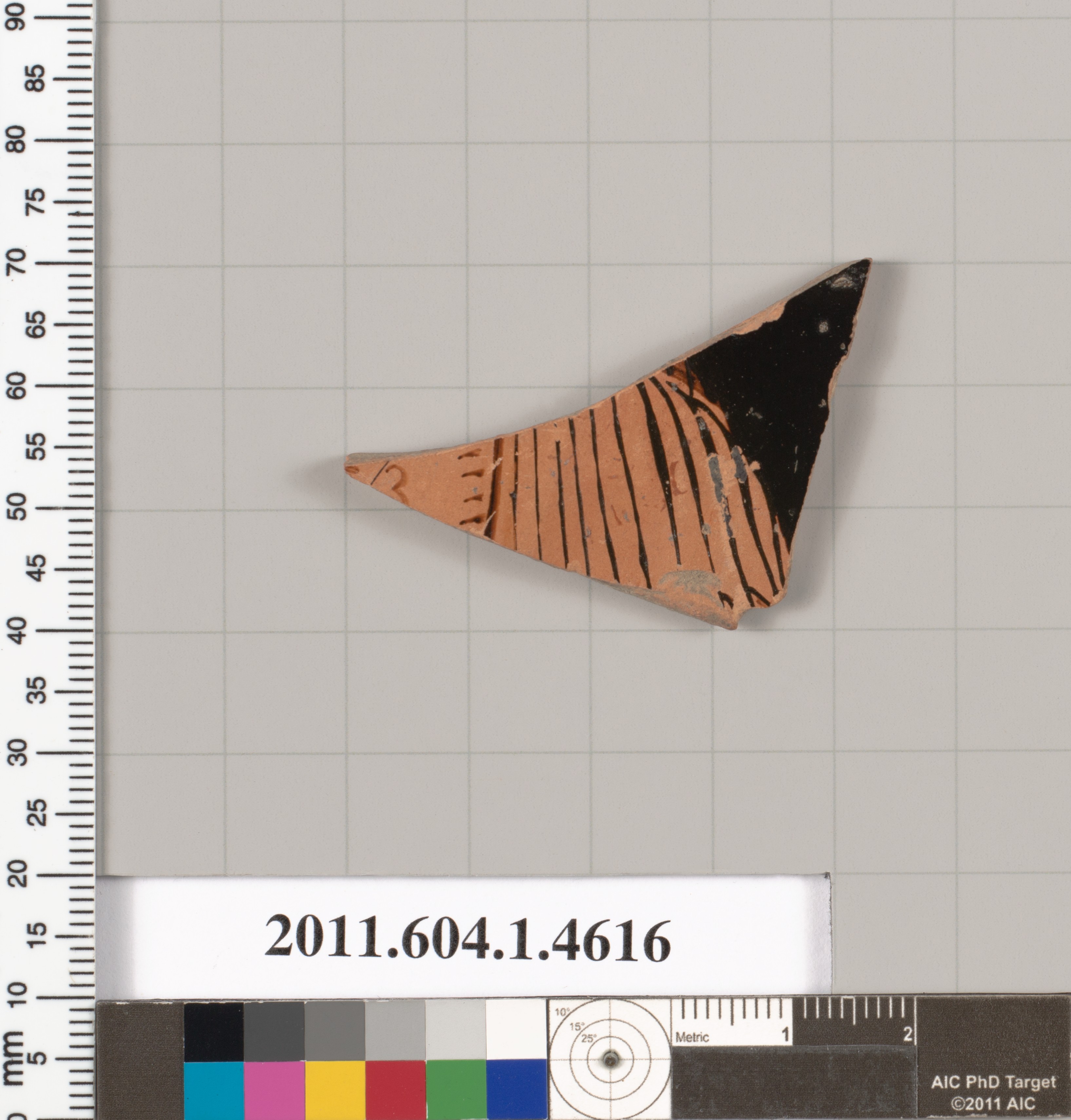
The Dialectics of Silence and Rupture: A Terracotta Fragment as a Blueprint for 2026 Old Money Silhouettes
The internal genetic code of Lauren Fashion Heritage Lab—anchored in the dialectic between the *Meiping*’s silent, wave-bound eternity and David’s theatrical, time-shattering *Death of Socrates*—finds an unexpected, almost archaeological resonance in the museum artifact before us: a terracotta fragment of an Attic kylix. This shard, a broken drinking cup from classical Greece, is neither a pristine vessel of Eastern stillness nor a narrative explosion of Western moral drama. It is, instead, a third term: a *witness to rupture*. For the 2026 Old Money silhouette, this fragment is not a decorative source but a philosophical template. It instructs us to design not for the seamless surface, but for the *edge where time breaks*—where the patina of heritage meets the violence of the present. The Old Money aesthetic, often misread as mere quiet luxury, is here redefined as a *curated archaeology of the self*: a garment that carries the memory of its own making, and the dignity of its own potential unmaking.
I. The Kylix as Anti-Meiping: The Materiality of the Broken
The Meiping vase, in our internal code, achieves eternity by *freezing* the wave into glaze. Its silence is a refusal of narrative. The Attic kylix fragment, conversely, achieves depth through *fracture*. Its terracotta body—once a vessel for symposium wine, for the conviviality of philosophical debate—is now a shard. The painted figures, likely a komast or a draped youth, are severed mid-gesture. This is not the static wave of the East; this is the *freeze-frame of catastrophe*. The kylix’s broken rim does not soothe the viewer with smooth curves; it presents a jagged edge that cuts against the hand that holds it.
For the 2026 Old Money silhouette, this translates into a rejection of the *unbroken* garment. The new heritage look does not fear the visible seam, the deliberate fray, the unpolished edge. Where the Meiping-inspired design would use a continuous, fluid line of cashmere or silk to suggest timelessness, the kylix-informed design introduces *strategic interruption*. A tailored wool overcoat, for instance, might feature a hand-finished hem that is deliberately left raw on the inner facing—a secret rupture visible only to the wearer. A silk charmeuse blouse may have its side seam constructed with a contrasting, exposed topstitch in gold-thread, echoing the kylix’s painted lines that are now broken by the fracture. The Old Money wearer, in 2026, does not project effortless perfection; she projects *effortful survival*. She wears the fragment of a lineage, not the whole urn.
II. The Death of Socrates in Terracotta: Narrative as Structural Memory
Our code posits that David’s painting is a “narrative explosion,” a linear time collapsing toward a moral apex. The kylix fragment, though broken, contains the *potential* for that explosion. The painted scene—even in its incompleteness—suggests a symposium, a space where Socrates himself might have debated the nature of the soul before drinking the hemlock. The fragment thus holds both the *event* (the philosophical discourse) and the *rupture* (the physical break). This is the key insight for 2026: the Old Money garment must be a *container of events*, not just a covering of the body.
Consider the construction of a 2026 heritage blazer. Instead of a clean, fused interior, the garment’s lining is printed with a fragmented reproduction of the kylix’s painted scene—a gesture that references the museum artifact’s incomplete narrative. The wearer, when removing the blazer, reveals this hidden story. This is not ostentation; it is *intimacy with history*. The silhouette itself—broad-shouldered, slightly oversized, with a dropped waist—echoes the kylix’s original *symposium posture*: reclined, contemplative, ready for discourse. The fabric, a heavy wool broadcloth in heritage-black, is treated with a subtle, irregular surface texture that mimics the terracotta’s porous, fired quality. This is not a smooth, modern finish; it is a *memory of the kiln*. The garment, like the shard, has been “fired” by time—by the hands of artisans who understand that true luxury is the *visible trace of process*.
III. The Dialectical Synthesis: Wearing the Question
The Meiping asks: *Is the wave frozen, or is time frozen?* The kylix fragment asks a more brutal question: *What remains when the cup is broken?* For the 2026 Old Money silhouette, the answer is: *the gesture remains*. The kylix’s painted hand, reaching for a wine bowl that is now missing, becomes a metaphor for the garment’s relationship to the body. The silhouette does not cling to the body; it *frames* it, leaving space for the wearer’s own narrative to unfold. The cut is architectural, but not rigid—it borrows from the kylix’s *tondo* (the circular interior) to create curved lapels and rounded pockets that soften the sharpness of the tailored shoulders. This is the dialectic resolved: the *silence of the Meiping* (the unadorned, fluid drape) meets the *rupture of the kylix* (the deliberate, visible construction) within the *narrative gravity of David* (the garment’s ability to confer moral weight upon the wearer).
The 2026 Old Money silhouette, therefore, is not a nostalgic return to a pre-war wardrobe. It is a *philosophical garment* that acknowledges the brokenness of the present. It wears its heritage like a shard of Attic pottery—not as a trophy, but as a *memento mori* that paradoxically empowers. The deep, heritage-black color of the primary fabric is not a void; it is the *ground* against which the fragment’s painted lines—here rendered as subtle, tonal embroidery or a jacquard weave—can emerge. The wearer becomes a living museum, but one where the artifacts are not behind glass. They are on the body, in the seams, in the deliberate asymmetry of a hem that falls one inch longer on the left, echoing the kylix’s broken edge.
IV. Conclusion: The Fragment as the New Totality
In the end, the terracotta kylix fragment teaches us that *totality is a lie*. The Meiping’s perfect, unbroken surface is a beautiful fiction; David’s complete, theatrical scene is a moral construction. The fragment, however, is *honest*. It admits that we do not possess the whole—we possess only the *trace* of the whole. The 2026 Old Money silhouette, informed by this artifact, embraces this honesty. It is a garment of *negative space*: the missing pieces of the kylix are as important as the present shard. The silhouette is designed with *deliberate absences*—a neckline that cuts sharply, suggesting a missing collar; a sleeve that ends mid-forearm, as if the cuff were broken off. These are not flaws; they are *invitations to completion*. The wearer completes the garment through her own presence, her own gestures, her own time.
Thus, the heritage of Lauren Fashion is not about preservation. It is about *transformation through fracture*. The kylix fragment, the Meiping’s frozen wave, and Socrates’ raised hand all converge in a single, silent instruction: *Design for the moment after the break, when the shard still glows with the warmth of the hand that held it.* That is the true Old Money silhouette of 2026—not a costume of the past, but a *vessel for the future’s memory*. It is worn, not displayed. It is broken, not perfect. And in that brokenness, it achieves a depth that no unbroken surface can ever possess.
Heritage Lab Insight
Genetic Bridge: Archive node focusing on Heritage-Black craftsmanship.