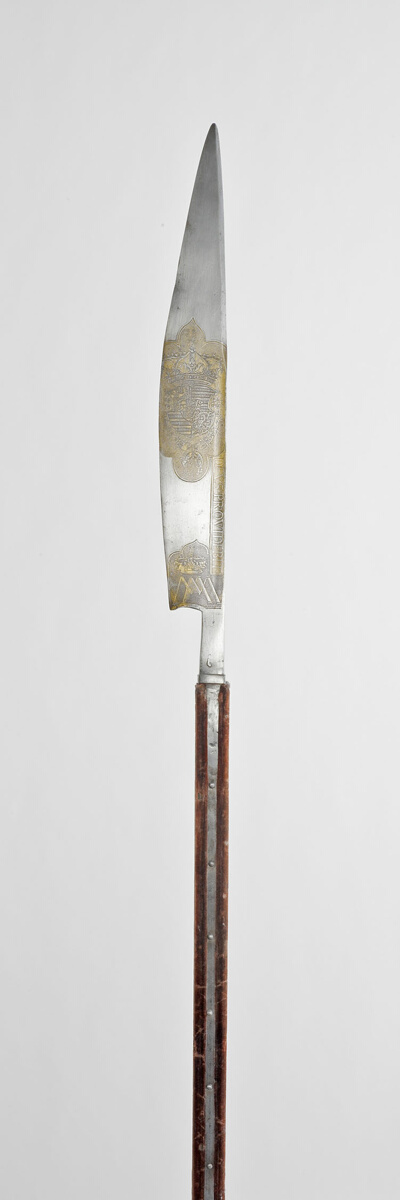
An Armoured Proposition: The Glaive as a Sartorial Statement
To consider the glaive—a polearm of formidable utility, a symbol of martial office—is, in the first instance, to consider function. Its presence denotes a perimeter, a sphere of protection, a literal cutting edge between sovereignty and threat. Yet, when commissioned for the bodyguard of a figure such as Maximilian, Archduke of Austria, King of Hungary and Bohemia, and later Holy Roman Emperor, the object transcends its base utility. It becomes, like the finest garment, a bespoke articulation of identity, power, and aesthetic principle. The specimen in question, a glaive of steel, iron, and gilding, with its haft of oak and its startling accompaniment of silk velvet, presents not as mere weaponry, but as a tailored proposition in authority. Its materiality speaks a nuanced language, where the fluid elegance of silk craftsmanship engages in a deliberate dialogue with the unyielding severity of tempered steel.
The Canvas and the Cut: Steel as Worsted, Gilding as Piping
Examine first the foundational cloth, as it were: the steel of the blade. This is no brutish slab of metal. Its elongated, curvilinear form, with a gracefully exaggerated curve to the cutting edge, suggests a sculptural intent. The forging process—the heating, the hammering, the careful grinding—parallels the shearing of the finest wool. Both demand an artisan’s eye for line and balance. The resultant blade is not simply sharp; it is draped. It falls from the socket with a lethal grace, its spine a clean line, its edge a sweeping curve. This is the garment’s silhouette.
Upon this austere canvas, we encounter the embellishment: the gilding. Applied with precision to the central ridge and perhaps the socket, this is not vulgar ostentation. It is, rather, the functional equivalent of discreet piping on a morning coat or the burnished buttons on a uniform tunic. It articulates the form, drawing the eye along the blade’s lines, highlighting its craftsmanship without obscuring its purpose. It is a note of regal distinction, a whisper of the Habsburg sunburst in a field of grey steel, confirming that this instrument serves not a mercenary, but a king—and, by extension, an emperor-in-waiting.
The Unexpected Lining: Silk Velvet and the Theatre of Power
Here we arrive at the piece’s most provocative sartorial intervention: the silk velvet. To sheath a portion of the oak haft in this most sumptuous, most tactile of textiles is an act of profound conceptual tailoring. Oak, strong and serviceable, is the practical choice—the sturdy twill of the working garment. Silk velvet is the realm of the court, of ceremony, of the robe d’apparat. Its integration transforms the glaive from a tool of the guard into a component of the imperial tableau.
Consider the sensory implications. The guard’s hand, resting upon the velvet-wrapped section, experiences not the rough, pragmatic grip of bare wood or leather, but the cool, plush density of sovereign luxury. This contact creates a constant, tactile reminder of the exalted nature of his duty. The velvet acts as a lining, the hidden luxury that separates the exquisite from the merely serviceable. Furthermore, in the context of a ceremonial precession or a static guard posture, the glaive is no longer held; it is presented. The fall of light on the deep, absorbent pile of the velvet provides a visual counterpoint to the gleam of steel and gold—a study in matte and sheen. It softens the weapon’s harshness without diminishing its authority, much as a velvet-collared overcoat tempers the severity of a Savile Row suit.
Context and Cut: Maximilian’s Fluid Elegance
The patron’s context renders this material dialogue profoundly coherent. Maximilian II, positioned between the militant Catholicism of his father, Ferdinand I, and the austere Protestantism he privately favoured, was a man of calculated equilibrium. His court was renowned for its intellectualism, its artistic patronage, and a political demeanour that sought conciliation over confrontation. This glaive, for his personal guard, embodies that very principle.
It is a weapon, yes, but one garbed in the aesthetics of peace and cultivation. The fluid elegance of the blade’s line, mirrored in the soft fall of the velvet, speaks of Renaissance humanism, of an appreciation for form that transcends mere function. It communicates that the Habsburg power it protects is not merely brute force, but a force tempered by culture, sophistication, and an impeccable sense of style. The guard, thus equipped, becomes more than a soldier; he is an extension of the imperial persona—a figure of restrained might, whose authority is underscored by his impeccable, and intimidating, turnout.
A Lasting Legacy: The Bespoke Nature of Authority
In conclusion, this heritage artifact stands as a masterclass in the bespoke language of power. Every element is considered, measured, and integrated to serve a narrative far greater than utility. The steel provides the impeccable cut, the gilding offers discreet embellishment, the oak supplies underlying structure, and the silk velvet delivers the unexpected, transformative luxury. Together, they craft a statement for the bodyguard, and by proxy for Maximilian himself, that is clear: here, authority is not shouted; it is tailored. It understands that true influence resides in the mastery of all materials to hand, from the forge to the loom, synthesising them into an object of fluid elegance and unequivocal command. It is a principle as relevant to the ateliers of today as it was to the armourers and weavers of the Habsburg court—that enduring impact lies in the details, in the lining as much as in the blade.