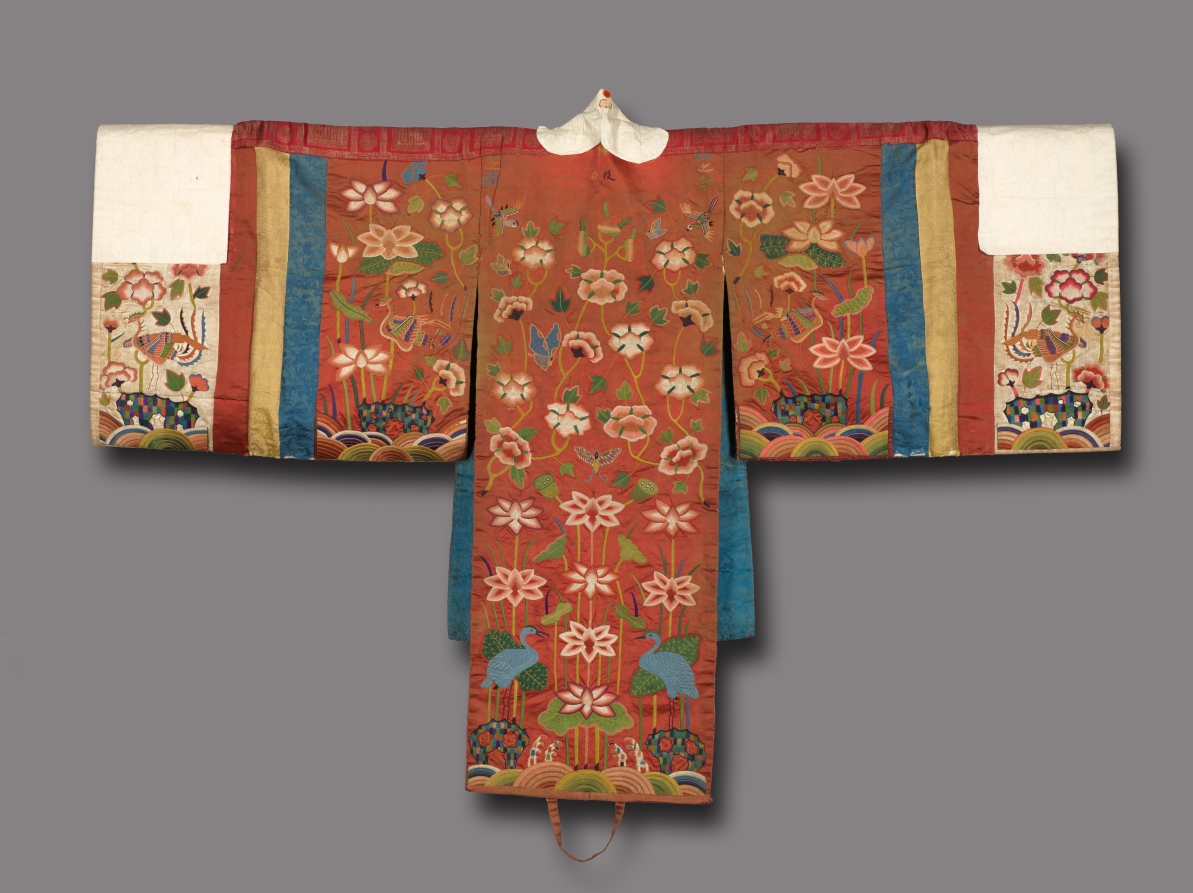
The Hwarot: A Study in Imperial Silk and the Architecture of Ceremony
Provenance and the Language of Silk
In the rarefied world of heritage textiles, few garments command the gravitas of the Korean Hwarot—a bridal robe whose very existence is a testament to the enduring dialogue between imperial patronage and artisanal mastery. To examine this piece is to read a manuscript written not in ink, but in the lustrous, unbroken filament of the silkworm. The Hwarot, worn by royal brides during the Joseon dynasty and later adopted by commoners for nuptial rites, is not merely a garment; it is a portable edifice of status, a wearable declaration of cosmic and social order. Its materiality—pure, cultivated silk—anchors it within a legacy that stretches from the mulberry groves of ancient China to the ateliers of the Korean court, a lineage that demands the same reverence a Savile Row cutter affords a bolt of Harris Tweed or a length of Scottish mohair.
The fabric itself is the first protagonist. Imperial silk weaving was never a casual industry; it was a state-sponsored discipline, governed by sumptuary laws and seasonal rhythms. The Hwarot’s silk is typically a dancheong-grade weave—a tight, high-density tabby or twill that provides a smooth, almost enamel-like surface. This is not the soft, drapey silk of a Parisian blouse. This is architectural silk, engineered to hold its shape beneath the weight of elaborate embroidery. The warp and weft are set with a precision that borders on obsessive, each thread combed and tensioned to within a hair’s breadth of perfection. In the same way a Savile Row tailor selects a cloth for its “hand” and its ability to hold a crease, the Joseon weaver selected this silk for its rigidity of surface—a canvas that would not pucker or distort under the density of gold-thread work.
The Materiality of Power: Weave, Weight, and Light
Touch is the first test. Run a gloved hand across a preserved Hwarot, and you will feel a surface that is paradoxically both cool and warm—cool in its smooth, unyielding finish, warm in the subtle give of the silk’s natural protein structure. The weight is substantial, a deliberate counterpoint to the ethereal associations of silk in Western fashion. This is a cloth that announces presence before a single step is taken. The weave density, often exceeding 120 threads per centimetre, creates a micro-texture that catches light in a manner akin to a calm sea—not a glitter, but a deep, shifting sheen that rewards slow, deliberate movement. This is the legacy of imperial weaving: a refusal of frivolity, a commitment to material gravitas.
The colour—typically a deep, saturated crimson or vermillion—is not incidental. Derived from madder root or cochineal, the dyeing process was a ritual in itself, requiring multiple immersions to achieve the requisite depth. The resulting hue is not a flat red; it is a layered, almost translucent colour that seems to glow from within. This is the same logic that governs a bespoke tailor’s choice of a midnight blue or a charcoal grey—a colour that is not merely seen but felt, a colour that carries the weight of tradition without shouting. The crimson of the Hwarot is the colour of yang—of life, of the sun, of the bride’s transition into a new cosmic role. Yet the silk’s materiality tempers this symbolism into something profoundly restrained.
Construction: The Tailoring of Ceremony
Here, the London Savile Row analogy becomes most acute. The Hwarot is not draped; it is cut and constructed. Its silhouette—a high waist, full sleeves, and a long, straight skirt—is achieved through a series of precise panels, each cut on the straight grain to preserve the silk’s structural integrity. The seams are not hidden; they are deliberately exposed and bound with contrasting silk ribbon, a technique reminiscent of the “pick-stitch” or “fell seam” of a hand-finished jacket. This is not an accident of construction but a philosophical choice: the garment celebrates its own making, acknowledging the hand of the artisan as a visible partner in the creation of meaning.
The embroidery—the Hwarot’s most famous feature—is applied after the garment is assembled, a practice that would horrify a Western embroiderer who works on the flat. Yet this post-construction application is precisely what gives the Hwarot its sculptural quality. Motifs of peonies, pomegranates, and the ten symbols of longevity are worked in gold-wrapped silk thread, laid in a couching technique that creates a raised, almost bas-relief surface. The gold thread, itself a product of imperial workshops, is not a mere decoration; it is a secondary structural element, adding weight and tension to the silk ground. The result is a garment that holds its shape like a suit of armour, yet moves with a liquid grace that only silk can provide.
The Legacy of Imperial Silk in Modern Context
To consider the Hwarot today is to consider the fragility of this legacy. The silk itself is a biological material, susceptible to light, humidity, and the inexorable pull of time. Yet its survival—in museum collections and private archives—speaks to the extraordinary durability of imperial-grade weaving. Unlike commercial silks, which are often weighted with metallic salts to enhance drape, the Hwarot’s silk is pure, unweighted, and thus capable of surviving centuries if properly housed. This is the same principle that governs a Savile Row suit: quality is not a luxury; it is a form of preservation.
The Hwarot’s materiality also offers a corrective to contemporary fashion’s obsession with speed. In an era of fast fashion and synthetic blends, the Hwarot stands as a rebuke—a reminder that silk, at its highest expression, is not a commodity but a repository of cultural memory. The imperial weavers who produced this cloth understood that their work would outlive them, that the silk would carry the weight of dynastic ambition and personal hope into an unknowable future. This is the same ethos that drives a master cutter on Sackville Street, who knows that his garment will be worn, altered, and eventually passed down—not as a relic, but as a living testament to the value of patience.
In the end, the Hwarot is not a costume. It is a material argument—a proposition that beauty, when executed with technical rigour and cultural intention, can transcend the merely decorative. Its silk is not a backdrop but a protagonist, a thread that connects the bride to the empress, the weaver to the wearer, the past to the present. For the heritage specialist, it is a masterclass in the discipline of materiality: a reminder that the true luxury is not in the ornament, but in the unbroken, unyielding integrity of the cloth itself.