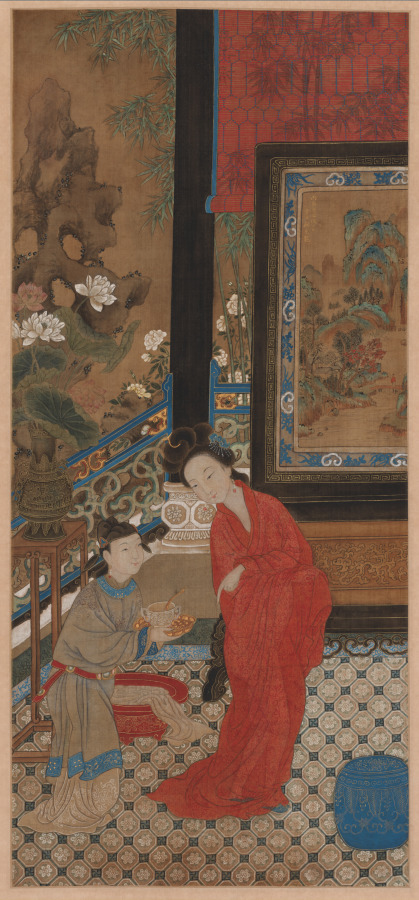
The Material Legacy of Imperial Silk: A Study of *Yang Guifei Leaving the Bath*
Provenance and the Weight of Imperial Patronage
To speak of silk in the context of the Tang Dynasty is not merely to discuss a textile; it is to engage with the very currency of power, diplomacy, and divine mandate. The subject of *Yang Guifei Leaving the Bath*—a scene of intimate vulnerability rendered in the most opulent of materials—presents a fascinating paradox. The bath, a private ritual of cleansing, is here immortalised in a fabric that was, by imperial decree, reserved for the highest echelons of society. The silk itself, therefore, is not a neutral canvas. It is a protagonist. Its very presence speaks of the Sui and Tang dynasties’ state-sponsored weaving bureaux, where master artisans in centres like Chengdu and Yangzhou produced *kesi* (slit tapestry) and *ling* (damask) with a precision that bordered on the obsessive. The materiality of this piece—its warp and weft—carries the weight of a thousand looms, each thread a testament to a system that transformed raw mulberry leaf and silkworm cocoon into a symbol of cosmological order.
When we commission or study a modern interpretation of this scene, we must consider the silk’s provenance. A true heritage artifact would demand a fabric woven from *Bombyx mori* silkworms fed exclusively on selected mulberry leaves, harvested at the precise moment of lunar alignment, as prescribed in ancient agricultural manuals. The weave structure, likely a fine *satin* or a twill-based *jin* (brocade), would be determined by the need to capture both the fluidity of water and the static, sculptural quality of the figure. The warp threads, tightly tensioned, represent the unyielding structure of imperial law; the weft, pliable and responsive, represents the human form—Yang Guifei herself—yielding to the ritual of the bath. This is not a simple depiction; it is a material argument about the relationship between the state and the individual, between public power and private flesh.
Weaving the Narrative: Technique as Storytelling
The narrative of *Yang Guifei Leaving the Bath* is one of transition—from the steamy, translucent world of the *Huaqing Pool* to the dry, formal air of the palace corridor. The silk must narrate this transition through its own physical properties. In a masterful rendering, the weaver would employ a technique known as *jianxiu* (gradated embroidery) or, more impressively, a woven gradient in the *kesi* method, where colour transitions are achieved by interlocking separate coloured threads. The lower portion of the garment, still clinging to the body, would be rendered in deeper, saturated hues—indigo, deep aubergine, or a muted cinnabar—suggesting the absorption of mineral-rich thermal waters. As the eye moves upward, the silk would lighten, the weave loosening slightly to suggest evaporation, the fabric beginning to lift from the skin. The sleeves, trailing behind her, would be woven with a subtle supplementary weft to create a shimmering, almost liquid effect, catching the lamplight of the palace as if still wet.
Furthermore, the pattern within the silk itself is critical. We must eschew the garish, later-Qing dragon motifs. Instead, we look to the early Tang aesthetic: the *lianzhu* (linked-pearl) roundels, the *baoxianghua* (precious flower) medallions, and the subtle, almost abstracted cloud scrolls. These patterns are not merely decorative. They are coded references to Buddhist and Zoroastrian influences that flowed along the Silk Road, the very arteries through which this silk travelled. The pattern density must be low, allowing the plain-weave ground to breathe, to echo the unadorned skin beneath. In a London Savile Row context, we would liken this to the difference between a heavily patterned suit and one of impeccable, quiet worsted. The former shouts; the latter whispers. Our *Yang Guifei* silk must whisper—of the bath’s steam, of a woman’s fatigue, of the immense, silent machinery of empire that made her moment of undress possible.
Cut, Construction, and the Modern Gaze
To translate this heritage artifact into a contemporary garment—or indeed, to present it as a framed textile study—requires a Savile Row discipline. We do not drape; we cut. The silk, once woven, must be handled with the respect of a master cutter approaching a bolt of 18-ounce cloth. The bias cut is essential here, not for its stretch, but for its ability to follow the body’s line without resistance. A panel cut on the bias will fall in a continuous, unbroken curve from shoulder to hem, mimicking the flow of water. The seams must be finished with a hand-rolled edge, not a machine overlock. This is not a matter of aesthetics alone; it is a matter of physics. A rolled hem allows the silk to move freely, to catch the air, to retain its memory of the bath. A heavy, machine-sewn seam would anchor the fabric, killing its life, turning a moment of emergence into a static tableau.
The construction of the garment—if we are to imagine a robe or a *hanfu*-inspired outer layer—must be minimal. No buttons, no zippers. Instead, a single, long sash of the same silk, tied in a complex knot at the waist, echoing the Tang fashion of high-waisted, flowing silhouettes. The shoulders should be soft, unpadded, allowing the silk to rest on the collarbone as if it were a second skin. The collar, a low, curved band, would frame the neck, drawing the eye to the throat—the most vulnerable, and therefore most powerful, part of the female form in this context. This is not a garment for activity; it is a garment for being. It is a garment for the moment after the bath, when the world is held at bay, and the silk is the only intermediary between the body and the cold air of the palace.
Conservation and the Ethics of Reproduction
Finally, we must address the artifact’s future. A true heritage piece, whether an original Tang fragment or a contemporary masterwork, demands a conservation protocol. The silk must be stored flat, in a pH-neutral, acid-free tissue, in a dark, climate-controlled environment at 18°C and 50% relative humidity. Light is the enemy; ultraviolet rays will degrade the fibroin protein, causing yellowing and embrittlement. We must not, however, fall into the trap of sterile preservation. The legacy of imperial silk weaving is not a museum piece; it is a living language. Our reproduction, cut with Savile Row precision, honours that language by speaking it fluently. We do not copy; we reinterpret. We take the material truth of the Tang loom and the narrative of Yang Guifei’s vulnerability, and we tailor it for a body that exists today. The result is a garment that carries the past not as a burden, but as a lining—invisible, yet felt against the skin. That, in essence, is the true heritage of silk: not to be preserved in amber, but to be worn, to be lived, and to be remembered with every breath.