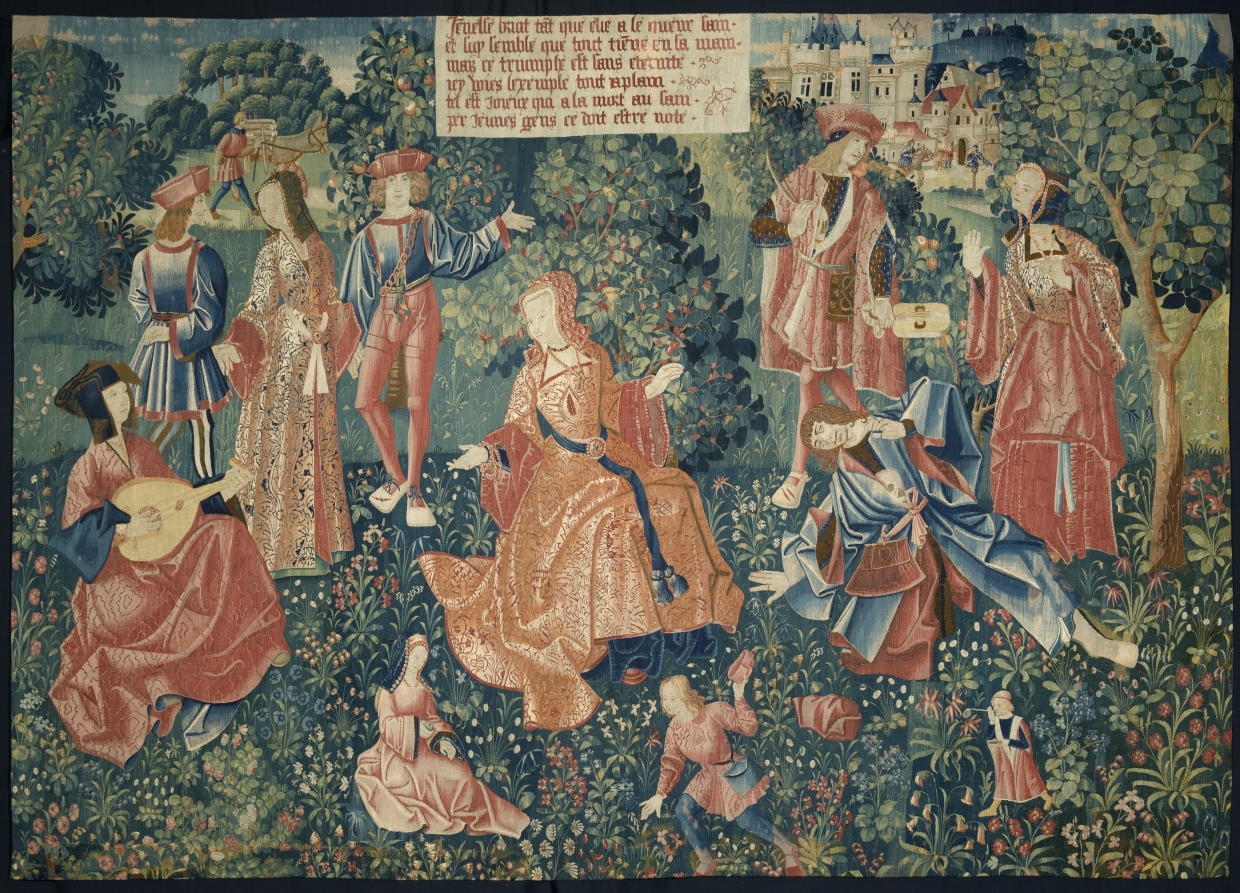
Heritage Research Artifact: The Youth of Chateau de Chaumont
Category: Silk
In the hushed ateliers of London’s Savile Row, where patience is a currency and cloth is a creed, we speak of provenance not as a footnote, but as a foundation. The garment before us—designated Youth from the Chateau de Chaumont set—is not merely an object of aesthetic delight. It is a material testament to a vanished epoch of imperial ambition, a fragment of a narrative woven in Lyon, worn in the corridors of power, and now preserved as a benchmark of uncompromising craft. To handle this silk is to read a ledger of decisions made under the weight of a crown.
The Materiality of Power: Silk as Statecraft
Let us first address the substrate itself. This is not the flimsy, mercerised imitation that passes for luxury in our accelerated age. The silk of Youth is a compound weave, a construction of extraordinary density and structural intelligence. The ground is a lustrous, tightly spun warp of mulberry silk, while the supplementary weft—a deeper, almost bruised indigo—rises in disciplined, low-relief patterns. The hand-feel is deceptive: there is a cool, dry finish upon first touch, yet beneath the fingertip lies a supple, almost liquid resilience. This is a cloth engineered for drape and durability, not for the fleeting season.
In the context of imperial silk weaving, this textile belongs to the lineage of the Grande Fabrique of Lyon, the state-sponsored manufactory that reached its zenith under Louis XIV and remained the gold standard through the Restoration and the Second Empire. The Chateau de Chaumont set, from which this piece derives, was not a commercial commission. It was a command—a demonstration of sovereign taste and technical supremacy. The weaver, likely a master of the Jacquard loom, would have worked from a point paper design that specified every single thread interaction. There is no room for error in such a system; a single misread card would fracture the entire narrative of the pattern.
Decoding the Pattern: The Language of Youth
Observe the motif. The name Youth is not a sentimental flourish. The pattern is composed of fruiting vine, budding acanthus, and a central, stylised cornflower—a trinity of symbols that speaks to the imperial mind. The vine suggests continuity and growth, the acanthus denotes immortality and the arts, while the cornflower, famously favoured by the Prussian court and later adopted by Wilhelm II, hints at a pan-European aristocratic dialogue. Yet the execution is distinctly French. The scale is intimate, almost intimate to the point of being discreet. This is not the bombastic, gold-threaded opulence of the Baroque. It is a Second Empire restraint, a confidence that does not need to shout.
The colour palette is equally telling. The base is a pale, unbleached ivory—the natural tone of the silk before any dye touches it. The pattern is rendered in a deep, mineral blue and a muted, oxidised silver. These are not the bright, chemical dyes of the late 19th century. They are derived from natural sources: woad or indigo for the blue, and a silver-gilt thread that has since tarnished to a soft pewter. This tarnish is not a flaw; it is a patina of age, a physical record of the piece’s journey through time. In the Savile Row tradition, we understand that a garment’s history is written in its creases and its fading. Here, the history is written in the very molecular structure of the metal thread.
Imperial Legacy: From Lyon to the Chateau
To place Youth within its historical milieu, we must consider the economics of imperial silk. The Chateau de Chaumont set was likely produced between 1855 and 1870, during the apogee of Napoleon III’s reign. This was a period when Lyon’s weavers were not merely artisans but strategic assets of the state. The emperor understood that silk was a diplomatic weapon—a gift to a foreign dignitary, a furnishing for a royal residence, or a ceremonial costume for a court function. The Youth panel, likely intended for an upholstered chair or a wall panel in a private salon, would have been part of a larger ensemble designed to project an image of cultivated, yet assertive, power.
The technical demands of this piece are staggering. The weft count exceeds 120 threads per centimetre. To achieve this, the weaver would have used a drawloom or an early Jacquard mechanism, requiring a team of two—one to operate the pedals, one to manage the pattern cords. The time to complete a single metre of this cloth would have been measured in weeks, not hours. The cost, adjusted for modern currency, would rival that of a bespoke suit from a top Savile Row house. This is not a fabric for the masses; it is a fabric for the annals of history.
Conservation and Contemporary Relevance
As a heritage specialist, my duty is not merely to admire but to interrogate. The condition of Youth is remarkably stable, thanks to the quality of the original dyeing and the absence of harsh light exposure. The silk retains its tensile strength, though it is now brittle in the folds. The silver threads show sulphidation, a natural darkening that we must stabilise but not reverse. To attempt to restore the original brightness would be to falsify the object’s biography. We preserve, we do not invent.
For the contemporary designer or tailor, Youth offers a masterclass in restraint and proportion. The pattern’s rhythm is irregular, yet balanced—a lesson in how to use ornament without overwhelming the silhouette. In an era of fast fashion and disposable textiles, this piece demands a slower, more deliberate engagement. It asks the wearer or the observer to consider the labour, the politics, and the artistry embedded in every square inch. That is the true legacy of imperial silk weaving: not the opulence, but the discipline.
In closing, let us treat Youth not as a relic but as a reference. It is a benchmark against which we measure our own standards of craft. When we cut a jacket on the Row, we are not merely shaping cloth; we are continuing a dialogue with the past. This silk, with its quiet authority and unyielding integrity, reminds us that true luxury is never loud. It is, like the finest bespoke garment, an act of profound respect for the material, the maker, and the moment.