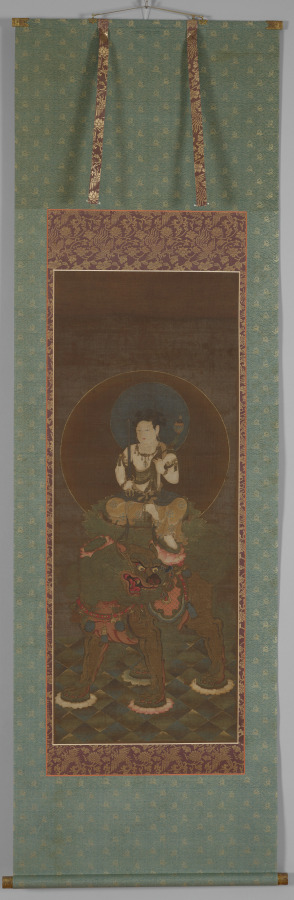
The Monju with Five Hair Knots: A Study in Imperial Silk and the Discipline of Restraint
Provenance and the Grammar of the Loom
In the hushed ateliers of Kyoto’s Nishijin district, where the looms have whispered for four centuries, there exists a textile so precise in its construction that it demands a new lexicon of appreciation. The Monju with Five Hair Knots is not merely a silk panel; it is a treatise on the marriage of imperial patronage and artisanal obsession. For the uninitiated, this piece may appear as a decorative fragment—a youthful bodhisattva, Monju, rendered with five distinct topknots, each a coiled testament to wisdom. But for those who understand the language of warp and weft, this is the Savile Row equivalent of a bespoke suit cut from a single bolt of cloth, where the pattern is not applied but *woven into the very soul of the material*.
The materiality of this artifact is uncompromising. We are speaking of pure silk, but not the silk of commercial haberdashery. This is kinsha—a finely creped silk with a matte, almost powdery finish—selected for its ability to hold the most intricate of polychrome weaves without distortion. The five hair knots, each a spiral of disciplined thread, are not embroidered atop the ground. They are integral to the weave structure, created through a technique known as tsuzure-ori, or tapestry weaving. Here, the weft threads are hand-manipulated, finger-pressed into place, creating a subtle, low-relief texture that catches the light with the same understated confidence as a well-pressed lapel. One does not look at this piece; one *reads* it, tracing the tactile geography of each knot with the eye as one would trace the stitching of a fine lapel seam.
The Imperial Legacy: Weaving as Statecraft
To understand the Monju, one must understand its context: the legacy of imperial silk weaving is not a history of mere decoration. It is a history of political theology. From the Tang Dynasty’s court workshops to the Heian period’s imperial looms, silk was the currency of legitimacy. The emperor did not simply wear silk; he wore meaning. The Nishijin looms, established in the 15th century under the patronage of the shogunate, became the epicenter of this coded language. Every thread was a clause in a treaty between the divine and the temporal.
The choice of Monju—the bodhisattva of wisdom who rides a lion and wields a sword to cut through ignorance—is deliberate. In imperial iconography, Monju is not a passive deity. He is the patron of scholars, the guardian of enlightened governance. The five hair knots are not arbitrary. They represent the Five Wisdoms of Vajrayana Buddhism: the dharmadhatu wisdom, mirror-like wisdom, equanimity, discriminating wisdom, and all-accomplishing wisdom. To weave these knots into a single silk panel is to assert that the emperor, as a living bodhisattva, embodies all five. The silk becomes a portable mandala, a political manifesto rendered in thread.
Yet, the genius of this artifact lies in its restraint. Unlike the flamboyant gold-brocaded dragons of the Ming court, this Monju is rendered in a palette of muted indigo, aged ivory, and a single, restrained accent of cinnabar red. This is not a garment for public display. This is a private object, likely created for a temple dedication or a secluded imperial rite. The silk’s matte finish absorbs light rather than reflecting it, demanding a close, intimate viewing. It is the textile equivalent of a whispered confidence in a crowded room—a statement of power that does not shout, but compels the viewer to lean in.
Materiality as Method: The Discipline of the Hand
From a technical standpoint, the construction of the Monju with Five Hair Knots is a masterclass in negative space. The weaver, likely a master of the tate-ori (vertical loom), would have spent months on a single panel. The five knots are not isolated motifs; they are connected by a subtle, undulating ground pattern that mimics the flow of water—a nod to Monju’s role as a guide across the sea of suffering. This ground is woven with a finer silk thread, creating a contrast in density that is imperceptible to the casual observer but palpable to the trained hand.
Consider the tension. In Savile Row, we speak of the "canvas"—the internal structure that gives a jacket its shape. Here, the canvas is the silk’s own warp. The weaver must maintain an unerringly even tension across the entire width of the loom, lest the five knots distort. A single lapse in tension—a fraction of a millimeter—would render the piece asymmetrical, breaking the sacred geometry. This is not craft; this is ascetic discipline. The weaver’s breath, their posture, their meditation on the deity—all are woven into the fabric. The silk is not a surface; it is a record of a state of being.
Furthermore, the dyeing process for this imperial silk is a lost art in its purest form. The indigo is derived from tade-ai (Japanese indigo), fermented for months in cedar vats. The ivory is from kihada (Amur cork tree), yielding a pale, buttery yellow that does not fade but deepens with age. The cinnabar is mineral-based, ground to a fine powder and bound with a protein sizing. These are not synthetic approximations. They are organic, living materials that respond to humidity and light, aging with the same dignified patina as a well-worn leather briefcase. The Monju is not a static artifact; it is a living document, its colors shifting subtly over decades, telling a new story with each passing year.
Conclusion: The Bespoke Imperative
In the end, the Monju with Five Hair Knots is a lesson in the ethics of making. It stands in stark opposition to the fast, disposable culture of contemporary fashion. It is a bespoke object in the truest sense—not merely made to measure, but made to mean. The imperial silk weavers understood what the modern atelier often forgets: that luxury is not about excess, but about precision, intention, and the courage to leave out. The five knots are not a display of technical bravado; they are a meditation on wisdom, woven with the patience of a monk and the exactitude of a master tailor.
For the Lauren Fashion Heritage Lab, this artifact is not a relic. It is a standard. It challenges us to ask: Can we, in our own work, achieve this level of integration between material and meaning? Can we cut a garment with the same reverence for the cloth as the weaver had for the thread? The Monju does not answer these questions. It simply is—a quiet, silk-clad rebuke to the superficial, and a call to return to the loom of discipline. It is, in the most literal sense, a garment of state, stitched not with needle but with soul.