An Examination of a Pastoral Scene in Silk: On Imperial Legacy and the Weaver’s Hand
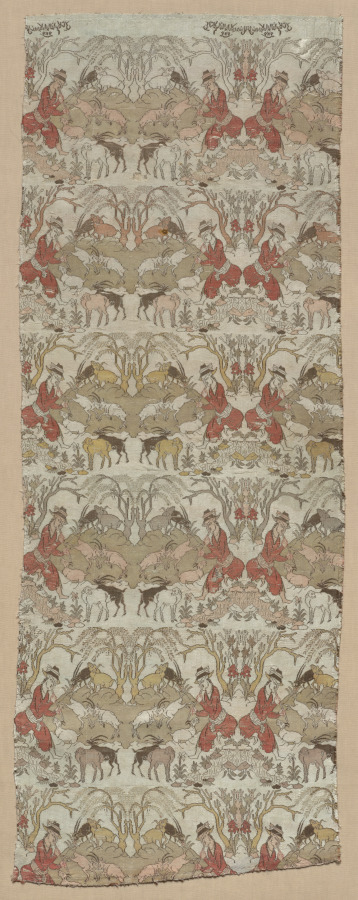
One must approach this artifact—a silk textile depicting goatherds in an idyllic landscape—not merely as a decorative panel, but as a confluence of supreme technical ambition and narrative intent. The very foundation of its materiality, silk, immediately establishes its provenance within the most rarefied echelons of imperial production. This is not a fabric of mere utility; it is a testament to a legacy where textile manufacture was a direct expression of state power, technological mastery, and aesthetic ideology. To analyse this piece is to engage with a complex language of threads, where every chromatic subtlety and figurative contour speaks of a system designed to astonish and to signify.
The Imperial Loom: A Monopoly on Magnificence
The context of imperial silk weaving is paramount. Consider the ateliers, the official workshops operating under stringent imperial patronage and control. Here, the production of such a textile was a meticulously governed affair, from the cultivation of the finest mulberry-fed silkworms to the hands of master weavers executing pre-ordained designs. The silk itself, a continuous filament of unparalleled strength and luminosity, was the chosen medium of courts and clerics for centuries. Its acquisition and transformation were matters of state, often guarded by draconian edicts. To possess, and more importantly, to produce silk of this calibre was to demonstrate a command over both nature and human artistry. The material, therefore, arrives pre-loaded with connotations of sovereignty, luxury, and an almost alchemical ability to transmute insect labour into a substance of light and wealth.
Decoding the Bucolic: Pastoralism as Imperial Narrative
The subject matter—goatherds in a landscape—presents a fascinating counterpoint to the sheer opulence of its medium. This is not a scene of imperial conquest or courtly ritual. It is a pastoral idyll, a vision of rustic tranquillity. One must not mistake this for simplicity. In the canon of imperial arts, such pastoral themes were deeply sophisticated constructs. They projected an image of a harmonious, well-ordered realm, where even the most humble subjects existed in peaceful prosperity under benevolent rule. The careful composition, the serene expressions of the herders, the gentle abundance of the flora and fauna—all are carefully curated elements. They speak less of observed rural life and more of an ideological ideal: the empire as a perfected natural order. The weaving of this scene in silk, the most imperial of materials, effectively frames this bucolic fantasy as an official statement, a testament to the peace and plenty fostered by the ruling house.
A Technical Dissection: Where Craft Becomes Art
To appreciate the achievement, one must lean in and consider the execution. The technique likely employed—be it fine satin weave, damask, or possibly kesi slit-tapestry—demands a forensic examination. The rendering of soft, naturalistic landscapes in the disciplined, grid-based language of the loom is a feat of extraordinary translation. Observe the subtle gradations of colour in the distant hills, achieved not through paint but through the meticulous interlocking of differently dyed threads. The foliage likely exhibits a sophisticated use of complementary warp and weft floats to suggest texture and depth. The figures of the goatherds, though possibly schematic in form, will possess a clarity of line that speaks of a master cartoon followed with devout precision. This is where the Savile Row analogy holds: it is in the unseen discipline, the absolute control of material to achieve an effect of effortless grace. The true cost lies not in the raw silk, but in the countless hours of focused skill required to make that silk depict dappled light on a goat’s flank or the gentle fold of a herdsman’s sleeve.
Legacy and Connoisseurship: Beyond the Surface Sheen
The legacy of this imperial silk weaving tradition is twofold. Firstly, it set an unimpeachable standard for technical and aesthetic ambition in textile arts. It created a lexicon of motifs and methods that influenced decorative arts across continents. Secondly, and more profoundly, it established silk as a primary medium for narrative and symbolic communication within a courtly context. This particular artifact, with its pastoral theme, sits within that grand tradition. For the modern connoisseur, the value lies in understanding these layers. One appreciates the sheer beauty—the luminous ground, the charming scene. But the deeper appreciation comes from recognising the artifact as a node within a vast network of imperial administration, botanical knowledge, chemical dyeing expertise, and sublime artistic skill. It is a product of a system that viewed the creation of beauty as a core function of statecraft.
In conclusion, this silk textile is a document of power, rendered in the most persuasive of materials. It employs a vision of rural peace to subtly underscore the reach and benevolence of the imperial order that commissioned it. Every thread is an act of compliance to a grand design, both pictorial and political. To hold it is to feel the weight of that legacy—not a heavy weight, but one of astonishing lightness and strength, a perfect metaphor for the enduring influence of the imperial silk loom. It remains, as it was always intended to be, a quiet and devastating assertion of supremacy.