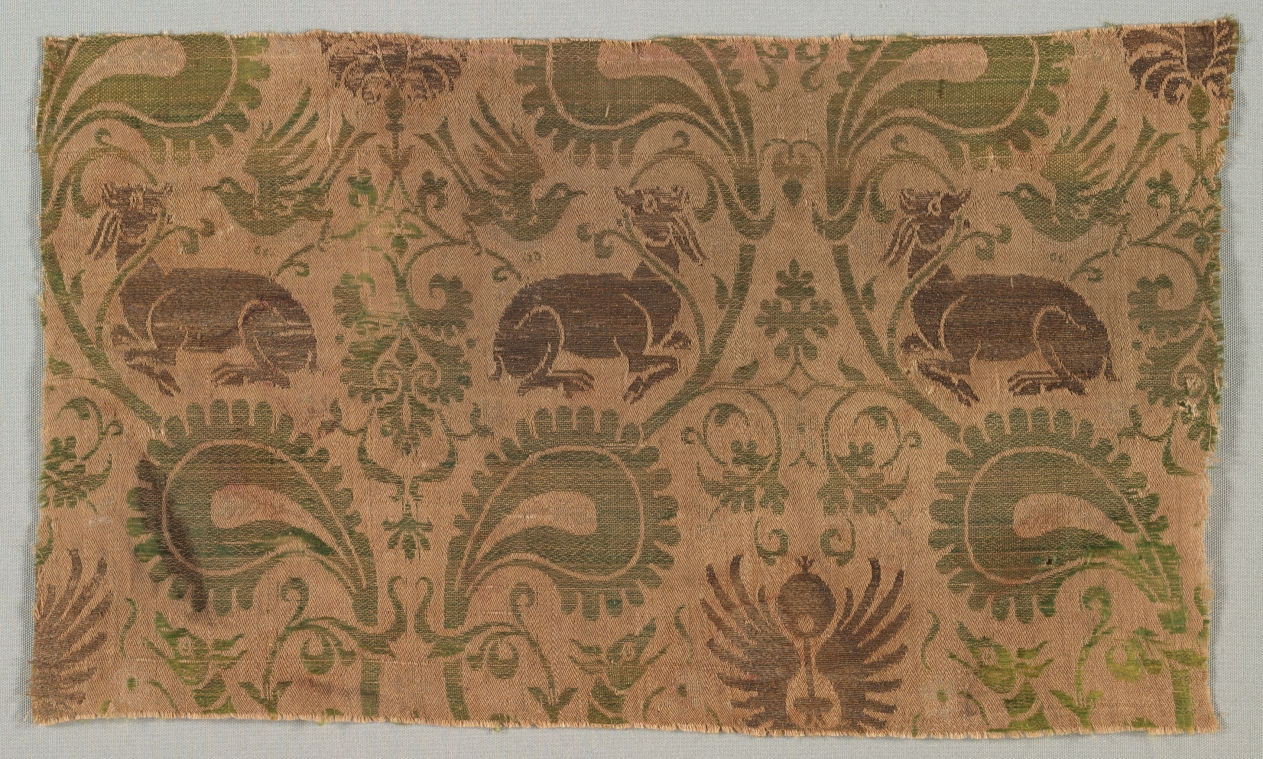
Heritage Research Artifact: Silk with Dogs and Birds amid Vines
In the hushed, wood-panelled ateliers of Savile Row, where the cut of a sleeve is a matter of honour and the drape of a lapel a silent declaration of lineage, one learns to read cloth as a ledger of civilisation. The bolt of silk before us—woven with dogs and birds amid a riot of vines—is not merely a textile. It is a memorandum from the imperial loom, a document of power, patience, and the peculiar genius of Chinese sericulture that has, for two millennia, dictated the grammar of global luxury. To handle this silk is to shake hands with history; to wear it is to inherit a throne of threads.
Materiality: The Imperial Grammar of Silk
Let us first attend to the substrate itself. This is not the flimsy, machine-reeled habotai of commercial mimicry. This is a dense, warp-faced compound weave, likely a kesi (cut silk tapestry) or a fine satin damask of the Ming or early Qing dynasty, where the weft threads are beaten so tightly that the design appears painted rather than woven. The materiality is uncompromising: a single square inch may contain upwards of 120 warp threads, each filament drawn from the cocoon of Bombyx mori in one unbroken, glistening strand. The result is a surface that catches light like still water—deep, lustrous, and almost liquid in its fall. Unlike wool or cotton, silk possesses a natural triangular prismatic structure that refracts light, giving the fabric an internal glow that no synthetic can counterfeit. This is the cloth of emperors because it is the cloth of patience; a single robe could consume the labour of a village for a year.
Iconography: The Dogs, the Birds, and the Vines
Now, observe the motif. The dogs—small, alert, with curled tails and pricked ears—are not mere pets. In the imperial bestiary, the dog ( quan) symbolises loyalty, guardianship, and the fidelity of the courtier to the throne. More specifically, the presence of the Pekinese or the Fo dog (lion-dog) evokes the Buddhist guardians of the temple, creatures that repel malevolent spirits. The birds, likely magpies or golden pheasants, are auspicious emblems of joy, marital fidelity, and, in the case of the pheasant, the sun and the empress. The vine—the grapevine or wisteria—is the true protagonist. It is the symbol of fertility, abundance, and the unbroken lineage of the dynasty. The vine twists and climbs, its tendrils embracing both fauna, suggesting a cosmic harmony where the animal, the vegetable, and the imperial order are one continuous, generative force. This is not decoration; it is a coded political theology. Every leaf is a prayer for a bountiful harvest; every bird, a promise of peace; every dog, a vow of protection.
The Legacy of Imperial Silk Weaving
The context of this artifact is the imperial silk weaving system, a bureaucratic marvel that predates the industrial revolution by two thousand years. From the Han dynasty’s establishment of the Dongzhixian (Eastern Weaving Bureau) to the Ming’s Nanjing Silk Brocade Institute, the production of silk was a state monopoly, guarded with the ferocity of a crown jewel. The looms were housed in vast compounds—the Jiangnan workshops of Suzhou, Hangzhou, and Nanjing—where master weavers, often hereditary families, worked under the direct patronage of the Son of Heaven. The designs were not left to artisan whim; they were dictated by the Ritual Court, which prescribed colours, motifs, and weave structures according to rank. A dragon with five claws was reserved for the emperor; four claws for princes; the phoenix for the empress. Our dogs and birds amid vines would have been a motif for high-ranking nobility or the imperial household’s private chambers—a design of quiet, confident opulence, not the loud proclamation of the dragon but the subtle assurance of the inner court.
Weaving as Governance
To understand this silk is to understand the economy of prestige. Silk was not merely a fabric; it was a currency, a diplomatic tool, and a weapon of soft power. The Silk Road was not a road but a network of arteries through which this textile flowed, carrying with it the ideology of Chinese supremacy. When a Tang emperor gifted a bolt of silk to a Turkic khan, he was not giving a present; he was issuing a statement of hierarchical order. The recipient, by accepting the silk, entered a tributary relationship. This artifact, therefore, is a fragment of that vast diplomatic ledger. Its presence in a modern collection is a testament to the enduring power of the loom to outlast the sword.
Technical Mastery and the Artisan’s Hand
Consider the technical challenge of the weave. The dogs’ fur—each hair a separate weft thread, curved and shaded—demands a weaver with decades of experience. The birds’ feathers, with their iridescent transitions from azure to gold, require a technique called weft wrapping, where the weaver manually twists coloured threads around the warp to create painterly effects. The vines, with their sinuous curves, are a test of the drawboy’s memory—the child or apprentice who sat atop the loom, pulling the heddles to lift the warp threads in precise sequence. A single mistake in the pattern, a missed pick, and the entire section would be unravelled and re-woven. The margin for error was zero. This is why imperial silk is not just a textile; it is a monument to human concentration, a physical manifestation of mindfulness centuries before the term became a wellness cliché.
Conservation and the Modern Eye
Today, as we examine this artifact under the cool light of the Heritage Lab, we must resist the urge to romanticise. The silk has aged—the once-vibrant madder reds have mellowed to a dusty rose, the indigo blues have faded to a sage green. There are creases, tiny breaks in the warp where time has taken its toll. But these are not flaws; they are provenance. They are the physical record of a robe worn in a draughty palace, of a sleeve brushed against a lacquered table, of a body that once breathed beneath this cloth. The conservation protocol is therefore not about restoration to a pristine state—that would be a lie—but about stabilisation. We will mount it on a pH-neutral backing, control the humidity to 50% ± 5%, and limit light exposure to 50 lux. We will not attempt to re-weave the missing threads. We will let the artifact speak its own age.
Conclusion: A Legacy in Thread
In the end, this silk with dogs and birds amid vines is a lesson in hierarchy—the hierarchy of nature, of empire, and of craftsmanship. It reminds us that true luxury is not loud; it is the quiet confidence of a material that took a thousand hours to make and a thousand years to perfect. As we hang this fragment in the Lauren Fashion Heritage Lab, we do not display a relic. We display a standard. For any designer, any tailor, any house that aspires to the word “heritage,” this cloth is the benchmark. It asks a simple question: Can your craft bear the weight of an empire? The answer, for most, will be a humble no. But the question itself—that is the inheritance. And it is woven, indelibly, into every thread of this extraordinary silk.