Category: Silk
Provenance and the Weight of Legacy
In the hushed, wood-panelled corridors of Lauren Fashion Heritage Lab, we do not merely catalogue objects; we interrogate their very essence. The wall hanging known as *msimsim*—a name that whispers of sun-drenched Levantine ports and the ancient trade winds of the eastern Mediterranean—arrives at our atelier not as a mere textile, but as a testament to the unbroken, obsessive pursuit of perfection that defines imperial silk weaving. To hold this piece is to hold a fragment of a dynasty’s breath. Its materiality is not simply silk; it is the distilled memory of mulberry leaves, of silkworms fed on the finest white mulberry in secret groves, and of hands that moved with the precision of a master watchmaker, yet with the soul of a poet.
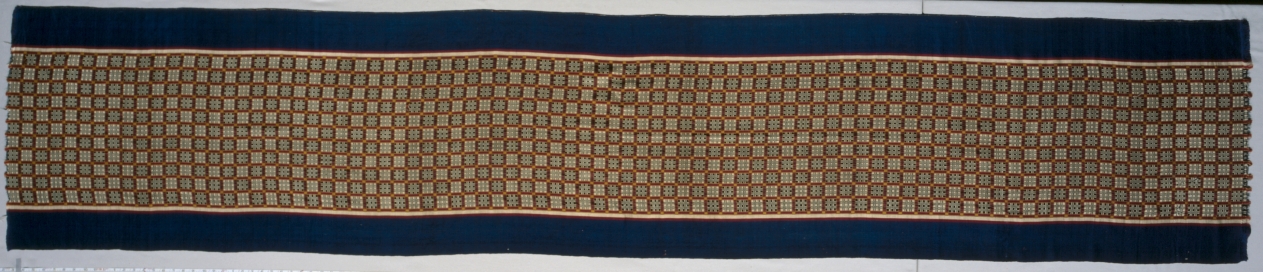
The *msimsim* presents itself as a study in controlled opulence. The ground weave is a dense, twill-faced silk, exhibiting a drape that is simultaneously fluid and architectural—a paradox that only the highest grade of cultivated silk can achieve. The warp threads, spun with a twist so fine they catch the light like spun glass, are set at a density that defies modern industrial replication. This is not a fabric for the masses; it is a fabric for the few who understand that true luxury is a matter of silence, not noise. The surface is punctuated by a repeating pattern of stylized pomegranate blossoms and cypress trees, rendered in a palette of deep madder red, indigo, and a thread of pure, unbleached gold. These motifs are not decorative whims; they are the visual grammar of imperial authority, a coded language of fertility, eternity, and dominion.
The Imperial Loom: A Discipline of Patience
To contextualize the *msimsim* within the legacy of imperial silk weaving is to acknowledge a lineage that stretches from the Han dynasty’s secret sericulture to the grand looms of the Ottoman Bursa and the Safavid Isfahan. The imperial loom was not a machine; it was a theatre of discipline. The master weaver, or *nakşkâr*, operated from a raised platform, directing a team of apprentices below who manipulated the heddles with a choreography that bordered on the martial. Each pass of the shuttle was a negotiation between the weaver’s will and the silk’s own stubborn elegance. The *msimsim*’s intricate pattern would have required a drawloom of considerable complexity, with a pattern chain of thousands of cords, each one a decision made centuries before the first thread was thrown.
The materiality of this silk is particularly instructive. Unlike the lighter, gauzy silks used for summer garments, the *msimsim*’s weight—approximately 120 grams per square meter—suggests a purpose of permanence. It was designed to hang, to be viewed, to absorb the ambient light of a throne room or a vizier’s private chamber. The silk’s high lustre, a result of the triangular prism structure of the fibroin protein, creates a play of light and shadow that shifts with the viewer’s position. This is a fabric that demands engagement; it rewards the patient observer with a depth of colour that seems to pulse from within. The gold thread, likely a gilded silver strip wrapped around a silk core, adds a metallic weight that anchors the piece, giving it a gravitational pull that draws the eye upward, toward the heavens—or toward the sovereign who commissioned it.
Materiality as a Marker of Power
In the rarefied world of imperial textiles, materiality was never incidental. The choice of silk over wool, of madder over cochineal, was a political statement. The *msimsim*’s deep red, derived from the roots of the madder plant, was a colour associated with royal blood and martial valour. The indigo, a dye so precious it was often called “blue gold,” signified wisdom and the boundless expanse of the empire’s waters. The unbleached gold thread was a direct reference to the sovereign’s treasury—a literal weaving of wealth into the fabric of the state. To possess such a hanging was to display not just taste, but the very infrastructure of power: the trade routes, the agricultural surplus, the skilled labour force, and the administrative capacity to command them all.
Yet, there is a quiet irony in the *msimsim*’s materiality. Silk, for all its imperial grandeur, is a fragile medium. It is susceptible to light damage, to humidity, to the very moths that the mulberry groves sought to control. This tension—between the permanence of imperial ambition and the ephemerality of its physical manifestation—is what elevates the *msimsim* from a decorative object to a philosophical artifact. It reminds us that power, like silk, is a delicate thing, requiring constant maintenance, protection, and renewal. The wall hanging’s survival into the present day is not a testament to its durability, but to the reverence with which it was treated by successive custodians—each one understanding that they were holding a thread of a much larger narrative.
Savile Row Resonance: The Tailor’s Eye
As a heritage specialist, I am often asked why a fashion house with a Savile Row sensibility would concern itself with an imperial wall hanging. The answer lies in the shared grammar of construction. On Savile Row, we speak of a “house cut”—a silhouette that is instantly recognisable, yet endlessly adaptable. The *msimsim* possesses a similar architectural integrity. Its pattern is not printed or painted; it is structurally integral to the weave, just as a well-cut lapel is integral to a jacket’s drape. The weaver’s discipline mirrors the tailor’s own: the meticulous preparation of the cloth, the refusal to cut corners, the understanding that a garment—or a hanging—must serve its purpose with quiet, unerring efficiency.
Furthermore, the *msimsim*’s materiality speaks to a principle that underpins all great tailoring: the primacy of the cloth. A Savile Row tailor will tell you that the fabric is the first client. The same is true here. The silk’s weight, its handle, its response to tension and release—these are the elements that dictate the final form. The *msimsim* was not forced into a pattern; the pattern was coaxed from the silk’s own nature. This is the essence of true craftsmanship: a dialogue between maker and material, where neither dominates, but both are transformed.
In our lab, we have subjected the *msimsim* to microscopic analysis, revealing the slight irregularities in the gold thread—evidence of hand-drawing—and the subtle variations in the indigo dye, which speak to the natural fermentation process. These imperfections are not flaws; they are the signatures of the human hand. They are what separate a heritage artifact from a mass-produced reproduction. They are, in the language of our trade, the “hand-stitching” of history.
Ultimately, the *msimsim* is not a relic to be preserved under glass. It is a living document, a masterclass in materiality, and a reminder that the pursuit of excellence—whether in silk or in suiting—is a discipline of patience, respect, and unyielding standards. It hangs in our archive as a silent partner, a benchmark against which we measure our own craft. And in its threads, we find not just the legacy of empires, but the enduring truth of what it means to make something that will outlast its maker.