← BACK TO ARCHIVES
Heritage-Black
Heritage Synthesis: Terracotta fragment of a skyphos (deep drinking cup)
Curated on Sep 01, 2026 // Node: LDN-01
The Grammar of Eternity: Translating Ancient Rhythms into the 2026 Old Money Silhouette
The Lauren Fashion Heritage Lab’s internal archives have long posited that true luxury is not a function of ornament, but of *duration*—the ability of a garment to outlive the season, the trend, and ultimately, the wearer. This principle finds its most profound external validation not in the salons of Paris or the ateliers of Milan, but in the quiet vitrines of the British Museum. There, two disparate Egyptian artifacts—the “Mold Fragment with Musicians” and the “Section of a Coffin Platform”—offer a dialectical study in the representation of time. When read against the terracotta fragment of a Greek skyphos (a deep drinking cup) from our visual source, they coalesce into a singular design philosophy: the 2026 Old Money silhouette must be an architecture of *controlled tension* and *repetitive calm*, a garment that captures the fleeting gesture of the body while simultaneously projecting the immutable permanence of heritage.
I. The Fragment as a Blueprint for Kinetic Restraint
The Egyptian mold fragment, though diminutive, is a masterclass in the economy of line. Its incised depiction of three musicians—the arched back of the harpist, the puffed cheeks of the double-flute player, the clapped hands of the percussionist—does not seek to replicate anatomy. Instead, it abstracts *movement* into a single, continuous contour. This is not the frozen action of a photograph, but the *essence* of action, compressed into a graphic notation. For the 2026 Old Money silhouette, this translates directly into the principle of *kinetic restraint*. The modern suit, the cashmere overcoat, the silk sheath—these are not static shells. They are fragments of a larger, continuous motion. The cut must allow for the suggestion of the body’s rhythm without ever revealing its full, unmediated form.
Consider the drape of a double-faced wool coat. The internal genetic code of the mold fragment demands that the shoulder seam not be a rigid architectural joint, but a fluid line that continues the flow from the collar to the sleeve. The tension is held in the *negative space*—the slight break in the fabric at the small of the back, the deliberate fall of the trouser break over the shoe. These are the “clapped hands” of the garment: moments of subtle, internal dynamism that suggest a life being lived, not a mannequin being displayed. The 2026 silhouette rejects the exaggerated shoulder or the aggressively tapered waist. Instead, it embraces a *continuous contour*—a line that runs from the nape of the neck to the hem of the skirt or trouser, unbroken by fussy darts or disruptive pockets. This is the “instant of the heartbeat” translated into tailoring: a garment that feels alive because its lines are not static, but perpetually poised at the apex of a gesture.
II. The Coffin Platform and the Logic of Repetition
If the mold fragment captures the *instant*, the coffin platform embodies the *epoch*. Its symmetrical geometry, the repeated scarabs, the ordered hieroglyphs—these are not decorative afterthoughts. They are a visual liturgy, a rhythmic incantation designed to simulate the cosmic breath of the Nile’s ebb and flow. The danger of such repetition is monotony; the genius of the ancient artisan was to infuse each repeated unit with a micro-variation in depth or spacing, creating a *slow, visual extension* that draws the eye across the surface in a meditative trance. This is the antithesis of the frantic, information-saturated aesthetic of the contemporary moment.
For the 2026 Old Money wardrobe, this logic dictates the use of *pattern and texture as a form of temporal architecture*. The pinstripe is no longer a mere business convention; it is a hieroglyph of order. The herringbone weave of a vicuña scarf is a repetition of small, interlocking “v”s that speak to a lineage of craftsmanship. The tonal jacquard of a silk tie, barely perceptible from a distance, reveals its intricate geometry only upon close inspection—a private language of eternity for the wearer and the discerning observer. The 2026 silhouette does not shout; it *recites*. It uses repetition not to bore, but to hypnotize, to create a field of visual calm that projects an unshakeable sense of belonging and permanence. This is the “coffin platform” strategy applied to dress: the garment becomes a portable cosmos, a zone of order in a chaotic world. The repeated motif—be it a monogram, a specific stitch, or a signature button—is not a logo, but a *mantra*.
III. The Terracotta Skyphos: The Synthesis of Form and Function
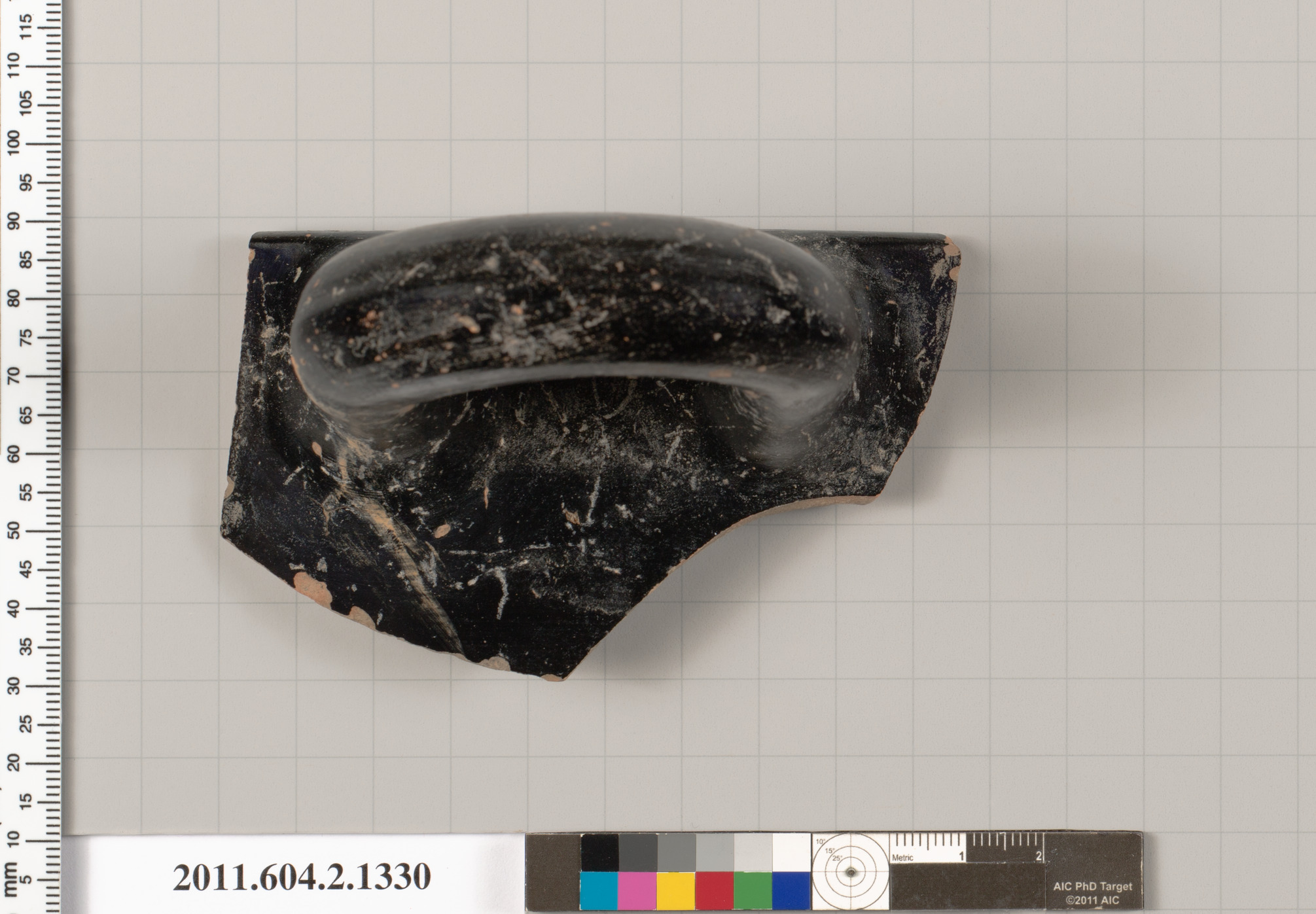
Our visual source, the Greek terracotta skyphos, provides the crucial synthesis. Unlike the Egyptian artifacts, which are either purely ritualistic or funerary, the skyphos is a vessel of *daily life*. It was held, passed, and drunk from. Its terracotta body is humble, yet its form is perfectly resolved for its function. The fragment we possess shows the curvature of the bowl and the attachment of a handle—a study in how a three-dimensional object accommodates the human hand. This is the missing link between the abstracted rhythm of the mold and the cosmic order of the coffin.
The 2026 Old Money silhouette must be a *skyphos*: a garment that is at once a piece of heritage architecture and a functional tool for modern living. The blazer is not merely a jacket; it is a vessel for the body’s daily rituals—the reach for a coffee cup, the handshake, the gesture of thought. Its construction must be *terracotta-like*: substantial, grounded, and honest in its materiality. This means a return to heavier, more structured fabrics—a 400-gram wool flannel, a raw silk twill, a dense cotton gabardine—that hold their shape like the walls of a clay vessel. The fit is neither tight nor baggy, but *enveloping*, providing a sense of containment and security. The internal pockets are not hidden conveniences but structural elements, much like the handles of the skyphos, designed to integrate seamlessly with the garment’s line.
The terracotta fragment also reminds us of the beauty of *imperfection*. The broken edges, the worn surface, the slight asymmetry of the wheel-thrown form—these are the traces of time and use. The 2026 Old Money aesthetic must therefore embrace a form of *curated patina*. This is not about distressed, artificially aged clothing. It is about investing in materials that *age gracefully*—cashmere that softens, leather that develops a rich patina, silk that gains a subtle luster with wear. The garment is designed to be a fragment of the wearer’s own history, a vessel that records the rhythm of their life. This is the ultimate luxury: not the pristine, untouched object, but the one that has absorbed the music of its owner’s days.
IV. Conclusion: The Rhythm of Inheritance
The 2026 Old Money silhouette, as derived from these ancient sources, is a study in philosophical materialism. It rejects the ephemeral for the enduring, the loud for the resonant. From the Egyptian mold fragment, it learns the power of the *suggested gesture*—the line that implies motion without completing it. From the coffin platform, it adopts the grammar of *repetitive order*—the pattern that calms the eye and projects permanence. And from the Greek skyphos, it synthesizes these principles into a *functional form*—a garment that is both a work of heritage art and a vessel for the mundane, beautiful acts of daily life.
The true heir to this legacy does not wear clothes; they *inhabit* them. They understand that a suit is not a costume but a fragment of a larger, continuous narrative. The hemline, the lapel width, the choice of a herringbone over a plain weave—these are not arbitrary decisions. They are the hieroglyphs of a personal cosmology, a silent language that speaks of one’s relationship to time. In a world obsessed with the new, the 2026 Old Money silhouette is a radical act of *temporal defiance*. It is a garment that carries the past into the future, not as a museum piece, but as a living, breathing rhythm. It is the sound of one hand clapping, translated into the fall of a shoulder seam—a moment of stillness that contains the echo of eternity.
Heritage Lab Insight
Genetic Bridge: Archive node focusing on Heritage-Black craftsmanship.