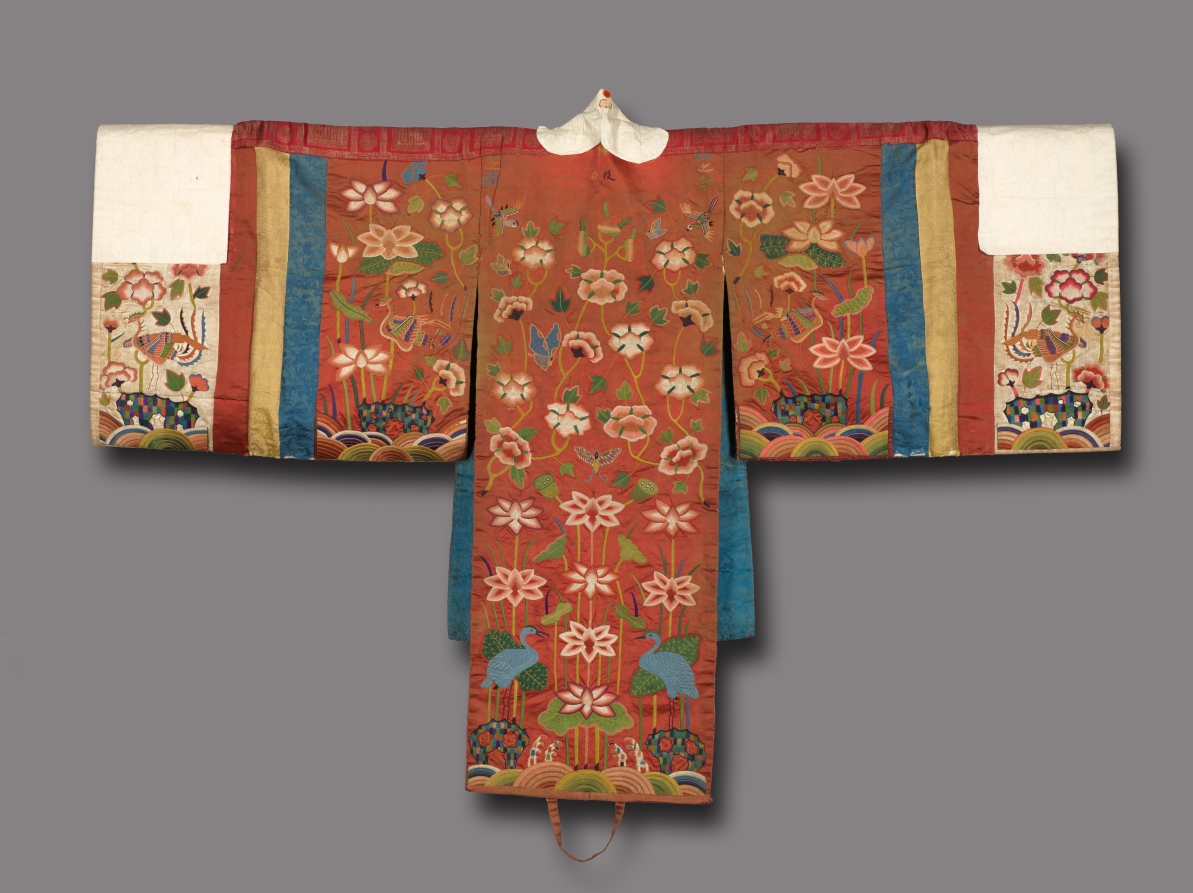
The Hwarot as Material Testament: Imperial Silk and the Architecture of a Bridal Robe
Provenance and the Politics of Thread
In the rarefied atmosphere of London’s Savile Row, where tailoring is less a trade and more a liturgy, we understand that cloth is never mute. It speaks of soil, of silkworm, of the hands that spun and the looms that disciplined. The Hwarot, the ceremonial bridal robe of the Korean Joseon dynasty, is not merely a garment; it is a folded document of imperial silk weaving’s zenith. To examine it is to read a ledger of dynastic power, where every centimetre of lustrous, warp-faced silk was a calculated assertion of sovereignty. The materiality of the Hwarot—its heavy, pliant body of mulberry silk—is the first and most commanding clause in its biography. Unlike the lighter, breathable silks reserved for everyday court wear, the Hwarot’s silk was woven with a deliberate density, a structural gravitas that allowed the robe to hold its architectural silhouette: the voluminous sleeves, the rigid, high collar, the sweeping train that trailed like a proclamation.
The legacy of imperial silk weaving is not a gentle inheritance. It is a brutal, exacting standard. The silkworms were fed on the finest mulberry leaves, their cocoons boiled at precise temperatures to yield filaments of unbroken length—sometimes exceeding a thousand metres. These filaments were then thrown, twisted, and dyed in vats of madder root, indigo, and gardenia, achieving hues that were not merely colours but ciphers of rank. For the Hwarot, the dominant palette of crimson and royal blue was not decorative. Crimson signified auspiciousness and warding against evil; blue, the cosmic order of the heavens. The silk itself, therefore, was a political medium, and the weavers—often guilds operating under direct royal patronage—were the silent architects of a visual language that brooked no dissent. The fabric was not woven to be worn; it was woven to be obeyed.
Construction and the Tailoring of Ritual
From a Savile Row perspective, the Hwarot’s construction is a masterclass in the tension between ornament and structure. The robe is cut on a grand scale—typically with a wingspan that dwarfs the wearer—yet the tailoring is remarkably flat, relying on the silk’s inherent stiffness and the layering of interlinings (often a coarse hemp or paper-like ramie) to create volume. This is not the bespoke, three-dimensional draping of a Western evening gown. It is a two-dimensional canvas, a ceremonial banner worn on the body. The sleeves, famously long and often left to hang or be held by attendants, are not functional in the Western sense. They are extensions of the robe’s symbolic field, their cuffs embroidered with paired dragons, phoenixes, and peonies—motifs that speak of marital harmony and imperial favour. The embroiderer, like a master cutter, worked within a strict geometry. Gold-wrapped silk threads, couched onto the surface, created raised, sculptural patterns that catch light differently from the ground silk, producing a chiaroscuro effect that is almost architectural.
The collar is a particular point of technical interest. It is a high, standing band, often finished with a separate white or pale silk trim—a stark contrast that frames the face with a severity reminiscent of a clerical vestment. This collar is not merely a finish; it is a structural element, stiffened and shaped to hold the head erect, to impose a posture of regal stillness. The fastenings, typically two long, wide ribbons tied at the right side, are not subtle. They are bold, functional closures that echo the sartorial logic of a double-breasted suit—an assertion of order and closure. The interior, though hidden, is not neglected. The lining is often a contrasting silk, a private indulgence, a secret signature of the weaver’s and embroiderer’s skill. This attention to the unseen is a hallmark of true craftsmanship, a principle that any tailor on Clifford Street would recognise as non-negotiable.
Patina, Preservation, and the Modern Gaze
What remains of the Hwarot today, in museum collections from Seoul to London, is a study in controlled decay. The silk, though durable, is hygroscopic—it absorbs and releases moisture, making it vulnerable to fluctuations in humidity. The gold threads, though metallic, are often wrapped around a silk core, which can oxidise and darken, creating a patina that is both a degradation and an enrichment. The colours, once blazing, have softened to a muted, dusty resonance, like a fresco after centuries of candle smoke. This patina is not a flaw; it is a narrative. It records the robe’s journey through time, its exposure to the bodies of brides, to the incense of ancestral rites, to the quiet darkness of storage chests. For the heritage specialist, the Hwarot is a paradox: it is at once a pristine artefact of imperial weaving and a fragile, perishable object that demands the most rigorous conservation protocols—controlled lighting, acid-free tissue, and a stable, cool environment.
In the contemporary context, the Hwarot has been re-appropriated, not as a living garment but as a symbol of cultural identity and sartorial excellence. Modern Korean brides may commission reinterpretations, but these are often simplified, machine-woven approximations that lack the structural integrity and symbolic density of the original. The legacy of imperial silk weaving, however, persists in the very DNA of the craft. The techniques of warp-faced weaving, of couched gold embroidery, of precise dyeing—these are not lost. They are preserved in the hands of a dwindling number of master artisans, many of whom are designated as Intangible Cultural Heritage. Their work, like that of a Savile Row cutter, is a negotiation with history, a discipline of patience, and a refusal to compromise on materiality. The Hwarot, in its silent, sumptuous glory, remains the ultimate benchmark—a reminder that true luxury is not about novelty but about the unbroken, unyielding standard of the thread.
To wear a Hwarot, or to merely stand before one in a glass case, is to confront the weight of that standard. It is to understand that silk, in its highest form, is not a fabric. It is a system of belief, a code of conduct, and a testament to the human capacity for order and beauty. And that, in the final analysis, is the only heritage worth preserving.