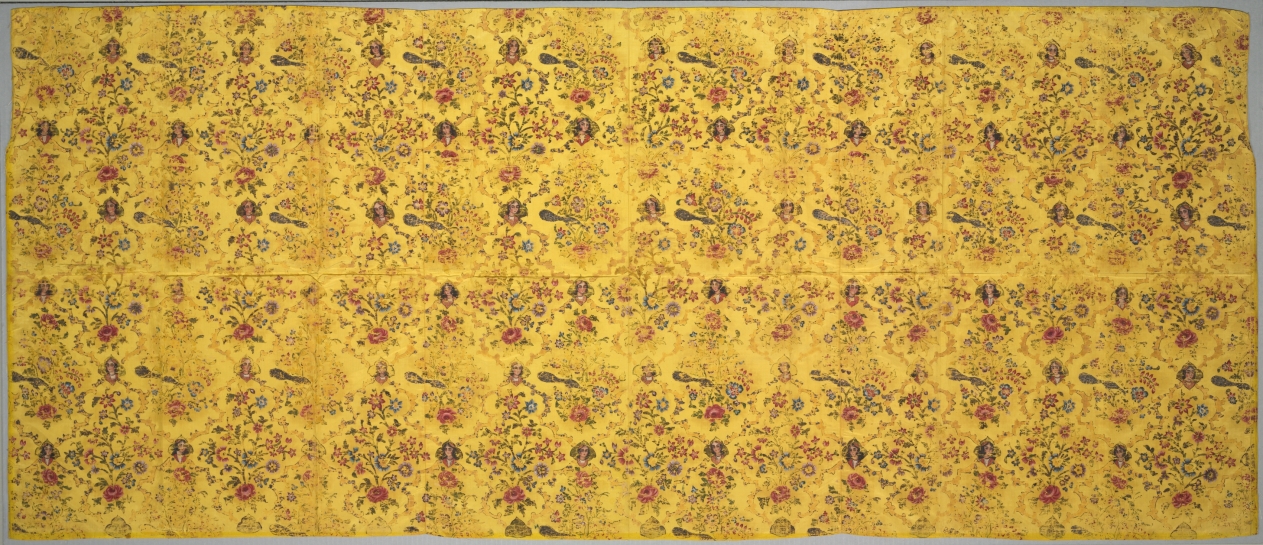
Heritage Research Artifact: The Imperial Silk Wall Covering
Category: Silk
In the hushed corridors of heritage preservation, where the whisper of silk is the only sound that survives the centuries, we encounter an object of singular authority. This wall covering—a composition of flora, peacocks, and portrait medallions—is not merely a textile. It is a statement of dynastic power, rendered in the most demanding medium known to the loom. For the connoisseur of Savile Row, where cloth is judged by its drape, its resilience, and its quiet assertion of status, this piece represents the apotheosis of the weaver's art: a fabric that does not clothe a body, but rather, ennobles an entire room.
The materiality of this artifact is its first and most profound declaration. Silk, in its imperial context, was never a casual choice. It was a currency of diplomacy, a marker of celestial mandate, and a testament to the technical supremacy of the imperial workshops. The very fibre, harvested from the Bombyx mori silkworm, carries with it a narrative of secrecy and monopoly—a trade secret so fiercely guarded that its revelation was punishable by death. In this wall covering, the silk is not merely a ground; it is a luminous field upon which the weaver has painted with threads. The natural lustre of the filament, its ability to refract light differently from every angle, imbues the surface with a living quality. As the daylight shifts across the room, the peacocks seem to stir, the flora appears to breathe, and the portrait medallions take on a sculptural depth that no painted surface could replicate.
The Grammar of Power: Flora, Avian, and the Human Countenance
Let us examine the iconography with the same rigour one would apply to a bespoke suit's lapel or the set of a shoulder seam. The flora is not decorative filler; it is a botanical lexicon of prosperity and seasonal renewal. Peonies, with their voluminous petals, signify wealth and honour. Lotus blossoms, emerging pristine from murky waters, speak of purity amidst the temporal world. Chrysanthemums, the emblem of longevity and the imperial house, anchor the composition in a discourse of endurance. Each stem, each leaf, is rendered with a botanical accuracy that borders on the scientific, yet is elevated by a rhythmic, almost musical, arrangement. This is not nature observed; it is nature perfected, curated for the imperial gaze.
The peacocks, striding with deliberate grace among the blooms, are the undisputed protagonists of the avian narrative. In the imperial lexicon, the peacock is the bird of a hundred eyes, a guardian against malevolent forces, and a symbol of the all-seeing vigilance of the throne. Its plumage, a riot of iridescent blues, greens, and golds, is the weaver's ultimate challenge. To capture the shifting, metallic sheen of a peacock's feather in silk requires not just skill, but an almost alchemical understanding of colour and light. The weaver has employed a technique of varying the twist and tension of the silk threads to create a moiré effect, a subtle play of light that mimics the bird's natural iridescence. The result is a creature that appears to be in constant, silent motion, its tail a fan of imperial authority.
The portrait medallions are the most intriguing element, for they introduce the human dimension into this natural and symbolic order. These are not generic faces; they are likely ancestral portraits, or representations of the reigning sovereign and consort. Framed within circular or lobed cartouches, they serve as a constant, omnipresent reminder of the dynasty's lineage. The medallions are woven with a fineness of detail that rivals miniature painting—the rendering of the eyes, the subtle modelling of the cheekbones, the precise articulation of the imperial headdress. In a room adorned with such a covering, the emperor or empress would be surrounded by their own legacy, a silent council of predecessors watching over the court. The placement of these medallions within the floral and avian chaos is deliberate; they are the fixed points of order, the anchors of human governance amidst the untamed fecundity of nature.
The Legacy of Imperial Weaving: A Technical Autopsy
To truly appreciate this artifact, one must understand the technical theatre that produced it. The legacy of imperial silk weaving is one of monumental scale and obsessive precision. These workshops, often housed within the Forbidden City or other imperial complexes, operated on a quasi-industrial scale, yet each piece was a bespoke commission. The loom itself—the drawloom, operated by a team of two, sometimes three, artisans—was a mechanical marvel. One weaver, the "drawboy," sat atop the loom, pulling the harness cords that raised the warp threads according to a complex pattern. The master weaver, below, manipulated the weft, inserting the coloured silks with a precision measured in fractions of a millimetre.
For a wall covering of this complexity, the pattern would have been designed by a court artist, then translated into a point paper—a grid-based blueprint where each square represented a single warp or weft thread. This document, often metres in length, was the weaver's score. The density of the weave is extraordinary; we are likely looking at a warp count exceeding 100 threads per centimetre. This is not a fabric; it is a tapestry in miniature, a woven bas-relief. The use of gold-wrapped threads—silk filaments twisted around a gilded paper core—adds another layer of opulence. These threads, used sparingly in the peacock's eyes and the medallion's borders, catch the light with a burnished, metallic glow, elevating the piece from the merely luxurious to the truly regal.
The colour palette, too, is a technical and symbolic achievement. The imperial yellow, or more accurately, the "apricot yellow" or "golden yellow," was reserved for the emperor's exclusive use. The blues and greens, derived from indigo and verdigris, are deep and resonant, while the reds, from madder or cochineal, are rich and warm. These dyes were not merely applied; they were fixed to the silk through a mordanting process that ensured their permanence. The result is a chromatic intensity that has survived centuries, a testament to the dyer's and weaver's mastery over their materials.
A Contemporary Reading: The Fabric of Legacy
For the modern observer, this wall covering is more than a historical curiosity. It is a benchmark of what cloth can achieve when it is elevated to the status of high art. In the context of contemporary luxury, where the term "heritage" is often bandied about with little substance, this artifact stands as a rebuke. It demands a level of craft, patience, and intellectual rigour that is almost extinct. The Savile Row tailor understands this instinctively. When he cuts a length of cloth, he is not merely shaping a garment; he is honouring a lineage of technique and material integrity. This wall covering is that same lineage, writ large on an architectural scale.
It speaks to a philosophy of permanence. In an age of fast fashion and disposable goods, this piece was designed to outlast its creators, to serve as a dynastic heirloom for generations. The flora will never wilt; the peacocks will never cease their silent vigil; the portraits will never age. This is the ultimate luxury: not the acquisition of an object, but the stewardship of a legacy. To stand before this wall covering is to be reminded that true power is not loud, but quiet; not fleeting, but enduring. It is a lesson in the art of the long view, woven in silk and gold, and it remains as relevant today as it was in the imperial courts where it was first unfurled. The fabric is the message, and the message is one of absolute, unassailable permanence.