← BACK TO ARCHIVES
Silk
Heritage Synthesis: Samite fragments with double-headed eagles, from the tomb of Saint Bernard Calvo
Curated on Sep 01, 2026 // Node: LDN-01
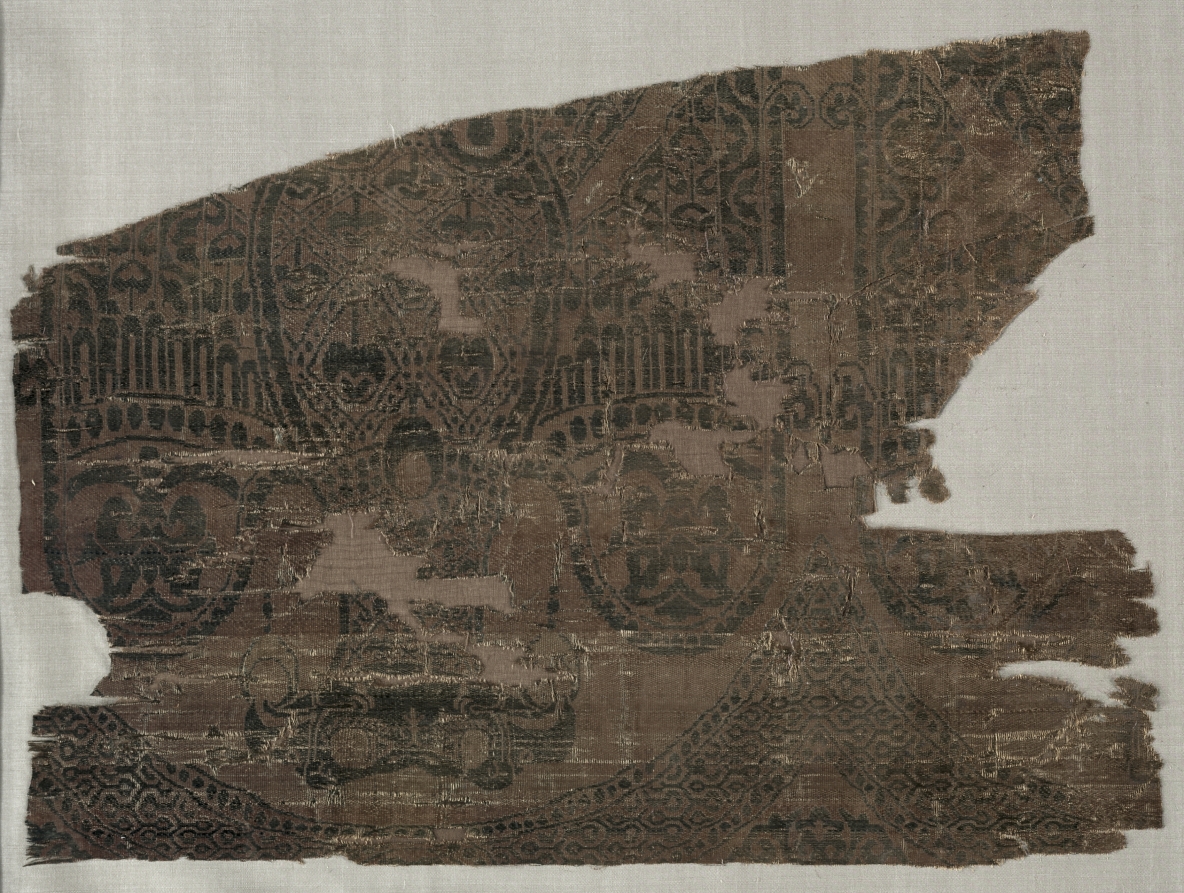
The Imperial Thread: Samite Fragments of Saint Bernard Calvo
In the hushed, climate-controlled vaults of ecclesiastical treasuries, one occasionally encounters an object that transcends its physical form to become a palimpsest of empire, faith, and artistry. Such is the case with the samite fragments bearing the double-headed eagle, recovered from the tomb of Saint Bernard Calvo. These are not mere remnants of vestments; they are the tangible echoes of a Byzantine and, later, Sicilian imperial weaving tradition that clothed the highest echelons of medieval power. To examine these silks is to read a chapter of history written not in ink, but in the lustrous, unbroken thread of the silkworm.
Materiality and the Language of Silk
The foundation of this artifact’s significance lies in its materiality. Samite, derived from the Old French *samit* and ultimately from the Byzantine Greek *hexamiton* (meaning “six threads”), is a heavy, luxurious silk textile woven in a twill structure. Unlike simpler tabby weaves, samite’s compound structure—typically with a warp-faced ground and a weft-faced pattern—allowed for the creation of dense, intricate, and vividly colored designs. The use of multiple weft threads, often in contrasting hues of crimson, sapphire, and gold, gave the fabric a remarkable depth and a subtle, shifting sheen that caught the candlelight of cathedrals and the sun of imperial courts alike.
The fragments from Saint Bernard Calvo’s tomb are no exception. The silk, though aged and fragmented, retains a remarkable integrity. The weave is tight, the surface smooth to the touch, a testament to the skill of the weavers who operated the drawlooms of the medieval Mediterranean. The double-headed eagle, the central motif, is rendered with geometric precision and stylized power. Each feather, each wing, is a deliberate act of creation, executed in a palette that would have once blazed with life. The choice of silk itself was a statement. In the medieval world, silk was not merely a textile; it was a currency of power, a diplomatic gift, and a marker of sacral kingship. Its presence in a saint’s tomb elevates the occupant from a local holy man to a figure connected to the universal, imperial order.
The Double-Headed Eagle: A Symbol of Sovereignty
The double-headed eagle is arguably the most potent heraldic symbol of the medieval and early modern periods. Its origins are complex, tracing back to Hittite and Roman iconography, but its definitive adoption as an imperial emblem occurred in the Byzantine Empire. For the Palaiologos dynasty, the last ruling house of Byzantium, the two heads represented the empire’s dominion over both East and West, a claim to universal sovereignty that echoed the old Roman ideal. The eagle, looking simultaneously toward the rising and setting sun, was a symbol of vigilance, power, and the emperor’s role as God’s vicegerent on earth.
The presence of this motif on the samite fragments in a Catalan tomb is not coincidental. It speaks directly to the complex web of cultural and political exchange that defined the 12th and 13th centuries. After the Fourth Crusade sacked Constantinople in 1204, many Byzantine artisans and weavers dispersed westward. More significantly, the Norman Kingdom of Sicily, under Roger II and his successors, had already established a magnificent silk workshop in Palermo, staffed by Greek and Arab craftsmen. These workshops produced textiles that fused Byzantine iconography with Islamic geometric patterns and Western European heraldic sensibilities. The double-headed eagle, adopted by the Hohenstaufen emperors who inherited the Sicilian crown, became a symbol of the Holy Roman Empire’s ambitions. Thus, a fragment of silk bearing this eagle is not merely a Byzantine artifact; it is a product of this vibrant, hybrid Mediterranean culture.
Contextualizing the Tomb of Saint Bernard Calvo
Saint Bernard Calvo, Bishop of Vich in Catalonia, lived during the late 12th and early 13th centuries (c. 1150–1243). He was a figure of considerable political and ecclesiastical influence, navigating the complex relationships between the Crown of Aragon, the Papacy, and the local nobility. His canonization and the subsequent veneration of his relics necessitated a burial of appropriate dignity. The choice to inter him in samite adorned with the double-headed eagle is a profound statement. It suggests that Calvo, or his executors, sought to align his memory with the imperial prestige that the symbol conveyed. It was a visual claim to authority, orthodoxy, and a connection to the broader Christian imperium.
The fragments themselves, likely part of a larger pall or set of vestments, would have been placed within the tomb as a mark of honor. In the medieval mindset, the body of a saint was a conduit of divine power, and the textiles that touched it were imbued with a secondary, sanctified status. The silk, an exotic and precious material, was considered appropriate for the incorruptible flesh of a holy man. The imperial eagle, woven into the very fabric, served as a silent testament to the saint’s own spiritual sovereignty and his place within a divinely ordained hierarchy that mirrored the earthly empire.
The Legacy of Imperial Silk Weaving
The legacy of these fragments extends far beyond the tomb itself. They are a primary source for understanding the diffusion of Byzantine silk technology and iconography across the medieval West. The samite weave, the specific dye techniques, and the iconographic program all point to a sophisticated network of production and trade. The Palermo workshops, established under Norman patronage, were the direct heirs of Constantinople’s imperial manufactories. When the Hohenstaufen dynasty fell, the artisans dispersed again, carrying their knowledge to Lucca, Venice, and other Italian city-states. This migration of skill laid the groundwork for the great Italian silk industry of the Renaissance.
The fragments from Vich are therefore not an isolated curiosity but a crucial link in a chain of transmission. They demonstrate how a symbol of Byzantine autocracy was adopted, adapted, and re-contextualized in the Latin West. The double-headed eagle, which would later become the emblem of the Russian Tsars and the Habsburgs, found one of its earliest and most significant Western expressions on the looms that produced these very textiles. To hold a fragment of this samite is to hold a piece of that imperial story—a story of conquest, craftsmanship, and the enduring human desire to clothe power in beauty. The silk has faded, but the message it carries remains indelibly woven into its threads.
Heritage Lab Insight
Lab Insight: CMA Silk Archive Node integration.