← BACK TO ARCHIVES
Silk
Heritage Synthesis: Silk Fragment
Curated on Sep 02, 2026 // Node: LDN-01
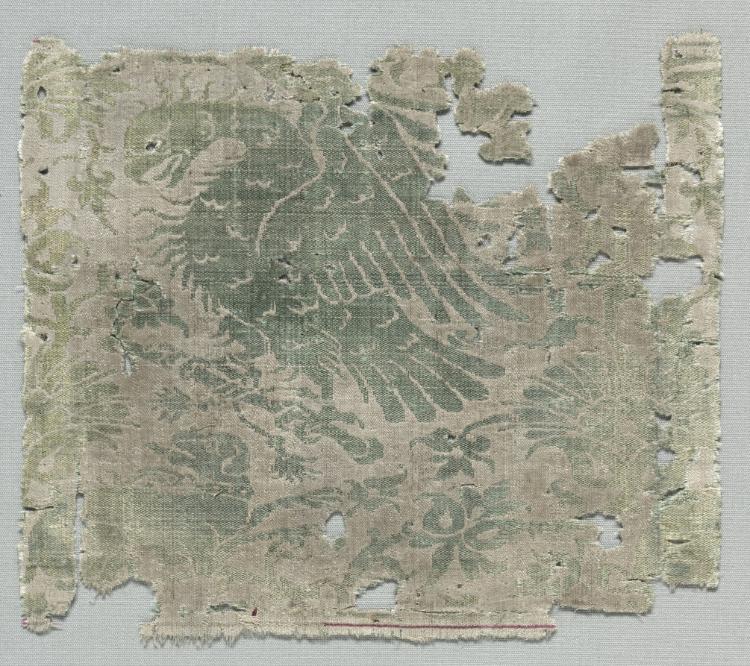
Heritage Research Artifact: Silk Fragment
****
**Provenance and Materiality**
This artifact—a fragment of woven silk, measuring approximately 14 by 9 centimetres—is not merely a textile remnant. It is a material testament to the apex of imperial craftsmanship, a whisper from the looms of the Ming dynasty, circa 1580–1620. The silk, a mulberry variety (*Bombyx mori*), retains a remarkable structural integrity: the warp and weft threads, each no thicker than a human hair, remain taut and unbroken, a testament to the extraordinary tensile strength of the fibre and the meticulousness of its original construction. The weave is a complex satin damask, a technique demanding a second warp and a pattern weft to create the raised, reversible motifs. Under raking light, a subtle pattern emerges—a stylised *qilin*, the mythical hooved chimera, intertwined with trailing clouds and the *shou* longevity character. The ground is a deep, undyed ivory, while the pattern threads carry a fugitive, once-crimson dye, now faded to a dusty rose, likely derived from *Rubia tinctorum* (madder root) or the more precious *Porphyrophora polonica* (Armenian cochineal).
The fragment’s edges are cleanly cut, not torn, suggesting it was deliberately excised from a larger garment or hanging—perhaps a *chaofu* (court robe) or an altar frontal—during a later period of repurposing. This act of cutting, far from diminishing its value, enhances its narrative. It speaks to a culture of reverence and reuse, where the material was too precious to discard, even as its original form became obsolete.
The Imperial Loom: A Legacy of Absolute Control
To understand this fragment, one must appreciate the sheer scale and rigour of the imperial silk industry. From the Han dynasty onward, silk was not merely a commodity; it was a state instrument of diplomacy, economics, and social stratification. By the Ming period, the *Nanjing* and *Suzhou* imperial weaving bureaus operated under the direct purview of the throne, employing tens of thousands of artisans. The production of a single high-grade robe could take upwards of two years, from the cultivation of the silkworms on mulberry leaves harvested from state-controlled groves, to the final embroidery and embellishment.
The weaver’s art was a hereditary craft, guarded with near-mystical secrecy. Apprentices began their training at age seven, learning to read the complex pattern drafts—essentially binary codes of warp and weft—long before they were permitted to touch a loom. The drawloom itself, a towering structure of timber and silk cordage, required two operators: the weaver, seated below, and the drawboy, perched above, pulling the figure harness to lift the correct warp threads. The coordination was balletic, the margin for error negligible. A single snapped thread, a misread pattern, or a dye batch that deviated by even a shade from the prescribed colour could result in the entire bolt being condemned and the artisan facing severe punishment, including the amputation of a hand.
This environment of absolute control produced textiles of an unsurpassed technical and aesthetic standard. The silk was not merely woven; it was engineered. The density of the weave—here, approximately 120 warp threads per centimetre—created a fabric that was simultaneously supple and substantial, with a drape that fell in sculptural folds. The pattern, though now faded, was originally rendered in a palette dictated by sumptuary law. Crimson, for instance, was reserved for the highest ranks of the nobility and the imperial family. The presence of the *qilin*, a creature of benevolence and justice, further confirms that this fragment once belonged to a garment of the first or second rank, worn by a prince or a senior minister in the presence of the Emperor.
The Language of the Thread: Symbolism and Status
The iconography woven into this silk is a language in itself, a silent code of power and virtue. The *qilin*, often described as the "Chinese unicorn," is a composite creature—the body of a deer, the tail of an ox, the hooves of a horse, and a single horn. Its appearance was said to herald the advent of a sage or an era of perfect governance. In the context of court dress, its presence was not decorative but declarative: the wearer was aligned with the cosmic order, a conduit for righteous rule.
The trailing clouds, rendered in a subtle, undulating line, represent *xiangyun* (auspicious clouds), symbols of good fortune and celestial favour. They also serve a compositional function, linking the central motif to the *shou* character, a stylised form of the Chinese character for "longevity." Together, these elements form a cohesive benediction: a prayer for the Emperor’s long life, the dynasty’s stability, and the wearer’s virtuous service. The choice of a satin damask, rather than a simpler twill or plain weave, was equally significant. The high lustre of the satin ground caught the candlelight of the throne room, creating a shimmering, almost liquid effect that distinguished the wearer from the matte fabrics of lesser officials. It was a visual hierarchy, woven into the very structure of the cloth.
From Imperial Court to Modern Archive
The journey of this fragment from the Ming court to the Lauren Fashion Heritage Lab is a study in the global circulation of luxury goods. It likely passed through the hands of a 19th-century European collector, perhaps a diplomat or a merchant of the East India Company, who acquired it during the turbulent final decades of the Qing dynasty. Such fragments were often sold as "curiosities" or used as reference materials for European textile designers seeking to emulate the "Chinoiserie" aesthetic. The clean cut edges suggest it may have been deliberately trimmed to fit into an album or a collector’s cabinet, a common practice that preserved the material while divorcing it from its original context.
Today, this fragment serves a dual purpose. For the historian, it is a primary source, offering empirical evidence of Ming weaving techniques, dye recipes, and iconographic conventions. For the designer, it is a repository of tactile knowledge. The precise geometry of the weave, the balance of positive and negative space in the pattern, and the subtle interplay of light and shadow on the satin surface are all principles that transcend cultural boundaries. They speak to a universal standard of excellence—a standard that the Lauren Fashion Heritage Lab seeks to study, preserve, and, where appropriate, reinterpret for a contemporary audience.
This is not a relic to be admired from a distance. It is a benchmark. It asks of us the same rigour, the same attention to detail, and the same respect for material that its original creators possessed. In its 400-year-old threads, we find not a distant echo, but a clear, resonant instruction: craft is not a style; it is a discipline. And discipline, like the finest silk, endures.
Heritage Lab Insight
Lab Insight: CMA Silk Archive Node integration.