Category: Silk
The Imperial Thread: Deconstructing the Roundels with Hunters
In the hushed, wood-panelled ateliers of Savile Row, where the measure of a man is taken in cloth as much as in character, one learns to read fabric as a language. The Roundels with Hunters is not merely a textile; it is a document, a diplomatic dispatch woven in silk, speaking of empires, of power’s performative rituals, and of a technical mastery that borders on the alchemical. To handle a fragment of this material is to hold a conversation with a lost world of courtly magnificence, a world where the loom was a throne and the weaver, a silent kingmaker.
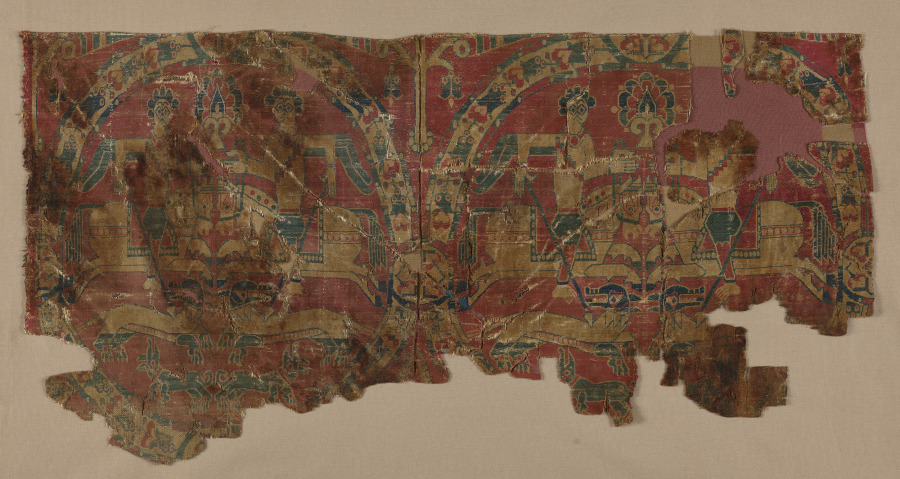
Our subject, a silk roundel, is a perfect circle of woven narrative. The design is deceptively simple: a central, radiating composition featuring mounted hunters, their bows drawn, in pursuit of game. Yet, within that circular frame lies a universe of meaning. The roundel format itself is significant—a self-contained cosmos, a mandala of royal authority. It is not a panoramic scene but a concentrated emblem, designed to be read from any angle, a symbol of the omnipresent and all-seeing sovereign. The hunter is not merely a man on a horse; he is the archetype of the ruler, the one who controls the wild, the one who provides, the one who commands the natural order. This is the visual language of the imperial silk weaving legacy, a lexicon of power that predates the written word in many courts.
Materiality and the Imperial Loom
The materiality is paramount. This is not the flimsy, machine-made silk of the modern haberdasher. This is imperial silk, a fabric of such density and lustre that it feels almost metallic to the touch. The weave is a compound structure, likely a lampas or a samite, where a main warp and weft create a ground fabric, and a secondary, often heavier, weft is bound to the surface to create the pattern. The result is a textile of extraordinary substance, one that would have stood rigid with gold thread and heavy with the weight of its own authority. The silk itself, cultivated in secret within the imperial seraglios, was a state monopoly. The very fibre was a form of currency, a measure of a kingdom’s wealth and its access to the rarest of resources.
Consider the technical challenge. To weave a perfect circle with a dynamic, multi-figured scene requires a mastery of the drawloom that is almost inconceivable to the modern mind. The pattern is not printed or embroidered; it is woven, with each thread a deliberate act of creation. The weaver, working from a complex pattern draft, would have manipulated hundreds of thousands of individual warp threads, each one controlled by a harness and a cord, to create the intricate interplay of ground and pattern. The precision required to render the musculature of the horses, the tension in the archer’s arm, the flight of the arrow—all within the confines of a circular repeat—is a testament to a level of skill that was cultivated over generations, passed down from father to son within the imperial workshops. This is not craft; this is a state-sponsored art form, a form of propaganda rendered in thread.
The Legacy of Power Woven in Silk
The legacy of imperial silk weaving is not simply a history of technique; it is a history of power. These roundels were not produced for the market. They were commissioned by the court, for the court. They adorned the robes of the emperor and his highest officials, the hangings of the throne room, the trappings of the royal horses. To wear or to display such a textile was to declare one’s place within the imperial hierarchy. The roundel, with its hunters, was a specific and potent symbol. It spoke of the ruler’s role as the supreme huntsman, the one who, like the mythical Nimrod, was a mighty hunter before the Lord. It was a visual claim to the divine right of kings, a right to hold dominion over both the land and its people.
Furthermore, these silks were instruments of diplomacy. They were the ultimate luxury gift, presented to foreign ambassadors and allied monarchs as tokens of esteem and, more pointedly, as demonstrations of the empire’s wealth and sophistication. A gift of such silk was not a mere courtesy; it was a statement of intent, a subtle assertion of dominance. The recipient, upon receiving a bolt of this fabric, was being told, in the most elegant and expensive way possible, that they were in the presence of a greater power. The roundel, in this context, becomes a piece of soft power, a weapon of persuasion wrapped in the finest of threads.
A Contemporary Resonance
For the modern connoisseur, the Roundels with Hunters offers a profound connection to this legacy. It is a piece of history that can be worn, a tangible link to a time when clothing was a form of statecraft. On Savile Row, we understand that a garment is never just a garment. It is a statement of identity, a carrier of meaning. To commission a jacket or a waistcoat using a reproduction of this silk, or to simply study the original, is to engage with that same language of power. It is to understand that true luxury is not about novelty but about provenance, about the story that is woven into the very fabric of the cloth.
The roundel’s circular form is also a reminder of the cyclical nature of power and the enduring appeal of the archetypal. The hunter, the horse, the chase—these are motifs that transcend time and culture. They speak to a primal human instinct, a desire for mastery and control. In a world of fast fashion and disposable trends, the Roundels with Hunters stands as a monument to permanence, to the idea that some things are worth the time, the skill, and the profound patience required to create them. It is a lesson in the enduring value of the hand-made, the bespoke, and the truly exceptional. And that, in essence, is the very soul of our craft.